
HRID 1435160As reactant
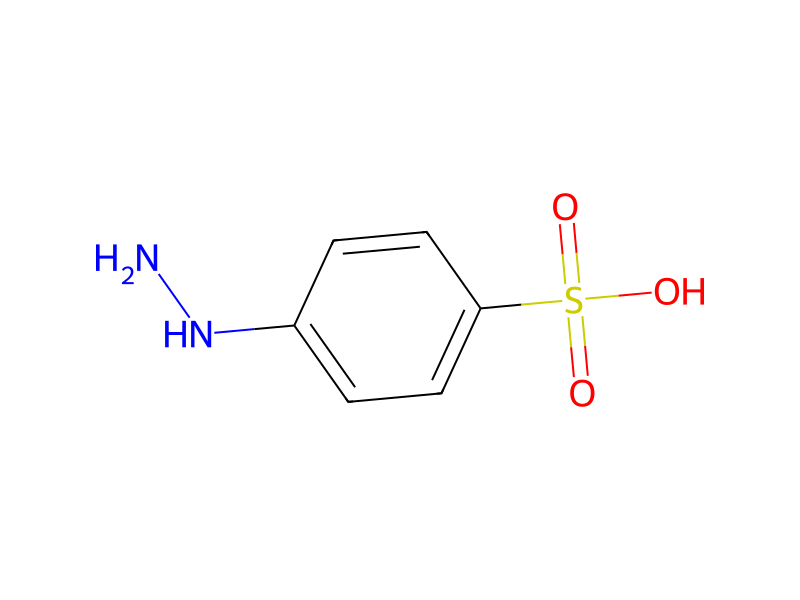
98-71-5NNc1ccc(S(=O)(=O)O)cc1IOMZCWUHFGMSEJ-UHFFFAOYSA-N98-71-5DTXSID9059177CHEMBL510966Safety information is for reference only and does not replace the supplier’s Safety Data Sheet (SDS), applicable regulations, or professional assessment.
Danger
H302 (71.4%): Harmful if swallowed [Warning Acute toxicity, oral]
P260, P261, P264, P264+P265, P270, P271, P280, P301+P317, P301+P330+P331, P302+P352, P302+P361+P354, P304+P340, P305+P351+P338, P305+P354+P338, P316, P317, P319, P321, P330, P332+P317, P337+P317, P362+P364, P363, P403+P233, P405, and P501 (click each P-code to see the statement)
Aggregated GHS information provided per 7 reports by companies from 3 notifications to the ECHA C&L Inventory. Each notification may be associated with multiple companies.
Uses4-Hydrazinobenzenesulfonic Acid is used as an intermediate to manufacture pharmaceuticals, dyes and other organic synthesis. They have active applications in organic synthesis for agrochemicals, pharmaceuticals, photographic, heat stabilizers, polymerization catalysts, flame-retardants, blowing agents for plastics, explosives, and dyes.
PreparationSynthesis of 4-Hydrazinobenzenesulfonic acid: Sodium 4-aminobenzenesulfonate was used as the starting material. It was mixed with water and 30% hydrochloric acid, and the mixture was cooled to 2°C. A sodium nitrite solution was then added dropwise at 0–5°C to achieve diazotization. The resulting diazonium salt solution was transferred into a mixture of sodium hydroxide solution and sodium metabisulfite, maintaining the feed temperature at 80–85°C and the pH between 6.2 and 6.7. After the addition was complete, the reaction mixture was stirred for an additional 1.5 hours. Subsequently, zinc powder and diatomaceous earth were added. The mixture was stirred and then filtered. The filtered reaction product was finally treated with acid to afford 4-hydrazinobenzenesulfonic acid.


