
9,10-Dibromoanthracene
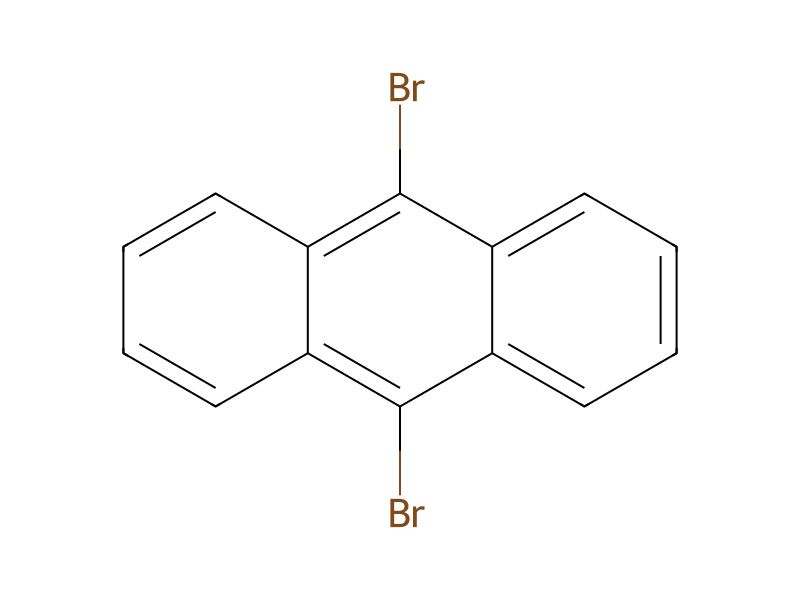
Basic information
- CAS
523-27-3- Standard SMILES
Brc1c2ccccc2c(Br)c2ccccc12- InChIKey
BRUOAURMAFDGLP-UHFFFAOYSA-N- Molecular formula
- C14H8Br2
- Average molar mass
- 336.02 g/mol
- Monoisotopic mass
- 333.89928
Names & identifiers
- Preferred name
- 9,10-Dibromoanthracene
- IUPAC
- 9,10-dibromoanthracene
- English name
- 9,10-Dibromoanthracene
- Molecular formula
- C14H8Br2
- Molecular weight
- 336.02
Names & synonyms
9,10-Dibromoanthracene523-27-3Anthracene, 9,10-dibromo-DTXSID5049312UNII-61CP7C5Y8261CP7C5Y82NSC 6263NSC-6263EINECS 208-342-4DTXCID00292689,10-DIBROMOANTHRACENE [MI]52f3-27-3
Show more names
9,10-Dibromoanthracene99%9,10-anthracenems-Dibromoanthracene9, 10-Dibromoanthrac10-Dibromoanthracene9,I O-Dibromanthracen9,1-Dibromoanthracene9,1O-dibromoanthracene9,10-DIRBOMOANTHRACENE
RefChem:107475Anthracene, 9,10dibromo208-342-4BRUOAURMAFDGLP-UHFFFAOYSA-NInChI=1/C14H8Br2/c15-13-9-5-1-2-6-10(9)14(16)12-8-4-3-7-11(12)13/h1-89,10-Dibromo-anthraceneMFCD00001244Anthracene,10-dibromo-
Database identifiers
- CAS
523-27-3- PubChem CID
- 68226
- DTXSID
DTXSID5049312- ChEMBL
CHEMBL3183379- UNII
- 61CP7C5Y82
- EC Number
- 208-342-4
- Nikkaji
- J6.630C
Properties
Computed structural properties
- XLogP
- 5.8
- Topological polar surface area
- 0 Ų
- Hydrogen bond donors
- 0
- Hydrogen bond acceptors
- 0
- Rotatable bonds
- 0
- Heavy atoms
- 16
- Formal charge
- 0
- Complexity
- 203
Experimental & physicochemical properties
PolymersOther Classes -> Halogenated Polyaromatics
SpringerMaterials Properties13C nuclear magnetic resonance spectrum
LogP6.29
Physical DescriptionYellow solid; [Merck Index]
Physicochemical properties
- Melting point
- 223 · 223-224 °C (lit.)
- Boiling point
- 342.21 °C · 342.21°C (rough estimate)
- Density
- 1.7167 · 1.7167 (estimate)
- refractive index
- 1.63 · 1.6300 (estimate)
- storage temp.
- Sealed in dry,Room Temperature
- solubility
- Chloroform
- form
- Fluffy Powder
- color
- Yellow to yellow-green
- Water Solubility
- Soluble in water.
Safety & regulation
Safety information is for reference only and does not replace the supplier’s Safety Data Sheet (SDS), applicable regulations, or professional assessment.
GHS classification
GHS Classification
Warning
H315 (16.3%): Causes skin irritation [Warning Skin corrosion/irritation]
P261, P264, P264+P265, P271, P273, P280, P302+P352, P304+P340, P305+P351+P338, P319, P321, P332+P317, P337+P317, P362+P364, P391, P403+P233, P405, and P501 (click each P-code to see the statement)
Aggregated GHS information provided per 49 reports by companies from 6 notifications to the ECHA C&L Inventory. Each notification may be associated with multiple companies.
Hazard information
Hazards SummaryAn irritant; [Alfa Aesar MSDS] See POLYCYCLIC AROMATIC HYDROCARBONS.
Hazard Classes and CategoriesSkin Irrit. 2 (16.3%)
Safety data
- PPE
- Eyeshields, Gloves
- wgk
- 3
- tsca
- TSCA listed
- ridadr
- UN 3077
- hs_code
- 29039990
- risk_code
- 36/37/38-50/53
- Signal word
- Warning
- Symbol(GHS)
- GHS09
- hazard_code
- Xi,N
- safety_code
- 37/39-26-61-60-36
- hazard_class
- 9
- Storage Class
- 11 - Combustible Solids
- Hazard statements
- H410
- Limited Quantities
Chemistry & industry
Uses & manufacturing
General Manufacturing InformationAnthracene, 9,10-dibromo-: ACTIVE
Applications
Description9,10-Dibromoanthracene is an organic chemical compound containing anthracene with two bromine atoms substituted on its central ring. As a symmetrically brominated anthracene derivative, it is bearing functional groups to extend its conjugation further mainly via C-C bond forming i.e. Stille and Suzuki coupling reactions. It is notable in that it was the first single molecule to have a chemical reaction observed by an atomic force microscope and scanning tunneling microscopy. It is a low-molecular-weight organic semiconductor. It can used as an initiator in visible-spectrum solar-light-mediated benzylic C–H oxygenation through solar light or the blue LED activate[1-2].
Uses9,10-Dibromoanthracene is a dibrominated polycyclic aromatic hydrocarbon (PAH). 9,10-Dibromoanthracene is often used as an energy acceptor and activator in reactions that produce chemiluminescence.
Preparation methods
Preparation9,10-Dibromoanthracene is synthesized by the bromination of anthracene. The bromination reaction is carried out at room temperature using carbon tetrachloride as a solvent. Using 80-85% anthracene as raw material, adding bromine to react for half an hour, the yield is 83-88%.
Upstream & downstream products
Upstream raw materials
Downstream products
Related reactions
32 records


Compound notes
Loading…