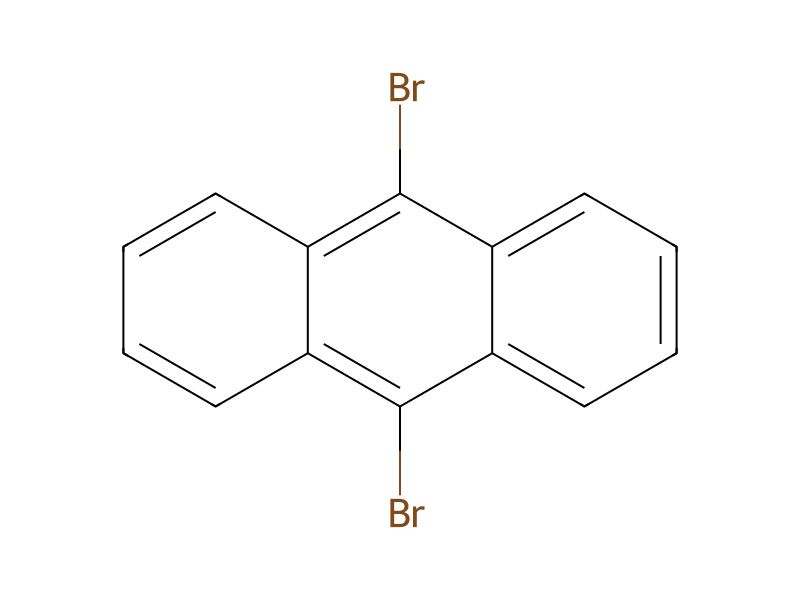
Under an argon atmosphere, the temperature of a solution of 9,10-dibromoanthracene (5 g, 15 mmol) in dry-THF (50 ml) was cooled to −69° C., and t-butyllithium (18 mmol) was dropped to the solution. After the mixture had been stirred for 3 hours, chlorotrimethylsilane (3 ml, 22.5 mmol) was added to the mixture, and the whole was stirred at −69° C. for an additional 3 hours. After the temperature of the resultant had been increased to room temperature, the resultant was quenched with sodium bicarbonate water, extracted with toluene, and dried with sodium sulfate. Then, the solvent was removed by distillation. The residue was dispersed and washed with hexane, the insoluble matter was removed, and the filtrate was condensed. The condensate was washed with ethanol, and was then subjected to silica gel column chromatography, whereby 1 g of 9-bromo-10-trimethylsilylanthracene was obtained.