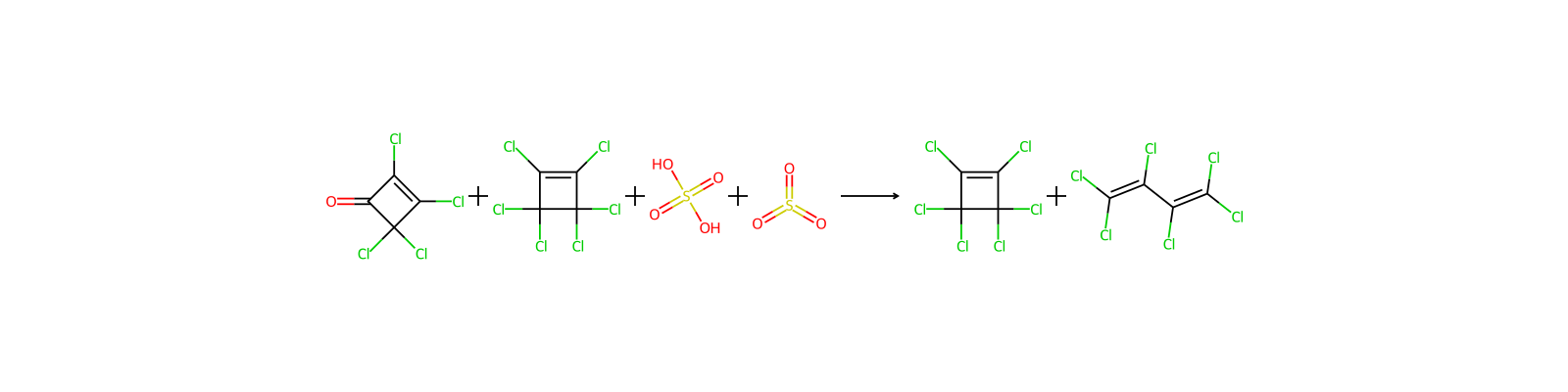
Hexachlorobutadiene
Completing data — refresh the page later to see the latest

Basic information
- CAS
87-68-3- Standard SMILES
ClC(Cl)=C(Cl)C(Cl)=C(Cl)Cl- InChIKey
RWNKSTSCBHKHTB-UHFFFAOYSA-N- Molecular formula
- C4Cl6
- Average molar mass
- 260.8 g/mol
- Monoisotopic mass
- 257.813116
Names & identifiers
- Preferred name
- Hexachlorobutadiene
- IUPAC
- 1,1,2,3,4,4-hexachlorobuta-1,3-diene
- English name
- Hexachloro-1,3-butadiene
- Molecular formula
- C4Cl6
- Molecular weight
- 260.76
Names & synonyms
HEXACHLORO-1,3-BUTADIENEHexachlorobutadiene87-68-3PerchlorobutadieneHexachlorobuta-1,3-dieneHCBD1,1,2,3,4,4-hexachlorobuta-1,3-dieneDolen-purHexachlorbutadiene1,3-Butadiene, 1,1,2,3,4,4-hexachloro-1,3-HexachlorobutadieneHexachlor-1,3-butadien
Show more names
c46Butadiene, hexachloro-C 46TripeneHexachL
RCRA waste number U1281,1,2,3,4,4-Hexachloro-1,3-butadienePerchloro-1,3-butadieneDTXSID7020683GP-40-66:120CQ8AAO9MO1NSC-3701DTXCID10683
Database identifiers
- CAS
87-68-3- PubChem CID
- 6901
- DTXSID
DTXSID7020683- ChEMBL
CHEMBL389950- ChEBI
CHEBI:5691- UNII
- CQ8AAO9MO1
- EC Number
- 201-765-5
- Nikkaji
- J3.541F
Properties
Computed structural propertiesFilling in
- XLogP
- 4.8
- Topological polar surface area
- 0 Ų
- Hydrogen bond donors
- 0
- Hydrogen bond acceptors
- 0
- Rotatable bonds
- 1
- Heavy atoms
- 10
- Formal charge
- 0
- Complexity
- 160
Physicochemical properties
- Melting point
- -19 °C · -19 °C
- Boiling point
- 210 · 210-220 °C(lit.)
- Density
- 1.68 · 1.68
- vapor pressure
- 0.2 mm · 0.2 mm Hg ( 20 °C)
- refractive index
- 20 · n20/D 1.555(lit.)
- Flash point
- 210 · 210-220°C
- storage temp.
- 4 °C · +4°C
- solubility
- Soluble in ethanol and ether (U.S. EPA, 1985)
- form
- liquid, clear
- Odor
- faint turpentine odor
- Water Solubility
- 4.78 at · (mg/L):4.78 at 25 °C (shake flask-LSC, Banerjee et al., 1980) 4 at 20–25 °C (Geyer et al., 1980)
- Merck
- 14 · 14,4678
- BRN
- 1766570 · 1766570
- Henry's Law Constant
- 3.55 · 3.55, 5.87, 6.90, 10.5, and 15.3 at 2.0, 6.0, 10.0, 18.0, and 25.0 °C, respectively (EPICS-SPME, Dewulf et al., 1999)
Safety & regulation
Safety information is for reference only and does not replace the supplier’s Safety Data Sheet (SDS), applicable regulations, or professional assessment.
Safety data
- OEB
- C
- OEL
- TWA: 0.02 ppm (0.24 mg/m3) [skin]
- PPE
- Faceshields, Gloves, Goggles, type ABEK (EN14387) respirator filter
- wgk
- 3
- tsca
- TSCA listed
- rtecs
- EJ0700000
- ridadr
- UN 2279
- hs_code
- 29032990
- Toxicity
- LD50 in male, female mice, rats (mg/kg): 105, 76, 216, 175 i.p.; 80, 65, 250, 270 orally (Gradiski)
- risk_code
- 24/25-34-40-50/53-39/23/24/25-23/24/25-11
- Signal word
- Warning
- Symbol(GHS)
- GHS07,GHS09
- hazard_code
- T,N,F
- safety_code
- 26-36/37/39-45-61-60-36/37-16-7
- hazard_class
- 6.1
- Storage Class
- 6.1A - Combustible acute toxic Cat. 1 and 2very toxic hazardous materials
- packing_group
- III
- Hazard statements
- H302-H312-H315-H317-H332-H400
- Limited Quantities
- 5.0 L (1.3 gallons) (liquid) or 5.0 kg (11 lbs) (solid)
- Excepted Quantities
- Max Inner Pack (30g or 30ml) and Max Outer Pack (1Kg or 1L)
- Hazard Classifications
- Acute Tox. 2 DermalAcute Tox. 3 OralAquatic Acute 1Aquatic Chronic 1Carc. 2Eye Irrit. 2Skin Irrit. 2
- Precautionary statements
- P264-P270-P280-P261-P272-P271-P273-P301+P312-P330-P302+P352-P312-P362+P364-P332+P313-P333+P313-P304+P340-P391-P501
Chemistry & industry
Applications
DescriptionHexachlorobutadiene was first synthesized in 1877 by chlorination of hexyl iodide. It is an industrial by-product of tetrachloroethylene, trichloroethylene, and perchloroethylene production.
UsesHexachloro-1,3-butadiene is used as an urinary biomarker as a tool for early screening of potential kidney toxicity. Hexachloro-1,3-butadiene (HCBD) causes kidney injury.
UsesIntermediate in the manufacture of rubber Compounds, chlorofluorocarbons, and lubricants. Hydraulic fluid, fluid for gyroscopes, heat transfer fluid, solvent, laboratory reagent. Soil fumigant for vineyards.
UsesProduced as an unwanted by-product during the production of tetrachloroethylene, trichloroethylene, carbon tetrachloride, and chlorine; formerly used as a pesticide in other countries
General DescriptionA colorless liquid with a mild odor. Insoluble in water and denser than water. Nonflammable. May be toxic by ingestion or inhalation. Used as a solvent and heat transfer fluid.
Upstream & downstream products
Downstream products
Additional notes
DefinitionChEBI: Hexachloro-1,3-butadiene is an organochlorine compound.
Related reactions
13 records


Compound notes
Loading…