9-Anthracenecarboxaldehyde
Completing data — refresh the page later to see the latest
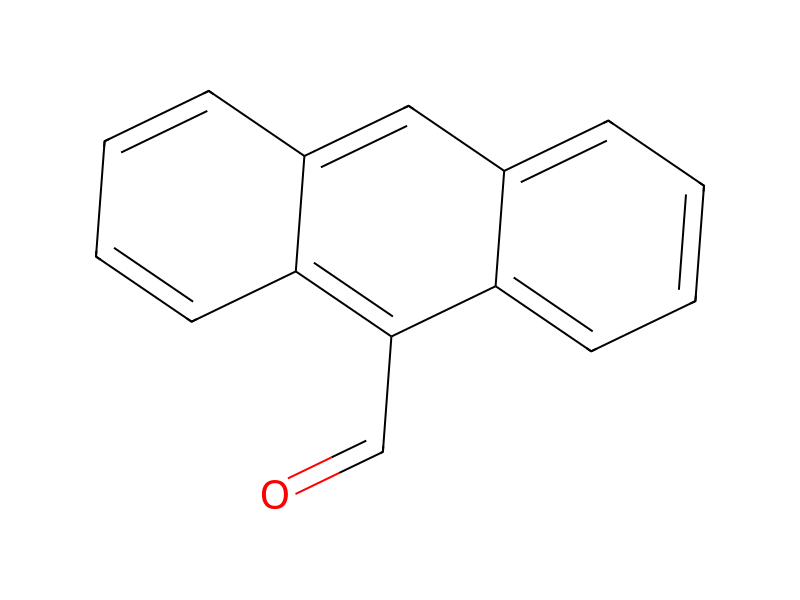
Basic information
- CAS
642-31-9- Standard SMILES
O=Cc1c2ccccc2cc2ccccc12- InChIKey
YMNKUHIVVMFOFO-UHFFFAOYSA-N- Molecular formula
- C15H10O
- Average molar mass
- 206.24 g/mol
- Monoisotopic mass
- 206.07316494
Names & identifiers
- Preferred name
- 9-Anthracenecarboxaldehyde
- IUPAC
- anthracene-9-carbaldehyde
- English name
- 9-Anthraldehyde
- Molecular formula
- C15H10O
- Molecular weight
- 206.24
Names & synonyms
9-Anthraldehyde642-31-99-Anthracenecarboxaldehyde9-Formylanthracene9-Anthrylaldehyde9-anthracene aldehydeNSC-15DTXSID9060940353S277YHYRefChem:549188DTXCID3044253211-383-0
Show more names
anthraldehydeAKOS B0298499-AnthaldehydeAKOS BBS-00003154
Anthracene-9-carbaldehyde9-Anthracenecarbaldehyde9-AnthrylcarboxaldehydeAnthracene-9-carboxaldehyde9-anthracenaldehydeMFCD00001254Anthracene-9-aldehyde9-Anthracenealdehyde
Database identifiers
- CAS
642-31-9- PubChem CID
- 69504
- DTXSID
DTXSID9060940- ChEMBL
CHEMBL4447118- UNII
- 353S277YHY
- EC Number
- 211-383-0
- Nikkaji
- J45.218A
Properties
Computed structural propertiesFilling in
- XLogP
- 4
- Topological polar surface area
- 17.1 Ų
- Hydrogen bond donors
- 0
- Hydrogen bond acceptors
- 1
- Rotatable bonds
- 1
- Heavy atoms
- 16
- Formal charge
- 0
- Complexity
- 238
Experimental & physicochemical properties
Physical DescriptionGold colored powder; [Alfa Aesar MSDS]
Kovats Retention Index
2094;368.3
357.3;356.6
Physicochemical properties
- Melting point
- 103 · 103-105 °C (lit.)
- Boiling point
- 305.09 °C · 305.09°C (rough estimate)
- Density
- 1.0701 · 1.0701 (rough estimate)
- refractive index
- 1.6324 · 1.6324 (estimate)
- storage temp.
- Keep in dark place,Sealed in dry,Room Temperature
- solubility
- Soluble in toluene.
- form
- Crystalline Powder or Needles
- color
- Yellow
- Sensitive
- Air Sensitive
- BRN
- 639167 · 639167
Safety & regulation
Safety information is for reference only and does not replace the supplier’s Safety Data Sheet (SDS), applicable regulations, or professional assessment.
GHS classification
GHS Classification
Warning
H302 (28.6%): Harmful if swallowed [Warning Acute toxicity, oral];H312 (28.6%): Harmful in contact with skin [Warning Acute toxicity, dermal];H315 (71.4%): Causes skin irritation [Warning Skin corrosion/irritation];H319 (100%): Causes serious eye irritation [Warning Serious eye damage/eye irritation];H332 (28.6%): Harmful if inhaled [Warning Acute toxicity, inhalation];H335 (57.1%): May cause respiratory irritation [Warning Specific target organ toxicity, single exposure; Respiratory tract irritation]
P261, P264, P264+P265, P270, P271, P280, P301+P317, P302+P352, P304+P340, P305+P351+P338, P317, P319, P321, P330, P332+P317, P337+P317, P362+P364, P403+P233, P405, and P501 (click each P-code to see the statement)
Aggregated GHS information provided per 7 reports by companies from 3 notifications to the ECHA C&L Inventory. Each notification may be associated with multiple companies.;Information may vary between notifications depending on impurities, additives, and other factors. The percentage value in parenthesis indicates the notified classification ratio from companies that provide hazard codes. Only hazard codes with percentage values above 10% are shown. For more detailed information, please visit ECHA C&L website.
Hazard information
Regulatory Information
Chemical: 9-Anthracenecarboxaldehyde
Status: Active Update: 24-04-2018 https://echa.europa.eu/registration-dossier/-/registered-dossier/18857
9-Anthracenecarboxaldehyde: Does not have an individual approval but may be used under an appropriate group standard
Hazards SummaryA skin and strong eye irritant; [Alfa Aesar MSDS] See POLYCYCLIC AROMATIC HYDROCARBONS.
Hazard Classes and CategoriesAcute Tox. 4 (28.6%);Acute Tox. 4 (28.6%);Skin Irrit. 2 (71.4%);Eye Irrit. 2 (100%);Acute Tox. 4 (28.6%)
Chemistry & industry
Pharmacology
Metabolism/Metabolites9-anthraldehyde has known human metabolites that include 9-Anthracenecarboxylic acid.
Uses & manufacturing
UsesSubstrate for microsomal aldehyde oxygenase activity. [ChemIDplus]
General Manufacturing Information9-Anthracenecarboxaldehyde: INACTIVE
Applications
Uses9-Anthraldehyde is used to prepare asymmetrical tridentate Schiff base ligands, 2-(9-anthrylmethyl-ideneamino)-4-methyl-phenol and functionalized ligand like 2-(anthracen-9-ylidene)-4,5-bis(diphenylphosphino)-4-cyclopentene-1,3-dione through Knoevenangel condensation with the diphosphine ligand 4,5-bis(diphenylphosphino)-4-cyclopentene-1,3-dione. It is also used as an intermediate for dyes, pigment, active pharmaceutical ingredients and other organic compounds. Further, it is involved in the Diels Alder reaction with benzenediazonium-2-carboxylate.
General DescriptionThe Diels-Alder reaction of 9-anthracenecarboxaldehyde with benzenediazonium-2-carboxylate was studied.
Upstream & downstream products
Upstream raw materials
Downstream products
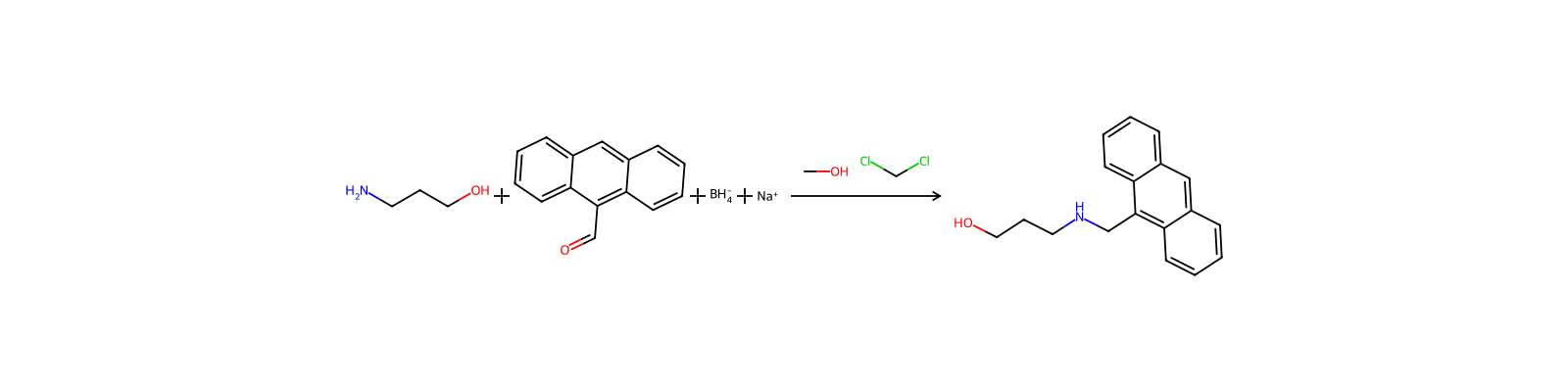
Related reactions
23 records


Compound notes
Loading…