
HRID 6450As reactant
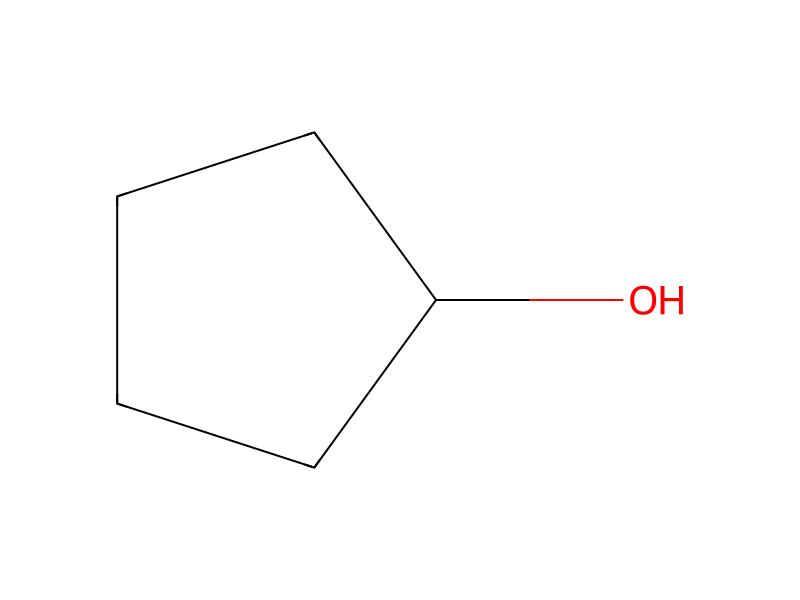
96-41-3OC1CCCC1XCIXKGXIYUWCLL-UHFFFAOYSA-NCyclopentanol appears as a colorless viscous liquid with a pleasant odor. Slightly less dense than water. Vapors heavier than air. Used to make perfumes and pharmaceuticals.
96-41-3DTXSID1033371CHEMBL288998CHEBI:16133Odor of amyl alcohol, somewhat like peppermint
Pleasant odor
SOL IN ALCOHOL, ETHER, ACETONE; SLIGHTLY SOL IN WATER
Sparingly soluble in water. Soluble in ethanol.
124 °F (NFPA, 2010)
124 °F (51 °C) (CLOSED CUP)
Safety information is for reference only and does not replace the supplier’s Safety Data Sheet (SDS), applicable regulations, or professional assessment.
Warning
H226 (100%): Flammable liquid and vapor [Warning Flammable liquids]
P210, P233, P240, P241, P242, P243, P280, P303+P361+P353, P370+P378, P403+P235, and P501 (click each P-code to see the statement)
Aggregated GHS information provided per 57 reports by companies from 3 notifications to the ECHA C&L Inventory.
Danger
H226: Flammable liquid and vapor [Warning Flammable liquids]
Chemical: Cyclopentanol
Commission Regulation (EC) No 1565/2000 (Repealed by Com. Implementing Reg. (EU) No 872/2012)
REACH registered substance: Cyclopentanol (EC: 202-504-8)
Cyclopentanol: HSNO Approval: HSR001247 Approved with controls
The New Jersey Worker and Community Right to Know Act requires public and private employers to provide information about hazardous substances at their workplaces. (N.J.S.A. 34:5A-1 et. seq.)
Excerpt from ERG Guide 129 [Flammable Liquids (Water-Miscible / Noxious)]:
· HIGHLY FLAMMABLE: Will be easily ignited by heat, sparks or flames.
Excerpt from ERG Guide 129 [Flammable Liquids (Water-Miscible / Noxious)]:
· May cause toxic effects if inhaled or absorbed through skin.
Used as a solvent (perfumes and pharmaceuticals) and for organic synthesis; [Hawley]
Perfume and pharmaceutical solvent, intermediate for dyes, pharmaceuticals, and other organics.
In the preparation of quingestanol acetate.
BY REDUCTION OF CYCLOPENTANONE WITH LIALH4 IN ETHER @ ROOM TEMP.
...BY MODIFIED MEERWEIN-PONDORF-VERLEY REDUCTION OF CYCLOPENTANONE IN PRESENCE OF ALUMINUM ISOPROPOXIDE & SODIUM HYDROXIDE. BY CATALYTIC HYDROGENATION OF PURE CYCLOPENTANONE WITH COPPER CHROMITE @ 150 °C & 150 ATM.
BY CATALYTIC HYDROGENATION OF CYCLOPENTANONE WITH PLATINUM OXIDE & PLATINUM BLACK @ 2-3 ATM: NOLLER, ADAMS, J AM CHEM SOC 48, 1084 (1926); BY HYDRATION OF CYCLOPENTENE IN AQ H2SO4: HEPP, US PATENT 2,414,646 (1947 TO PHILLIPS PETR)...
Uses(1) Cyclopentanol is used in medicine, dyes preparation and spices, it can also used for solvent of drugs and spices. (2) It is used for organic synthesis intermediates, it is used for pharmaceuticals, dyes and spices production, it is also used for solvent of drugs and spices. (3) It is used as spice and medicine solvent and dye intermediates. (4) It is used in medicine, dyes and perfumes production, it is also used for solvent of drugs and spices.
UsesCyclopentanol is a versatile compound used as a building block, intermediate and solvent.
UsesCyclopentanol can be used as:An alkylating agent in the preparation of alkylated aromatic compounds using Fe3+-montmorillonite catalyst via Friedel–Crafts alkylation reaction.A reactant in the acylation of alcohols with an acid anhydride or acid chloride.A substrate in the synthesis of high-density polycyclic aviation fuel by the Guerbet reaction.
General DescriptionA colorless viscous liquid with a pleasant odor. Slightly less dense than water. Flash point 124°F. Vapors heavier than air. Used to make perfumes and pharmaceuticals.


CYCLOPENTANOL is an alcohol. Flammable and/or toxic gases are generated by the combination of alcohols with alkali metals, nitrides, and strong reducing agents. They react with oxoacids and carboxylic acids to form esters plus water. Oxidizing agents convert them to aldehydes or ketones. Alcohols exhibit both weak acid and weak base behavior. They may initiate the polymerization of isocyanates and epoxides.
/GUIDE 129: FLAMMABLE LIQUIDS (Polar/Water-Miscible/Noxious)/ Fire or Explosion: HIGHLY FLAMMABLE: Will be easily ignited by heat, sparks or flames. Vapors may form explosive mixtures with air. Vapors may travel to source of ignition and flash back. Most vapors are heavier than air. They will spread along ground and collect in low or confined areas (sewers, basements, tanks). Vapor explosion hazard indoors, outdoors or in sewers. Those substances designated with a (P) may polymerize explosively when heated or involved in a fire. Runoff to sewer may create fire or explosion hazard. Containers may explode when heated. Many liquids are lighter than water.
/GUIDE 129: FLAMMABLE LIQUIDS (Polar/Water-Miscible/Noxious)/ Health: May cause toxic effects if inhaled or absorbed through skin. Inhalation or contact with material may irritate or burn skin and eyes. Fire will produce irritating, corrosive and/or toxic gases. Vapors may cause dizziness or suffocation. Runoff from fire control or dilution water may cause pollution.
/GUIDE 129: FLAMMABLE LIQUIDS (Polar/Water-Miscible/Noxious)/ Public Safety: CALL Emergency Response Telephone Number on Shipping Paper first. If Shipping Paper not available or no answer, refer to appropriate telephone number listed on the inside back cover. As an immediate precautionary measure, isolate spill or leak area for at least 50 meters (150 feet) in all directions. Keep unauthorized personnel away. Stay upwind. Keep out of low areas. Ventilate closed spaces before entering.
/GUIDE 129: FLAMMABLE LIQUIDS (Polar/Water-Miscible/Noxious)/ Protective Clothing: Wear positive pressure self-contained breathing apparatus (SCBA). Structural firefighters' protective clothing will only provide limited protection.
For more DOT Emergency Guidelines (Complete) data for CYCLOPENTANOL (8 total), please visit the HSDB record page.
Cyclopentanol
UN2244
Class 3 Flammable and combustible liquid (49 eCFR § 173.120)
PG III: the degree of danger presented by the material is minor
· CALL 911. Then call emergency response telephone number on shipping paper. If shipping paper not available or no answer, refer to appropriate telephone number listed on the inside back cover.
· ELIMINATE all ignition sources (no smoking, flares, sparks or flames) from immediate area.
Excerpt from ERG Guide 129 [Flammable Liquids (Water-Miscible / Noxious)]:
General First Aid:
If material on fire or involved in fire: Do not extinguish fire unless flow can be stopped or safely confined. Use water in flooding quantities as fog. Solid streams of water may be ineffective. Use "alcohol" foam, dry chemical or carbon dioxide. Cool all affected containers with flooding quantities of water. Apply water from as far a distance as possible. Keep run-off water out of sewers and water sources.
IN GENERAL, MATERIALS WHICH ARE TOXIC AS STORED OR WHICH CAN DECOMP INTO TOXIC COMPONENTS...SHOULD BE STORED IN COOL, WELL-VENTILATED PLACE, OUT OF DIRECT RAYS OF SUN, AWAY FROM AREAS OF HIGH FIRE HAZARD & SHOULD BE PERIODICALLY INSPECTED & MONITORED.
SRP: At the time of review, criteria for land treatment or burial (sanitary landfill) disposal practices are subject to significant revision. Prior to implementing land disposal of waste residue (including waste sludge), consult with environmental regulatory agencies for guidance on acceptable disposal practices.
If material not on fire and not involved in fire: Keep sparks, flames, and other sources of ignition away. Keep material out of water sources and sewers. Build dikes to contain flow as necessary. Attempt to stop leak if without undue personnel hazard.
Personnel protection: Keep upwind. Avoid breathing vapors. ... Do not handle broken packages unless wearing appropriate personal protective equipment.
Excerpt from ERG Guide 129 [Flammable Liquids (Water-Miscible / Noxious)]:
Immediate precautionary measure
Excerpt from ERG Guide 129 [Flammable Liquids (Water-Miscible / Noxious)]:
... Wear appropriate chemical protective gloves, boots and goggles. Wear positive pressure self-contained breathing apparatus. ...
TERRESTRIAL FATE: Based on a recommended classification scheme(1), an estimated Koc value of 58(SRC), determined from a measured log Kow(2) and a recommended regression-derived equation(3), indicates that cyclopentanol will have high mobility in soil(SRC); leaching of this compound may be important under some environmental conditions(SRC). In soil, cyclopentanol is expected to readily biodegrade(SRC). In tests using activated sludge inocula, 95% of the inital COD (cyclopentanol at 200 mg/L COD), was removed over 120 hours(4); 97%(5) of the theoretical BOD was obtained within 5 days (cyclopentanol at 100 mg/L). Volatilization of cyclopentanol should be important from dry soil surfaces(SRC) given a measured vapor pressure of 1892 mm Hg at 25 °C(6). Volatilization from moist soil surfaces will be very slow(SRC) based on an estimated Henry's Law constant of 2.6X10⁻⁶ atm-cu m/mole(7,SRC).
AQUATIC FATE: Based on a recommended classification scheme(1), an estimated Koc value of 58(SRC), determined from an experimental log Kow(2) and a recommended regression-derived equation(3), indicates that cyclopentanol will not adsorb to suspended solids and sediment(SRC) in the water. Cyclopentanol is expected to readily biodegrade in water(SRC). In tests using activated sludge inocula, 95% of the inital COD (cyclopentanol at 200 mg/L COD), was removed over 120 hours(4); 97%(5) of the theoretical BOD was obtained within 5 days (cyclopentanol at 100 mg/L). Cyclopentanol will volatilize from water surfaces based on an estimated Henry's Law constant of 2.6X10⁻⁶ atm-cu m/mole(SRC), developed using a fragment constant estimation method(6). Estimated half-lives for a model river and model lake are 13 and 98 days, respectively(3,SRC). An estimated BCF value of 2(3,SRC), from a measured log Kow(2), suggests that cyclopentanol will bioconcentrate in aquatic organisms(SRC) according to a recommended classification scheme(7).
ATMOSPHERIC FATE: According to a suggested classification scheme(1), a measured vapor pressure of 1892 mm Hg at 25 °C(2) indicates that cyclopentanol will mainly exist in the vapor phase in the ambient atmosphere. Vapor-phase cyclopentanol is degraded in the atmosphere by reaction with photochemically produced hydroxyl radicals(SRC); the half-life for this reaction in air is estimated to be about 1.5 days(3,SRC).
The Koc of cyclopentanol is estimated as approximately 58(SRC), using a measured log Kow of 0.71(1) and a regression-derived equation(2,SRC). According to a recommended classification scheme(3), this estimated Koc value suggests that cyclopentanol has high mobility in soil(SRC).
Cyclopentanol (CAS # 96-41-3) was evaluated for acute oral toxicity. The test substance was administered by gavage to Wistar-derived male rats. Dosage and mortality data are as follows: 2.5 ml/kg (5/5); 1.25 ml/kg (5/5); and 0.625 ml/kg (5/6). Toxic signs included sluggish; unsteady gait; red fluid around eyes and mouth; and convulsions at 1.25 and 0.625 ml/kg. Gross pathology revealed mottled red and tan livers; distended and gas-filled stomachs; and pale kidneys.
Cyclopentanol (CAS # 96-41-3) was evaluated for acute dermal toxicity. The test substance was applied once to the clipped-intact skin of male New Zealand white rabbits for 24 hours. Dosages and mortality data are as follows: 1.60 ml/kg (2/2); 0.20 ml/kg (4/4); 0.10 ml/kg (0/4); and 0.05 ml/kg (0/2). The LD50 was determined to be 0.141 ml/kg. Toxic signs at 0.20 ml/kg and above, include erythema, edema, vocalization, hyperactivity, lacrimation and convulsions. Gross pathology revealed mottled red and light tan livers, and tan kidneys.
Cyclopentanol (CAS # 96-41-3) was evaluated for acute inhalation toxicity. The test substance was administered to 6 rats (strain and sex not indicated) per single exposure for 136 minutes (100% mortality) or 68 minutes (no mortalities) as a substantially saturated atmosphere at room temperature. LT50 was determined to be 96 minutes. Mortality resulted after a few hours. Toxic signs included lacrimation, hypoactivity, severe tremors, ataxia, salivation, dilated pupils, and coordination loss. Gross pathology revealed dark red lungs, and gas-filled stomach and intestines.
Cyclopentanol (CAS # 96-41-3) was evaluated for primary dermal irritation. The test substance was applied in 0.01 ml amounts to the clipped, uncovered intact skin of 5 rabbits (sex and strain not indicated), either undiluted or in dilutions of 10%, 1.0%, 0.1%, or 0.01% solvent. No irritation was noted on 4 rabbits, and moderate capillary injection was noted on one rabbit (Grade 2) at an unspecified concentration.
Cyclopentanol (CAS # 96-41-3) was evaluated for primary eye irritation. The test substance was applied to the conjunctival sac of 5 rabbits (sex and strain not indicated) at 0.005 ml, 0.02 ml, 0.10 ml, or 0.5 ml of undiluted or 0.5 ml of 40%, 15%, 5%, or 1% dilutions of test material. Moderate to severe corneal injury with iritis resulted from 0.005 ml of undiluted and 0.5 ml of 40% dilution of test material. No injury to minor corneal injury, with iritis in one rabbit, resulted from 15% dilution.
Cyclopentanol was detected in 10% of expired air samples taken from an urban population of humans(28 subjects, 224 expired air samples); the average concentration was 0.9 ng cyclopentanol/L expired air(1). 8.5% of 387 expired air samples from 54 human subjects contained cyclopentanol at an average concentration of 0.329 ng/L expired air(2).
LIQUID ALICYCLIC HYDROCARBONS WILL DEHYDRATE & DELIPIDIZE SKIN ON REPEATED OR PROLONGED CONTACT & CAUSE DERMATITIS. DIRECT CONTACT...WITH LUNG TISSUE (ASPIRATION) WILL CAUSE PULMONARY EDEMA, PNEUMONITIS & HEMORRHAGE. VAPORS IN SUFFICIENT CONCN WILL CAUSE IRRITATION OF MUCOUS MEMBRANES. /ALICYCLIC HYDROCARBONS/
TOXICOLOGICALLY, THE ALICYCLIC HYDROCARBONS RESEMBLE THEIR OPEN CHAIN RELATIVES, THE ALIPHATIC HYDROCARBONS. IN GENERAL, THEY ARE ANESTHETICS & CNS DEPRESSANTS WITH A RELATIVLY LOW ORDER OF ACUTE TOXICITY. ...CUMULATIVE TOXICITY FROM REPEATED EXPOSURE TO LOW ATMOSPHERIC CONCN IS IMPROBABLE. /ALICYCLIC HYDROCARBONS/
Cyclopentanol, present at a COD of 200 mg/L, was readily biodegraded with 97% COD removal in 5 days using an adapted, activated sludge inoculum(1). A 5 day BOD test using a non-adapted sewage culture resulted in a BOD nearly 95% of the theoretical for cyclopentanol(2). Cyclopentanol at 100 mg/L had a BOD 53% of the theoretical after 24 hours, using a Warburg respirometer(2). Trichosporon cutaneum KUY-6A, a yeast strain isolated from a soil enrichment culture, was able to grow using cyclopentanol(3).
An estimated BCF value of 2 was calculated for cyclopentanol(SRC), using a measured log Kow of 0.71(1) and a recommended regression-derived equation(2). According to a classification scheme(3), this BCF value suggests that bioconcentration in aquatic organisms will not be low(SRC).
The Henry's Law constant for cyclopentanol is estimated as 2.6X10⁻⁶ atm-cu m/mole(SRC) using a fragment constant estimation method(1). This value indicates that cyclopentanol will volatilize from water surfaces(2,SRC). Based on this Henry's Law constant, the volatilization half-life from a model river (1 m deep, flowing 1 m/sec, wind velocity of 3 m/sec) is estimated as approximately 13 days(2,SRC). The volatilization half-life from a model lake (1 m deep, flowing 0.05 m/sec, wind velocity of 0.5 m/sec) is estimated as approximately 98 days(2,SRC). Cyclopentanol's high vapor pressure, 1892 mm Hg(3) indicates that volatilization from dry soil surfaces should occur(SRC); based on this compound's Henry's Law constant(1,SRC), significant volatilization from moist soil surfaces is not expected(SRC).
The rate constant for the vapor-phase reaction of cyclopentanol with photochemically produced hydroxyl radicals has been measured as 10.7X10⁻¹² cu cm/molecule-sec at 25 °C(1). This corresponds to an atmospheric half-life of about 1.5 days at an atmospheric concentration of 5X10+5 hydroxyl radicals per cu cm(1,SRC).
DefinitionChEBI: Cyclopentanol is the simplest member of the class of cyclopentanols bearing a single hydroxy substituent. The parent of the class of cyclopentanols.