HomeMCPWorkbenchSkills
HomeWorkbenchNotificationsMe
llms.txt · MCP GuidePrivacy Policy · Terms of Service · Supportv1.8.0
  1. Home
  2. /Compound

P-Toluic Acid

HCID 7470
New noteNew reactionRequest quotes
Print preview

Completing data — refresh the page later to see the latest
Basic informationOverviewNames & identifiersPropertiesSafety & regulationChemistry & industryRelated reactionsCompound notes
Substructure searchFind similar structures

Basic information

CAS
99-94-5
Standard SMILES
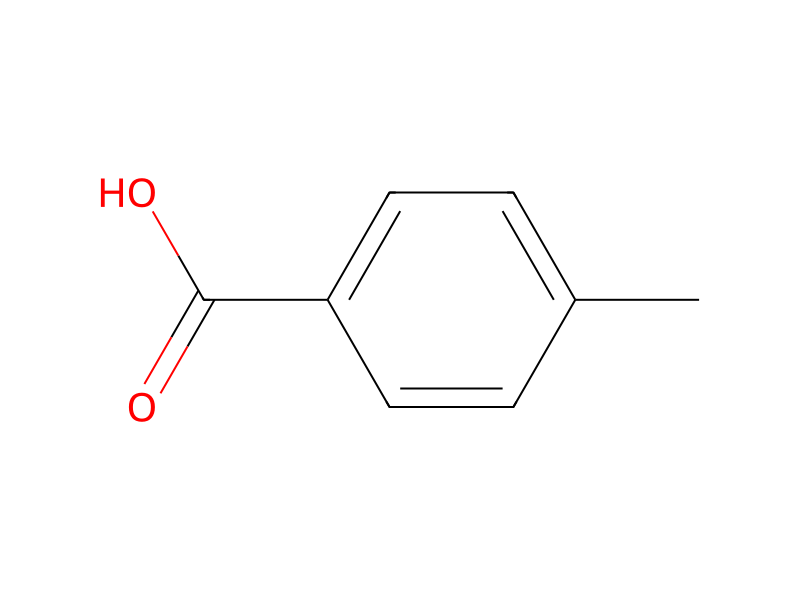
Cc1ccc(C(=O)O)cc1
InChIKey
LPNBBFKOUUSUDB-UHFFFAOYSA-N
Molecular formula
C8H8O2
Average molar mass
136.15 g/mol
Monoisotopic mass
136.0524295

Overview

P-toluic acid is a white powder. Sublimes. (NTP, 1992)

Names & identifiers

Preferred name
P-Toluic Acid
IUPAC
4-methylbenzoic acid
English name
p-Toluic acid
Molecular formula
C8H8O2
Molecular weight
136.15

Names & synonyms

4-Methylbenzoic acidP-TOLUIC ACID99-94-54-Toluic acidp-Methylbenzoic acidCrithminic acidBenzoic acid, 4-methyl-p-Toluylic acidp-CarboxytolueneToluenecarboxylic acidDTXSID6021618A26GBX5SSV
Show more names
PTLAp-Tolylcarboxylic acidp-toluic
NSC-2215DTXCID801618CHEBI:36635RefChem:858222202-803-3para-Toluic acid4-Methyl-Benzoic AcidMFCD00002565

Database identifiers

CAS
99-94-5
PubChem CID
7470
DTXSID
DTXSID6021618
ChEMBL
CHEMBL21708
ChEBI
CHEBI:36635
UNII
A26GBX5SSV
EC Number
202-803-3
Nikkaji
J5.162D

Properties

Computed structural propertiesFilling in

XLogP
2.3
Topological polar surface area
37.3 Ų
Hydrogen bond donors
1
Hydrogen bond acceptors
2
Rotatable bonds
1
Heavy atoms
10
Formal charge
0
Complexity
123

Experimental & physicochemical properties

Chemical ClassesOther Classes -> Organic Acids
SpringerMaterials PropertiesBoiling point
LogP · 2 items

2.27

2.43

Solubility · 2 items

less than 1 mg/mL at 66 °F (NTP, 1992)

0.34 mg/mL at 25 °C

Boiling Point525 to 527 °F at 760 mmHg (NTP, 1992)
Melting Point · 2 items

356 to 360 °F (NTP, 1992)

181 °C

Vapor Pressure0.0061 [mmHg]
Physical Description · 4 items

P-toluic acid is a white powder. Sublimes. (NTP, 1992)

Dry Powder

White solid; [CAMEO] White to yellow-brown solid; [OECD SIDS] White powder; [Alfa Aesar MSDS]

Solid

Physicochemical properties

Safety & regulation

Safety information is for reference only and does not replace the supplier’s Safety Data Sheet (SDS), applicable regulations, or professional assessment.

GHS classification

GHS Classification · 5 items

This chemical does not meet GHS hazard criteria for 2.8% (5 of 180) of reports.

Warning

H315 (10.6%): Causes skin irritation [Warning Skin corrosion/irritation]

P261, P264, P264+P265, P272, P280, P302+P352, P305+P351+P338, P321, P332+P317, P333+P317, P337+P317, P362+P364, and P501 (click each P-code to see the statement)

Aggregated GHS information provided per 180 reports by companies from 12 notifications to the ECHA C&L Inventory. Each notification may be associated with multiple companies.

Hazard information

Regulatory Information · 4 items

Chemical: Benzoic acid, 4-methyl-

Benzoic acid, 4-methyl- is listed on the EPA's Chemical Data Reporting (CDR) system. Manufacturers and importers of Benzoic acid, 4-methyl- are required to report information about their production and use of this chemical to the EPA under the Toxic Substances Control Act (TSCA). (40 eCFR Part 711)

Status: Active Update: 20-12-2019 https://echa.europa.eu/registration-dossier/-/registered-dossier/25126

4-Methylbenzoic acid: Does not have an individual approval but may be used under an appropriate group standard

Fire HazardsFlash point data for this chemical are not available; however, it is probably combustible. (NTP, 1992)
Health HazardsSYMPTOMS: Symptoms of exposure to this compound may include skin and eye irritation.
Hazards Summary · 1 item

May cause skin and eye irritation; Harmful by ingestion, inhalation, and skin absorption; [NTP] A skin sensitizer in human volunteers; [OECD SIDS] An irritant; Harmful by ingestion; [Alfa Aesar MSDS] See Methyl 4-methylbenzoate and Phenylacetic acid.

Reactive Group

Chemistry & industry

Pharmacology

Cellular LocationsCytoplasm

Uses & manufacturing

Uses · 2 items

Used in agricultural chemicals and as an animal feed supplement; [NTP] Used as an intermediate for photosensitive pigments, fluorescent dyes, and colorants; [OECD SIDS]

Farming (Feed Additives) [Category: Industry]

U.S. Production2023: 1,000,000 - <8,500,000 lb
Consumer UsesCorrosion inhibitor
Industry UsesAnti-adhesive/cohesive
General Manufacturing Information · 2 items

All Other Basic Organic Chemical Manufacturing

Benzoic acid, 4-methyl-: ACTIVE

Applications · 3 items

Usesp-Toluic Acid is used as a reagent in the synthesis of several organic compounds including that of 2-aryl-1,3,4-oxadiazole derivatives which are potential antibacterial agents. Also used in the synthesis of 4-(bromomethyl) benzoic acid.

UsesIntermediates of Liquid Crystals

Usesp-Toluic Acid is used as a reagent in the synthesis of several organic compounds including that of 2-aryl-1,3,4-oxadiazole derivatives which are potential antibacterial agents. Also used in the synthesis of 4-(bromomethyl) benzoic acid.

Upstream & downstream products

Upstream raw materials

Concentrated hydrochloric acid

Related reactions

539 records
New reaction record
HRID 1158 reaction equation
HRID 1158As reactantuspto-grants-1998_03
HRID 1421 reaction equation
HRID 1421As reactantuspto-grants-1998_03
HRID 3669 reaction equation
HRID 3669As reactantuspto-grants-1998_03
HRID 3671 reaction equation
HRID 3671As reactantuspto-grants-1998_03
HRID 9740 reaction equation
HRID 9740As productAs reactantuspto-grants-2006_08
HRID 9741 reaction equation
HRID 9741As productAs reactantuspto-grants-2006_08
HRID 13740 reaction equation
HRID 13740As productuspto-grants-2010_06
HRID 14750 reaction equation
HRID 14750As reactantuspto-grants-2010_06
Page 1 of 68

Compound notes

Loading…

On this pageBasic informationOverviewNames & identifiersPropertiesSafety & regulationChemistry & industryRelated reactionsCompound notes
More actions
New noteNew reactionRequest quotes
Melting point
177 · 177-180 °C (lit.)
Boiling point
274 · 274-275 °C (lit.)
Density
1 · 1,06 g/cm3
bulk density
700 kg/m3 · 700kg/m3
vapor pressure
0.02 hPa · 0.02 hPa (70 °C)
refractive index
1.512 · 1.5120 (estimate)
Flash point
181 °C · 181°C
storage temp.
30 °C · Store below +30°C.
solubility
0.3 g/l · 0.3g/l
form
Powder
pka
4.36 · 4.36(at 25℃)
color
White to slightly yellow-cream
PH
3.73 · 3.73(1 mM solution);3.2(10 mM solution);2.69(100 mM solution)
Water Solubility
0.1 g/100 · <0.1 g/100 mL at 19 ºC
Specific Heat Capacity
1.24 J/ · Cp(crystal): 1.24 J/(g·K), at 25℃
Merck
14 · 14,9535
BRN
507600 · 507600
Henry's Law Constant
2.7 · 2.7×102 mol/(m3Pa) at 25℃, Wang et al. (2017)
Stability
Stable. Incompatible with strong oxidizing agents, strong bases.
InChI
1S/C8H8O2/c1-6-2-4-7(5-3-6)8(9)10/h2-5H,1H3,(H,9,10)
InChIKey
LPNBBFKOUUSUDB-UHFFFAOYSA-N
SMILES
Cc1ccc(cc1)C(O)=O
LogP
2.44 · 2.44
CAS DataBase Reference
99 · 99-94-5(CAS DataBase Reference)
EWG's Food Scores
1 · 1
FDA UNII
26 GBX5SSV · A26GBX5SSV
NIST Chemistry Reference
4 · Benzoic acid, 4-methyl-(99-94-5)
EPA Substance Registry System
4 · Benzoic acid, 4-methyl- (99-94-5)
UNSPSC Code
12352106 · 12352106
NACRES
22 · NA.22
Symbol(GHS)
7 · GHS07
Signal word
Warning
Hazard statements
317 · H317
Precautionary statements
261 · P261-P272-P280-P302+P352-P333+P313-P362+P364
Hazard Codes
Xn
Risk Statements
22 · 22
Safety Statements
22 · 22-24/25
WGK Germany
1 · 1
RTECS
1575000 · XU1575000
Autoignition Temperature
570 °C · 570 °C
TSCA
TSCA listed
HS Code
29163900 · 29163900
Storage Class
11 · 11 - Combustible Solids
Hazard Classifications
1 · Skin Sens. 1
Toxicity
50 orally · LD50 orally in Rabbit: 400 mg/kg
REACH Registrations
Active
Acids, Carboxylic
Reactivity Profile · 1 item

P-TOLUIC ACID is a carboxylic acid. Carboxylic acids donate hydrogen ions if a base is present to accept them. They react in this way with all bases, both organic (for example, the amines) and inorganic. Their reactions with bases, called "neutralizations", are accompanied by the evolution of substantial amounts of heat. Neutralization between an acid and a base produces water plus a salt. Carboxylic acids with six or fewer carbon atoms are freely or moderately soluble in water; those with more than six carbons are slightly soluble in water. Soluble carboxylic acid dissociate to an extent in water to yield hydrogen ions. The pH of solutions of carboxylic acids is therefore less than 7.0. Many insoluble carboxylic acids react rapidly with aqueous solutions containing a chemical base and dissolve as the neutralization generates a soluble salt. Carboxylic acids in aqueous solution and liquid or molten carboxylic acids can react with active metals to form gaseous hydrogen and a metal salt. Such reactions occur in principle for solid carboxylic acids as well, but are slow if the solid acid remains dry. Even "insoluble" carboxylic acids may absorb enough water from the air and dissolve sufficiently in it to corrode or dissolve iron, steel, and aluminum parts and containers. Carboxylic acids, like other acids, react with cyanide salts to generate gaseous hydrogen cyanide. The reaction is slower for dry, solid carboxylic acids. Insoluble carboxylic acids react with solutions of cyanides to cause the release of gaseous hydrogen cyanide. Flammable and/or toxic gases and heat are generated by the reaction of carboxylic acids with diazo compounds, dithiocarbamates, isocyanates, mercaptans, nitrides, and sulfides. Carboxylic acids, especially in aqueous solution, also react with sulfites, nitrites, thiosulfates (to give H2S and SO3), dithionites (SO2), to generate flammable and/or toxic gases and heat. Their reaction with carbonates and bicarbonates generates a harmless gas (carbon dioxide) but still heat. Like other organic compounds, carboxylic acids can be oxidized by strong oxidizing agents and reduced by strong reducing agents. These reactions generate heat. A wide variety of products is possible. Like other acids, carboxylic acids may initiate polymerization reactions; like other acids, they often catalyze (increase the rate of) chemical reactions. This chemical is incompatible with strong oxidizers. It is also incompatible with strong bases. (NTP, 1992).

Air and Water ReactionsFine dust dispensed in air in sufficient concentrations, and in the presence of an ignition source is a potential dust explosion hazard. (NTP, 1992). Insoluble in water.
Hazard Classes and CategoriesSkin Irrit. 2 (10.6%)

Safety & protection

Fire FightingFires involving this material can be controlled with a dry chemical, carbon dioxide or Halon extinguisher. A water spray may also be used. (NTP, 1992)
First Aid · 1 item

EYES: First check the victim for contact lenses and remove if present. Flush victim's eyes with water or normal saline solution for 20 to 30 minutes while simultaneously calling a hospital or poison control center. Do not put any ointments, oils, or medication in the victim's eyes without specific instructions from a physician. IMMEDIATELY transport the victim after flushing eyes to a hospital even if no symptoms (such as redness or irritation) develop.

Nonfire Spill Response · 1 item

SMALL SPILLS AND LEAKAGE: Should a spill occur while you are handling this chemical, FIRST REMOVE ALL SOURCES OF IGNITION, then you should dampen the solid spill material with 60-70% ethanol and transfer the dampened material to a suitable container. Use absorbent paper dampened with 60-70% ethanol to pick up any remaining material. Seal the absorbent paper, and any of your clothes, which may be contaminated, in a vapor-tight plastic bag for eventual disposal. Solvent wash all contaminated surfaces with 60-70% ethanol followed by washing with a soap and water solution. Do not reenter the contaminated area until the Safety Officer (or other responsible person) has verified that the area has been properly cleaned.

Personal Protective Equipment (PPE) · 1 item

RECOMMENDED RESPIRATOR: Where the neat test chemical is weighed and diluted, wear a NIOSH-approved half face respirator equipped with an organic vapor/acid gas cartridge (specific for organic vapors, HCl, acid gas and SO2) with a dust/mist filter. (NTP, 1992)

Toxicology

Adverse EffectsSkin Sensitizer - An agent that can induce an allergic reaction in the skin.
RAIS Toxicity Values · 4 items

0.005

PPRTV Current

0.05

PPRTV Current

EPA Provisional Peer-Reviewed Toxicity Values · 6 items

p-Toluic Acid

5 x 10^-3 mg/kg-day

5 x 10^-2 mg/kg-day

PDF Document

Inadequate information to assess carcinogenic potential

2017

Hazard Quotient Level 0.1 or Cancer Risk Level 1E-06 · 6 items

3.20e+02

4.10e+03

9.00e+01

1.00e+03

2.30e-02

5.00e-03

Hazard Quotient Level 3 or Cancer Risk Level 1E-04 · 6 items

9.50e+02

1.20e+04

2.70e+02

1.00e+03

5.00e-03

Volatile

Safety data

wgk
1
tsca
TSCA listed
rtecs
XU1575000
hs_code
29163900
Toxicity
LD50 orally in Rabbit: 400 mg/kg
risk_code
22
Signal word
Warning
Symbol(GHS)
GHS07
hazard_code
Xn
safety_code
22-24/25
Storage Class
11 - Combustible Solids
Hazard statements
H317
REACH Registrations
Active
Hazard Classifications
Skin Sens. 1
Autoignition Temperature
570 °C
Precautionary statements
P261-P272-P280-P302+P352-P333+P313-P362+P364
p-Xylene
Oxygen
Cobalt naphthenate
Nitric acid
p-Cymene

Downstream products

4-Hydroxy-3-methylbenzoic acidMethyl 4-amino-6-indolecarboxylateO,O-Bisisopropyl O-(4-(methylsulfinyl)phenyl) phosphorothioate4-Bromomethylbenzamide1-(3-Chloro-4-((cyclopropylamino)methyl)phenyl)ethanone4-(Chloromethyl)benzoic acid4-(Bromomethyl)-N-(L-methylethyl)benzamide4-Bromomethylbenzoic acidp-Tolyl isocyanate3-Amino-4-methylbenzoic acid4-Bromomethyl benzoyl bromide 963-Chloro-4-((cyclopropylamino)methyl)benzaldehydeN-Benzylhydroxylamine hydrochloridep-Toluoyl chlorideMethyl 4-methylbenzoate2,3,5,6-Tetrafluoro-4-methylbenzyl alcohol4,N-Dimethyl-N-methoxybenzamideMordant Blue 524-Formylphenyl 4-methylbenzoate

Additional notes

DefinitionChEBI: A methylbenzoic acid in which the methyl substituent is located at position 4.