HomeMCPWorkbenchSkills
HomeWorkbenchNotificationsMe
llms.txt · MCP GuidePrivacy Policy · Terms of Service · Supportv1.8.3
  1. Home
  2. /Compound

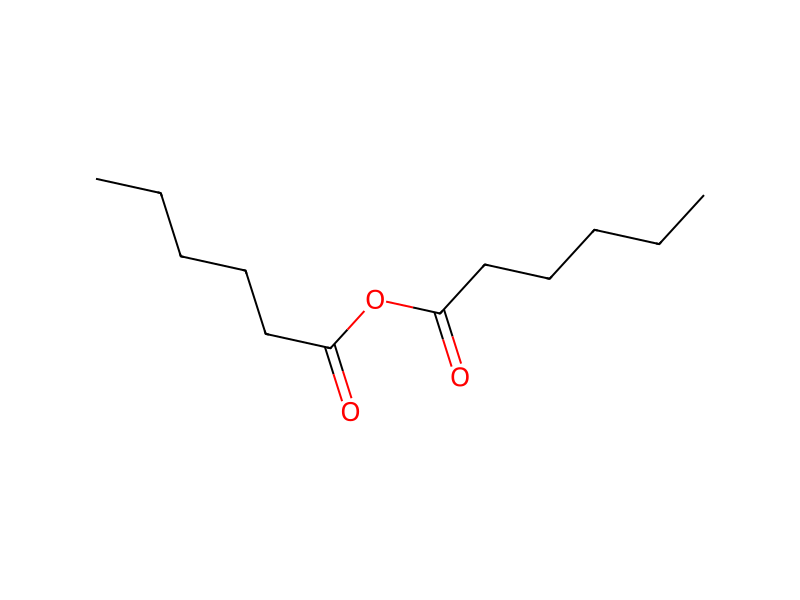
Hexanoic anhydride

HCID 74918
New reaction
Print
Basic informationOverviewNames & identifiersPropertiesSafety & regulationChemistry & industryRelated reactionsCompound notes
Substructure searchFind similar structures

Basic information

CAS
2051-49-2
Standard SMILES
CCCCCC(=O)OC(=O)CCCCC
InChIKey
PKHMTIRCAFTBDS-UHFFFAOYSA-N
Molecular formula
C12H22O3
Average molar mass
214.3 g/mol
Monoisotopic mass
214.15689456

Overview

hexanoic anhydride has been reported in Nicotiana tabacum with data available.

Names & identifiers

Preferred name
Hexanoic anhydride
IUPAC
hexanoyl hexanoate
English name
HEXANOIC ANHYDRIDE
Molecular formula
C12H22O3
Molecular weight
214.3

Names & synonyms

Hexanoic anhydride2051-49-2hexanoyl hexanoateCaproic anhydrideHexanoic acid, anhydriden-Hexanoic anhydrideHexanoic acid, 1,1'-anhydrideCaproic acid anhydrideCapronic acid anhydrideCapronic anhydrideHexanoyl anhydriden-Hexanoic acid anhydride
Show more names
hexanoylhexanoateN-HEXOIC ANHYDRIDEn-CapriocanhydrideN-CAPROIC ANHYDRIDEN-CAPRONIC ANHYDRIDE
GG70Y8LTBYEINECS 218-121-4AI3-06132DTXSID20870929EC 218-121-4RefChem:787419Hexanoic acid, 1,1'anhydrideDTXCID30818610

Database identifiers

CAS
2051-49-2
PubChem CID
74918
DTXSID
DTXSID20870929
UNII
GG70Y8LTBY
EC Number
218-121-4
Nikkaji
J95.911A

Properties

Computed structural properties

XLogP
3.7
Topological polar surface area
43.4 Ų
Hydrogen bond donors
0
Hydrogen bond acceptors
3
Rotatable bonds
10
Heavy atoms
15
Formal charge
0
Complexity
167

Experimental & physicochemical properties

Chemical Classes · 2 items

Other Classes -> Acid Anhydrides, Other

Industrial compound

SpringerMaterials PropertiesOptical coefficient
Physical DescriptionClear slightly yellow liquid; [Acros Organics MSDS]

Physicochemical properties

Melting point
-40 °C · -40 °C
Boiling point
244 °C · 244 °C
Density
0.93 · 0.93
vapor pressure
2.9 Pa · 2.9Pa at 25℃
refractive index
1.43 · 1.43
Flash point
128 °C · 128 °C
storage temp.
30 °C · Store below +30°C.
solubility
1 g/10 · ethanol: soluble1g/10 mL, clear, colorless
form
clear liquid

Safety & regulation

Safety information is for reference only and does not replace the supplier’s Safety Data Sheet (SDS), applicable regulations, or professional assessment.

GHS classification

GHS Classification · 4 items

Danger

H314 (96.7%): Causes severe skin burns and eye damage [Danger Skin corrosion/irritation]

P260, P264, P280, P301+P330+P331, P302+P361+P354, P304+P340, P305+P354+P338, P316, P321, P363, P405, and P501 (click each P-code to see the statement)

Aggregated GHS information provided per 61 reports by companies from 5 notifications to the ECHA C&L Inventory.

Hazard information

Regulatory Information · 3 items

Chemical: Hexanoic acid, anhydride

REACH registered substance: Hexanoic anhydride (EC: 218-121-4)

Hexanoic anhydride: Does not have an individual approval but may be used under an appropriate group standard

Other Safety InformationIMAP assessments - Hexanoic acid, anhydride: Environment tier I assessment
Hazards SummaryCauses burns; Inhalation may cause corrosive injuries to upper respiratory tract and lungs; [Acros Organics MSDS] See Butyric anhydride.
Hazard Classes and CategoriesSkin Corr. 1B (96.7%)

Toxicology

Adverse EffectsDermatotoxin - Skin burns.

Safety data

PPE
Faceshields, Gloves, Goggles, type ABEK (EN14387) respirator filter
wgk
3

Chemistry & industry

Uses & manufacturing

General Manufacturing InformationHexanoic acid, 1,1'-anhydride: ACTIVE
Applications · 3 items

UsesHexanoic anhydride has been used in:green synthesis of esters of acyclovir (acyclovir prodrugs)preparation of hexanoyl-modified chitosan nanoparticles and chitosan-based polymeric surfactants via N-acylation of chitosans

UsesHexanoic anhydride was used in:green synthesis of esters of acyclovir (acyclovir prodrugs)preparation of hexanoyl-modified chitosan nanoparticlespreparation of chitosan-based polymeric surfactants via N-acylation of chitosans

UsesHexanoic Anhydride, is used as a reactant in the total synthesis of acremomannolipin A via steroselective β-mannosylation of 4,6,-O-benzylidene-protected mannosyl sulfoxide with a D-mannitol derivative.

Preparation methods · 1 item

PreparationTo an ice-cooled flask containing 116 gm (1.0 mole) of n-caproic acid is added 21.0-23.10 gm (0.5-0.55 mole) of ketene at a rate of 0.45 mole/hr. The reaction mixture is fractionally distilled at atmospheric pressure to afford a forecut of acetone, acetic acid, and acetic anhydride. The oil bath is raised to 220°C over a 1-hr period, kept there for 3 hr to ensure complete removal of acetic acid, and then cooled. The distillation is continued under reduced pressure to afford 86-95 gm (80-87%), b.p. 109- 112°C (3 mm Hg) and b.p. 118-121°C (6 mm Hg).

Upstream & downstream products

Upstream raw materials

Hexanoic acidketene

Downstream products

Related reactions

13 records
New reaction record
HRID 127178 reaction equation
HRID 127178As reactant
HRID 376018 reaction equation
HRID 376018As reactant
HRID 507492 reaction equation
HRID 507492As solvent
HRID 1089038 reaction equation
HRID 1089038As reactant
HRID 1110938 reaction equation
HRID 1110938As solvent
HRID 1199790 reaction equation
HRID 1199790As reactant
HRID 1276545 reaction equation
HRID 1276545As reactant
HRID 1444589 reaction equation
HRID 1444589As solvent
PreviousPage 1 of 2

Compound notes

On this pageBasic informationOverviewNames & identifiersPropertiesSafety & regulationChemistry & industryRelated reactionsCompound notes
color
Colorless to Almost colorless
explosive limit
0.7 % · 0.7%(V)
Water Solubility
Hydrolyzes in water.
Sensitive
Moisture Sensitive
BRN
1776561 · 1776561
InChI
1S/C12H22O3/c1-3-5-7-9-11(13)15-12(14)10-8-6-4-2/h3-10H2,1-2H3
InChIKey
PKHMTIRCAFTBDS-UHFFFAOYSA-N
SMILES
CCCCCC(=O)OC(=O)CCCCC
LogP
4.45 at · 4.45 at 25℃
CAS DataBase Reference
2051 · 2051-49-2(CAS DataBase Reference)
FDA UNII
70 Y8LTBY · GG70Y8LTBY
EPA Substance Registry System
Hexanoic acid, anhydride (2051-49-2)
UNSPSC Code
12352100 · 12352100
NACRES
22 · NA.22
Symbol(GHS)
5 · GHS05
Signal word
Danger
Hazard statements
314 · H314
Precautionary statements
280 · P280-P303+P361+P353-P304+P340+P310-P305+P351+P338-P363-P405
PPE
Faceshields, Gloves, Goggles, type ABEK (EN14387) respirator filter
Hazard Codes
C
Risk Statements
34 · 34
Safety Statements
26 · 26-36/37/39-45
RIDADR
3265 · UN 3265 8/PG 2
WGK Germany
3 · 3
TSCA
TSCA listed
HazardClass
8 · 8
PackingGroup
III
HS Code
2915900090 · 2915900090
Storage Class
8 A · 8A - Combustible corrosive hazardous materials
Hazard Classifications
1 B · Skin Corr. 1B
REACH Registrations
Active
Limited Quantities
1 L · 1.0 L (0.3 gallons) (liquid) or 1 Kg (2.2 lbs) (solid)
Excepted Quantities
Max Inner Pack (30g or 30ml) and Max Outer Pack (500g or 500ml)
tsca
TSCA listed
ridadr
UN 3265 8/PG 2
hs_code
2915900090
risk_code
34
Signal word
Danger
Symbol(GHS)
GHS05
hazard_code
C
safety_code
26-36/37/39-45
hazard_class
8
Storage Class
8A - Combustible corrosive hazardous materials
packing_group
III
Hazard statements
H314
Limited Quantities
1.0 L (0.3 gallons) (liquid) or 1 Kg (2.2 lbs) (solid)
Excepted Quantities
Max Inner Pack (30g or 30ml) and Max Outer Pack (500g or 500ml)
REACH Registrations
Active
Hazard Classifications
Skin Corr. 1B
Precautionary statements
P280-P303+P361+P353-P304+P340+P310-P305+P351+P338-P363-P405
GERANYL CAPROATEN-OCTYL CAPROATEn-Caproic acid isopropyl esterHexanamidePENTYL HEXANOATE