
Basic information
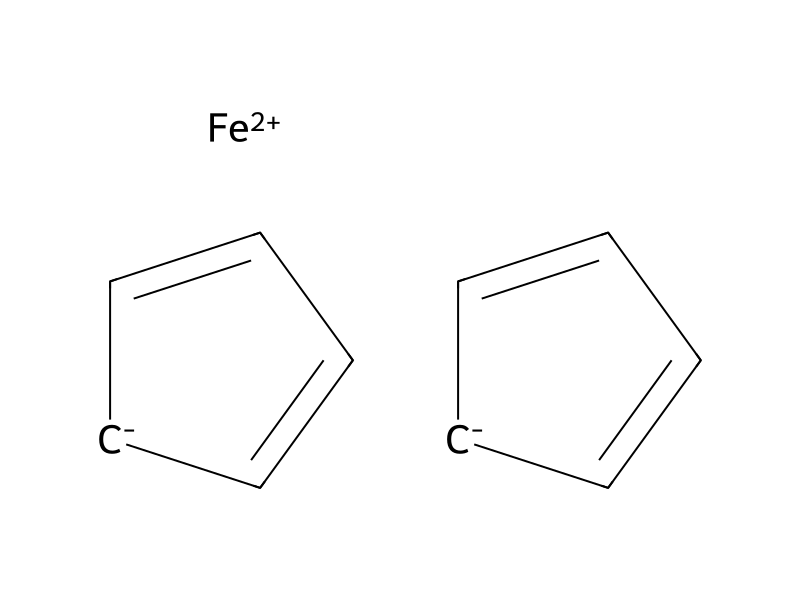
- Standard SMILES
[Fe+2].c1cc[cH-]c1.c1cc[cH-]c1- InChIKey
KTWOOEGAPBSYNW-UHFFFAOYSA-N- Molecular formula
- C10H10Fe
- Average molar mass
- 186.03 g/mol
- Monoisotopic mass
- 186.013186
Names & identifiers
- Preferred name
- Bis(eta-cyclopentadienyl) iron
- IUPAC
- bis(cyclopenta-1,3-diene);iron(2+)
- English name
- Ferrocene
- Molecular formula
- C10H10Fe
- Molecular weight
- 186.03
Names & synonyms
CCRIS 3195HSDB 2878EINECS 203-039-3UNII-U96PKG90JQAI3-23119FERROCENE [MI]FERROCENE [HSDB]EC 203-039-3SCHEMBL29681ferrous;cyclopenta-1,3-dieneBis(eta-cyclopentadienyl) ironFe(C5H5)2
Show more names
ermaotieFERROCENBIS(CYCLOPENTADIENYL)IRONBIS(CYCLOPENTADIEN)IRONcataneFerrotsenOxolan-3-olDICYCLOPENTADIENYLIRONIRON DICYCLOPENTADIENYLFERROCENE
DTXCID105326Bis( cyclopentadienyl)eisen(II)Tox21_202514NCGC00091936-01NCGC00260063-01CAS-102-54-5Q/TY.J08.19-2022NS00041498
Database identifiers
- CAS
102-54-5- PubChem CID
- 7611
- UNII
- U96PKG90JQ
Properties
Computed structural properties
- Topological polar surface area
- 0 Ų
- Hydrogen bond donors
- 0
- Hydrogen bond acceptors
- 2
- Rotatable bonds
- 0
- Heavy atoms
- 11
- Formal charge
- 0
- Complexity
- 11
Physicochemical properties
- Melting point
- 172 · 172-174 °C (lit.)
- Boiling point
- 249 °C · 249 °C (lit.)
- Density
- 1.49 · 1.490
- bulk density
- 500 kg/m3 · 500kg/m3
- vapor pressure
- 0.03 mm · 0.03 mm Hg ( 40 °C)
- Flash point
- 100 °C · 100°C
- storage temp.
- 30 °C · Store below +30°C.
- solubility
- 2 O; · insoluble in H2O; soluble in ethanol, ethyl ether,benzene, dilute HNO 3
- form
- crystal
- color
- orange
- Water Solubility
- practically insoluble
- Sensitive
- Air & Moisture Sensitive
- λmax
- 358 nm · 358 nm
- Sublimation
- 100 · 100 ºC
- Merck
- 14 · 14,4037
- Exposure limits
- 10 mg/m3,as · ACGIH:TLV-TWA 10 mg/m3,as FeOSHA:PEL-TWA 15 mg/m3 (total dust),5 mg/m3 (respirable fraction)NIOSH:REL-TWA 10 mg/m3 (total dust),5 mg/m3 (respirable fraction)
- Stability
- Stable at room temperature. Incompatible with strong oxidizing agents. Highly flammable.
- InChI
- 1S/2C5H5.Fe/c2*1-2-4-5-3-1;/h2*1-5H;
- InChIKey
- DFRHTHSZMBROSH-UHFFFAOYSA-N
- SMILES
- [Fe].[CH]1[CH][CH][CH][CH]1.[CH]2[CH][CH][CH][CH]2
- LogP
- 3.711 at · 3.711 at 22℃
- CAS DataBase Reference
- 102 · 102-54-5(CAS DataBase Reference)
- EWG's Food Scores
- 1 · 1
- FDA UNII
- 96 PKG90JQ · U96PKG90JQ
- NIST Chemistry Reference
- Ferrocene(102-54-5)
- EPA Substance Registry System
- Ferrocene (102-54-5)
- UNSPSC Code
- 12352103 · 12352103
- NACRES
- 22 · NA.22
- Symbol(GHS)
- 2 · GHS02,GHS07,GHS08,GHS09
- Signal word
- Danger
- Hazard statements
- 228 · H228-H302+H332-H360FD-H373-H410
- Precautionary statements
- 202 · P202-P210-P273-P301+P312-P304+P340+P312-P308+P313
- target organs
- Liver
- PPE
- 3 · Eyeshields, Gloves, type P3 (EN 143) respirator cartridges
- Hazard Codes
- F,Xn,N
- Risk Statements
- 11 · 11-22-51/53-2017/11/22
- Safety Statements
- 61 · 61-22-24/25
- OEB
- B
- OEL
- 10 mg/m3 · TWA: 10 mg/m3 (total)
- RIDADR
- 1325 · UN 1325 4.1/PG 2
- WGK Germany
- 2 · 2
- RTECS
- 700000 · LK0700000
- Autoignition Temperature
- 150 °C · >150 °C
- TSCA
- TSCA listed
- HazardClass
- 4.1 · 4.1
- PackingGroup
- II
- HS Code
- 29310095 · 29310095
- Storage Class
- 4.1 B · 4.1B - Flammable solid hazardous materials
- Hazard Classifications
- 4 InhalationAcute · Acute Tox. 4 InhalationAcute Tox. 4 OralAquatic Chronic 1Flam. Sol. 1Repr. 1BSTOT RE 2 Inhalation
- Hazardous Substances Data
- 102 · 102-54-5(Hazardous Substances Data)
- Toxicity
- 50 orally · LD50 orally in Rabbit: 1320 mg/kg LD50 dermal Rat > 3000 mg/kg
- REACH Registrations
- Active
- Limited Quantities
- 1 Kg · 1.0 Kg (2.2 lbs)
- Excepted Quantities
- Max Inner Pack (30g or 30ml) and Max Outer Pack (500g or 500ml)
Safety & regulation
Safety data
- OEB
- B
- OEL
- TWA: 10 mg/m3 (total)
- PPE
- Eyeshields, Gloves, type P3 (EN 143) respirator cartridges
- wgk
- 2
- tsca
- TSCA listed
- rtecs
- LK0700000
- ridadr
- UN 1325 4.1/PG 2
- hs_code
- 29310095
- Toxicity
- LD50 orally in Rabbit: 1320 mg/kg LD50 dermal Rat > 3000 mg/kg
- risk_code
- 11-22-51/53-2017/11/22
- Signal word
- Danger
- Symbol(GHS)
- GHS02,GHS07,GHS08,GHS09
- hazard_code
- F,Xn,N
- safety_code
- 61-22-24/25
- hazard_class
- 4.1
- Storage Class
- 4.1B - Flammable solid hazardous materials
- packing_group
- II
- target organs
- Liver
- Hazard statements
- H228-H302+H332-H360FD-H373-H410
- Limited Quantities
- 1.0 Kg (2.2 lbs)
- Excepted Quantities
- Max Inner Pack (30g or 30ml) and Max Outer Pack (500g or 500ml)
- REACH Registrations
- Active
- Hazard Classifications
- Acute Tox. 4 InhalationAcute Tox. 4 OralAquatic Chronic 1Flam. Sol. 1Repr. 1BSTOT RE 2 Inhalation
- Autoignition Temperature
- >150 °C
- Precautionary statements
- P202-P210-P273-P301+P312-P304+P340+P312-P308+P313
- Hazardous Substances Data
- 102-54-5(Hazardous Substances Data)
Chemistry & industry
Applications
UsesFerrocene and its derivatives have various applications in different fields. It can be used as additives in rocket fuel, antiknock agent in gasoline, curing agent in rubber and silicone resin, and ultraviolet absorber. It can also be used in the production of metal-containing polymers and as a coating material for spacecraft. Ferrocene has a smoke abatement and combustion facilitating effect, which can reduce smoke production and increase power efficiency in fuel. It can also be used as an iron fertilizer for plants and as a pesticide. Ferrocene derivatives have applications as antioxidants, stabilizers, catalysts, and promoting agents in different industrial and organic synthesis processes. Addition of ferrocene to fuels such as diesel, gasoline, heavy oil, and coal can decrease the fuel consumption rate and reduce smoke production. Overall, ferrocene has unique characteristics that make it suitable for various applications in different fields.
UsesFerrocene is used as a catalyst for vulcanization, acceleration, and polymerization, as a chemical intermediate for polymeric compounds such as high temperature polymers, as an antiknock additive for gasoline, as a coating for missiles and satellites, and as a high-temperature lubricant.
General DescriptionFerrocene appears as orange crystalline solid or orange-yellow powder. Sublimes above 212 °F. Camphor odor. (NTP, 1992)
Upstream & downstream products
Upstream raw materials
Downstream products
Suppliers50 total
国药集团化学试剂有限公司86-21-63210123 · [email protected]
梯希爱(上海)化成工业发展有限公司021-67121386 · [email protected]
上海阿拉丁生化科技股份有限公司400-6206333 13167063860 · [email protected]
科瑞迪化学400-821-5857 021-64326257 · [email protected]
上海将来实业股份有限公司400-0066400 13621662912 · [email protected]
Syntechem Co.,Ltd[email protected]
上海迈瑞尔生化科技有限公司4006356688 18621169109 · [email protected]
武汉易泰科技有限公司上海分公司18930552037 · [email protected]
天津中信凯泰化工有限公司022-66880623 · [email protected]
阿法埃莎(中国)化学有限公司400-6106006 · [email protected]
上海德默医药科技有限公司400-021-7337 2355568890 · [email protected]
安耐吉化学&3A(安徽泽升科技股份有限公司)400-0056266 · [email protected]
重庆张邦医药科技有限责任公司028-84252981 18583719936 · [email protected]
北京绿百草科技发展有限公司010-61136123 · [email protected]
上海瀚鸿科技股份有限公司021-54306202 13764082696 · [email protected]
上海景颜化工科技有限公司13817811078 · [email protected]
上海隆盛化工有限公司58099637 13585536065 · [email protected]
山东信恒化工有限公司152-15269160605-0605 15269160605 · [email protected]
武汉丰泰威远科技有限公司027-87465837 19945049750 · [email protected]
山东西亚化学有限公司13355009207 13355009207 · [email protected]
玛雅试剂+86 (573) 82222445 (0)18006601000 452520369 · [email protected]
四川库利南科技有限公司400-1166-196 18981987031 · [email protected]
天津希恩思生化科技有限公司400 638 7771 · [email protected]
斯百全化学(上海)有限公司021-021-021-67601398-809-809-809 15221380277 · [email protected]
北京泰亚杰科技有限公司021-33690831-8001 13552411790;18616022633 · [email protected]
艾科试剂4008-755-333 18080918076 · [email protected]
上海思域化工科技有限公司86-21-34053660 · [email protected]
赛默飞世尔科技(中国)有限公司800-810-5118 · [email protected]
张家港保税区凯利特化工有限公司18606289633 15862625988 · [email protected]
上海遐瑞医药科技有限公司+86 21 61551611
上海健超生物科技有限公司150-2103-5486 18017383231 · [email protected]
TCI AMERICA800-4238616 · [email protected]
TOKYO CHEMICAL INDUSTRY CO., LTD.03-36680489 · [email protected]
TCI Europe320-37350700 · [email protected]
上海贤鼎生物科技有限公司4009209199 · [email protected]
上海倍卓生物科技有限公司021-61119791,13386096464 · [email protected]
Xunteng International Trading Co.,Limited—
北京环宇世纪化学科技有限公司hysj_bj.com
上海将来实业股份有限公司021-61552785 · [email protected]
日照力德士化工有限公司010-51268198 · [email protected]
郑州鸿晟医药科技有限公司0371-0371-13526885213 15637198702 · [email protected]
美岚实业(上海)有限公司021-58958189 · [email protected]
上海石洋化工有限公司021-56795766 · [email protected]
上海爱蝶实业有限公司021-58957966 18930537195 · [email protected]
成都零六生物科技有限公司400-1166-196 13458535857 · [email protected]
广拓化学(上海)有限公司021-60899189-8001 18918189673 · [email protected]
上海麦克林生化科技股份有限公司15221275939 15221275939 · [email protected]
杭州杰恒化工有限公司0571-87396432 · [email protected]
上海嵩爰化工科技有限公司010-1234567 18521000990 · [email protected]
上海有朋化工有限公司021-69005955 13701776567 · [email protected]
Additional notes
Definitionferrocene: An orange-red crystallinesolid, Fe(C5H5)2; m.p. 173°C. Itcan be made by adding the ioniccompound Na+C5H5- (cyclopentadienylsodium, made from sodium andcyclopentadiene) to iron(III) chloride.In ferrocene, the two rings are parallel,with the iron ion sandwiched betweenthem (hence the namesandwich compound: see formula).The bonding is between pi orbitalson the rings and d-orbitals on theFe2+ ion. The compound can undergoelectrophilic substitution on theC5H5rings (they have some aromatic character).It can also be oxidized to theblue ion (C5H5)2Fe+. Ferrocene is the first of a class of similar complexescalled sandwich compounds. Its systematicname is di-π-cyclopentadienyliron(II).
Related reactions
104 records




Linked notes
Loading…