
3,4-Dihydroisoquinoline
Completing data — refresh the page later to see the latest
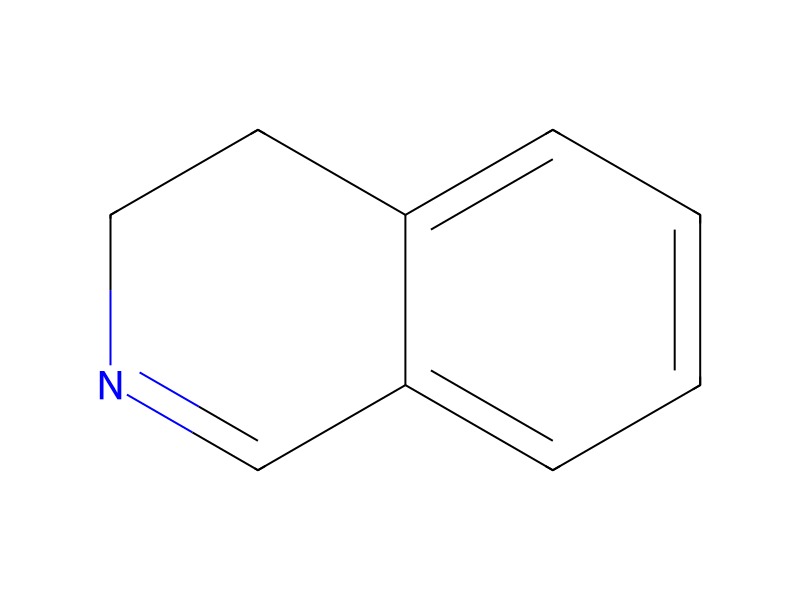
Basic information
- CAS
3230-65-7- Standard SMILES
C1=NCCc2ccccc21- InChIKey
NKSZCPBUWGZONP-UHFFFAOYSA-N- Molecular formula
- C9H9N
- Average molar mass
- 131.17 g/mol
- Monoisotopic mass
- 131.07349929
Overview
structure in first source
Names & identifiers
- Preferred name
- 3,4-Dihydroisoquinoline
- IUPAC
- 3,4-dihydroisoquinoline
- English name
- 3,4-Dihydroisoquinoline
- Molecular formula
- C9H9N
- Molecular weight
- 131.17
Names & synonyms
3,4-Dihydroisoquinoline3230-65-72K2ZCG3PSZG 1616NSC-3007DTXSID20186037G-1616RefChem:91123DTXCID30108528221-769-0Isoquinoline, 3,4-dihydro-3,4-dihydro-isoquinoline
Show more names
AKOS 213-2523,4-DihydroisoquinoL4-DIHYDROISOQUINOLINE3,4-Dihydroisoquinoline ,97%3,4-Dihydroisoquinoline >=97.5% (GC)3,4-DIHYDROISOQUINOLINE ISO 9001:2015 REACH
MFCD00033714Isoquinoline,4-dihydro-EINECS 221-769-0UNII-2K2ZCG3PSZSCHEMBL56690NSC3007NSC 3007AKOS015840990
Database identifiers
- CAS
3230-65-7- PubChem CID
- 76705
- DTXSID
DTXSID20186037- UNII
- 2K2ZCG3PSZ
- EC Number
- 221-769-0
- Nikkaji
- J262.336F
Properties
Computed structural propertiesFilling in
- XLogP
- 1.3
- Topological polar surface area
- 12.4 Ų
- Hydrogen bond donors
- 0
- Hydrogen bond acceptors
- 1
- Rotatable bonds
- 0
- Heavy atoms
- 10
- Formal charge
- 0
- Complexity
- 140
Experimental & physicochemical properties
SpringerMaterials PropertiesChemical shift
Physicochemical properties
- Melting point
- 251 · 251-254℃
- Boiling point
- 241.8 · 241.8±20.0℃ (760 Torr)
- Density
- 1.05 · 1.05±0.1 g/cm3 (20 ºC 760 Torr)
- refractive index
- 1.6041 · 1.6041 (589.3 nm 30℃)
- Flash point
- 91.6 · 91.6±22.6℃
- storage temp.
- 2 · 2-8°C
- form
- solid
- pka
- 5.8 · 5.80±0.20(Predicted)
- Appearance
- White to off-white Solid
- InChI
- InChI=1S/C9H9N/c1-2-4-9-7-10-6-5-8(9)3-1/h1-4,7H,5-6H2
- InChIKey
- NKSZCPBUWGZONP-UHFFFAOYSA-N
- SMILES
- C1C2=C(C=CC=C2)CCN=1
Safety & regulation
Safety information is for reference only and does not replace the supplier’s Safety Data Sheet (SDS), applicable regulations, or professional assessment.
GHS classification
GHS Classification
Danger
H302 (97.6%): Harmful if swallowed [Warning Acute toxicity, oral]
P262, P264, P264+P265, P270, P280, P301+P317, P302+P352, P305+P351+P338, P316, P321, P330, P332+P317, P337+P317, P361+P364, P362+P364, P405, and P501 (click each P-code to see the statement)
Aggregated GHS information provided per 42 reports by companies from 3 notifications to the ECHA C&L Inventory. Each notification may be associated with multiple companies.
Hazard information
Hazard Classes and CategoriesAcute Tox. 4 (97.6%)
Safety data
- wgk
- 3
- ridadr
- UN 2811 6.1 / PGII
- risk_code
- 22-24-36/38
- Signal word
- Danger
- Symbol(GHS)
- GHS06
- hazard_code
- T
- safety_code
- 26-36/37-45
- Storage Class
- 6.1A - Combustible acute toxic Cat. 1 and 2very toxic hazardous materials
- Hazard statements
- H302-H310-H315-H319
- Hazard Classifications
- Acute Tox. 2 DermalAcute Tox. 4 OralEye Irrit. 2Skin Irrit. 2
- Precautionary statements
- P262-P280-P301+P312+P330-P302+P352+P310-P305+P351+P338
Chemistry & industry
Applications
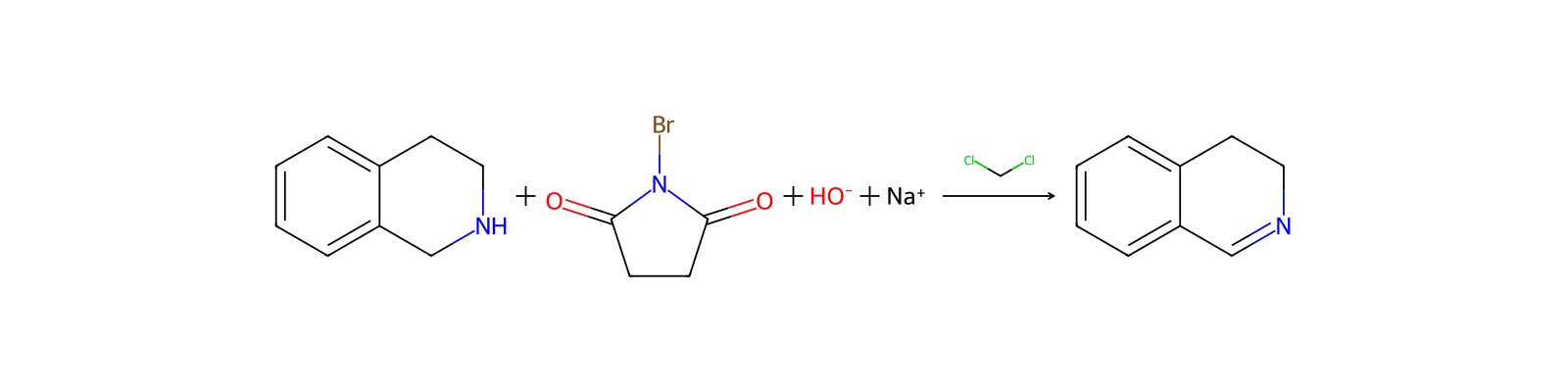
Uses3,4-Dihydroisoquinoline is derived from 1,2,3,4-Tetrahydroisoquinoline (T293820), which is used as a reagent in the preparation of 4-(1,2,4-oxadiazol-5-yl)piperidine-1-carboxamides as antiproliferative tubulin inhibitors.
Uses3,4-Dihydroisoquinoline can be used as a reactant to synthesize: 5,6-Dihydro-8H-isoquino[1,2-b]quinazolin-8-one by decarboxylative cyclization reaction with isatoic anhydride using tetrabutylammonium iodide (TBAI). 1-naphtholyl tetrahydroisoquinoline by aza-Friedel-Crafts reaction with various naphthols. 3,4-dihydroisoquinoline pseudo bases, which are employed as starting materials for the preperation of 3-benzazepine derivatives.
Upstream & downstream products
Upstream raw materials
Related reactions
56 records






Compound notes
Loading…