
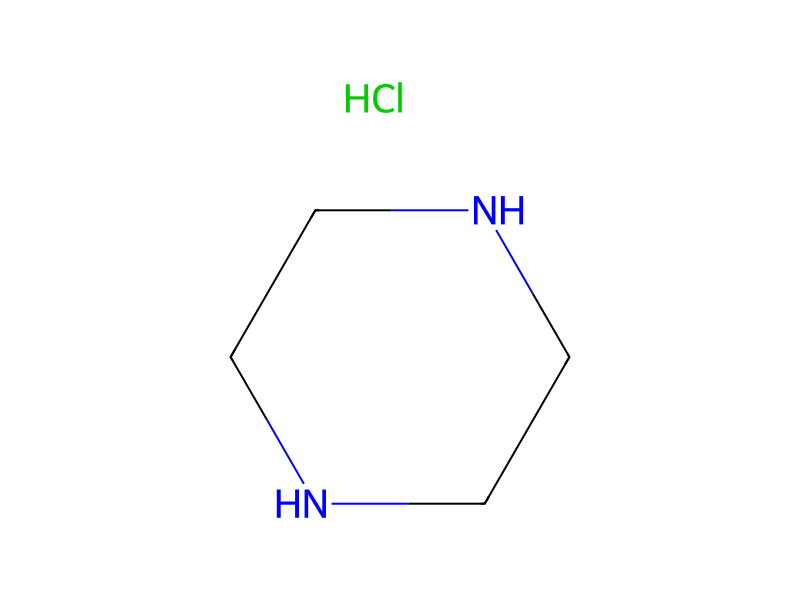
Basic information
- Standard SMILES
C1CNCCN1.Cl- InChIKey
MSQACBWWAIBWIC-UHFFFAOYSA-N- Molecular formula
- C4H11ClN2
- Average molar mass
- 122.6 g/mol
- Monoisotopic mass
- 122.0610761
Names & identifiers
- Preferred name
- Piperazine, hydrochloride (1:?)
- IUPAC
- piperazine;hydrochloride
- English name
- Piperazine dihydrochloride
- Molecular formula
- C4H12Cl2N2
- Molecular weight
- 159.06
Names & synonyms
PIPERAZINE HYDROCHLORIDE6094-40-2RefChem:863447Piperazine, hydrochloride (1:?)DTXSID601096371228-042-7Piperazine monohydrochloridePiperazine HCl7542-23-6Piperazinium chloridePiperazine, monohydrochloridepiperazine;hydrochloride
Show more names
Piperazine dihydrochloridePiperazine/hydrochloric acid,(1:x)Piperazine hydrochloride hydrate, 98%Piperazine hydrochloride salt complex
Piperazine hydrochloride hydrate7N36JHA4P6UNII-7N36JHA4P6Piperazine, hydrochloride (1:1)EINECS 228-042-7EINECS 231-422-5SCHEMBL7690piperazine hydrochloride salt
Database identifiers
- CAS
6094-40-2、7542-23-6- PubChem CID
- 82044
- DTXSID
DTXSID2064739- UNII
- 7N36JHA4P6
- EC Number
- 228-042-7、231-422-5
Properties
Computed structural properties
- Topological polar surface area
- 24.1 Ų
- Hydrogen bond donors
- 3
- Hydrogen bond acceptors
- 2
- Rotatable bonds
- 0
- Heavy atoms
- 7
- Formal charge
- 0
- Complexity
- 26
Experimental & physicochemical properties
Color/Form
CREAM COLORED CRYSTALLINE POWDER
WHITE NEEDLES
White to creamy colored needles or powder.
SolubilitySOLUBILITY IN WATER: 35% @ 0 °C, 41% @ 20 °C, 48% @ 50 °C; INSOL IN ORGANIC SOLVENTS
DecompositionWhen heated to decomposition it emits very toxic fumes of nitrous oxide and hydrogen chloride.
Stability/Shelf Life
STABLE @ TEMP TO 270 °C & IN NEUTRAL OR ACID MEDIA
Stability of piperazine can be accomplished by use of its simple salts, /including hydrochloride/, which are more stable than the piperazine base.
Other Experimental Properties
SLIGHTLY HYGROSCOPIC
82-83 °C /Monohydrate/
Physicochemical properties
- Melting point
- 147 · 147-149°C
- Sensitive
- Hygroscopic
- BRN
- 3670129 · 3670129
- Symbol(GHS)
- 8 · GHS08
- Signal word
- Danger
- Hazard statements
- 319 · H319-H412-H317-H334-H315-H361fd
- Precautionary statements
- 261 · P261-P285-P304+P341-P342+P311-P501-P264-P280-P302+P352-P321-P332+P313-P362-P261-P272-P280-P302+P352-P333+P313-P321-P363-P501-P264-P280-P305+P351+P338-P337+P313P-P273-P501
- Risk Statements
- 36 · 36/37/38-42/43
- Safety Statements
- 22 · 22-26-36/37/39-45
Safety & regulation
GHS classification
GHS Classification
Danger
H315: Causes skin irritation [Warning Skin corrosion/irritation];H317: May cause an allergic skin reaction [Warning Sensitization, Skin];H319: Causes serious eye irritation [Warning Serious eye damage/eye irritation];H334: May cause allergy or asthma symptoms or breathing difficulties if inhaled [Danger Sensitization, respiratory];H361fd: Suspected of damaging fertility; Suspected of damaging the unborn child [Warning Reproductive toxicity];H412: Harmful to aquatic life with long lasting effects [Hazardous to the aquatic environment, long-term hazard]
P203, P233, P260, P261, P264, P264+P265, P271, P272, P273, P280, P284, P302+P352, P304+P340, P305+P351+P338, P318, P321, P332+P317, P333+P317, P337+P317, P342+P316, P362+P364, P403, P405, and P501 (click each P-code to see the statement)
Danger
Hazard information
Regulatory InformationHazard Traits - Respiratory Toxicity;Authoritative List - EC Annex VI Resp. Sens. - Cat. 1;Report - if used as a fragrance or flavor ingredient
FDA Requirements
Manufacturers, packers, and distributors of drug and drug products for human use are responsible for complying with the labeling, certification, and usage requirements as prescribed by the Federal Food, Drug, and Cosmetic Act, as amended (secs 201-902, 52 Stat. 1040 et seq., as amended; 21 U.S.C. 321-392).
NIOSH RecommendationsRecommended Exposure Limit: 10 Hr Time-Weighted Avg: 5 mg/cu m.
Hazard Classes and Categories
Reproductive toxicity - category 2;Eye irritation - category 2;Skin irritation - category 2;Respiratory sensitisation - category 1;Hazardous to the aquatic environment (chronic) - category 3;Skin sensitisation - category 1
Repr. 2;Skin Irrit. 2;Eye Irrit. 2;Resp. Sens. 1;Skin Sens. 1;Aquatic Chronic 3
Hazardous Reactivities and IncompatibilitiesWater [Note: Slightly hygroscopic (i.e., absorbs moisture from the air)].
Safety & protection
Disposal Methods
SRP: At the time of review, criteria for land treatment or burial (sanitary landfill) disposal practices are subject to significant revision. Prior to implementing land disposal of waste residue (including waste sludge), consult with environmental regulatory agencies for guidance on acceptable disposal practices.
Preventive Measures
If material not on fire and not involved in fire: Keep sparks, flames, and othersources of ignition away. Keep material out of water sources and sewers. Build dikes to contain flow as necessary. /Piperazine/
Personnel protection: Avoid breathing vapors. Keep upwind. ... Avoid bodily contact with the material. ... Do not handle broken packages unless wearing appropriate personal protective equipment. Wash away any material which may have contacted the body with copious amounts of water or soap and water. If contact with the material anticipated, wear appropriate chemical protective clothing. /Piperazine/
The worker should immediately wash the skin when it becomes contaminated.
Work clothing that becomes wet or significantly contaminated should be removed and replaced.
Workers whose clothing may have become contaminated should change into uncontaminated clothing before leaving the work premises.
Threshold Limit Values (TLV)
8 hr Time Weighted Avg (TWA): 5 mg/cu m.
Excursion Limit Recommendation: Excursions in worker exposure levels may exceed 3 times the TLV-TWA for no more than a total of 30 minutes during a work day, and under no circumstances should they exceed 5 times the TLV-TWA, provided that the TLV-TWA is not exceeded.
Personal Protective Equipment (PPE)
Wear appropriate personal protective clothing to prevent skin contact.
Wear appropriate eye protection to prevent eye contact.
Eyewash fountains should be provided in areas where there is any possibility that workers could be exposed to the substance; this is irrespective of the recommendation involving the wearing of eye protection.
Facilities for quickly drenching the body should be provided within the immediate work area for emergency use where there is a possibility of exposure. [Note: It is intended that these facilities provide a sufficient quantity or flow of water to quickly remove the substance from any body areas likely to be exposed. The actual determination of what constitutes an adequate quick drench facility depends on the specific circumstances. In certain instances, a deluge shower should be readily available, whereas in others, the availability of water from a sink or hose could be considered adequate.]
Toxicology
Interactions
IN ISOLATED FROG & RABBIT HEARTS PIPERAZINE PRODUCED BIPHASIC EFFECT WITH INITIAL NEG INOTROPIC ACTION FOLLOWED BY POS INOTROPIC ACTION. FORMER PHASE WAS ANTAGONIZED BY ATROPINE, HEXAMETHONIUM & DIGOXIN. DIRECT ACTION ON THE HEART IS SUGGESTED. /PIPERAZINE HYDROGEN CHLORIDE/
Human Toxicity Excerpts
... SIDE EFFECTS ... INCL HEADACHES, NAUSEA, VOMITING, DIARRHEA, LETHARGY, TREMOR, INCOORDINATION, MUSCULAR WEAKNESS ... & VAGUE OCULAR DISTURBANCES. /PIPERAZINE SALTS/
LOSS OF CONSCIOUSNESS, DYSARTHRIA, APRAXIA, CLONIC SPASMS, TREMOR, MUSCULAR WEAKNESS, DROPPING OF OBJECTS, INABILITY TO THINK CLEARLY &/OR HALLUCINATIONS SEEN IN 35 YR OLD PT WITH TERMINAL RENAL FAILURE TAKING 30 MG PIPERAZINE HEXAHYDRATE/KG BODY WT/DAY FOR 10 DAYS. /PIPERAZINE HEXAHYDRATE/
SEVERE ILLNESS OCCURRED IN A 25 YR OLD WOMAN AFTER ADMIN OF PIPERAZINE ON 2 SEPARATE OCCASIONS. EVIDENCE FAVORS A HYPERSENSITIVITY MECHANISM RATHER THAN A DIRECT TOXIC EFFECT OF DRUG OR ITS METABOLITES. /PIPERAZINE/
ACUTE HUMAN EXPOSURES HAVE RESULTED IN MILD TO MODERATE SKIN BURNS & SENSITIZATION. MILD TO MODERATE ASTHMA HAS BEEN ASSOCIATED WITH INHALATION OF DUST.
Non-Human Toxicity Excerpts
EYE CONTACT, MARKED PAIN AND MODERATE EYE IRRITATION WHICH HEALS IN 2 DAYS WITH NO CORNEAL INJURY. SKIN CONTACT VERY SLIGHT IRRITATION.
VOMITING & DIARRHEA IS OCCASIONALLY REPORTED IN CATS & DOGS ESPECIALLY IF OVERDOSED. /ORAL ADMIN/
IN ISOLATED FROG & RABBIT HEARTS PIPERAZINE PRODUCED BIPHASIC EFFECT WITH INITIAL NEG INOTROPIC ACTION FOLLOWED BY POS INOTROPIC ACTION. FORMER PHASE WAS ANTAGONIZED BY ATROPINE, HEXAMETHONIUM & DIGOXIN. DIRECT ACTION ON HEART IS SUGGESTED. /PIPERAZINE/
Non-Human Toxicity ValuesLD50 Rat oral 4,900 mg/kg
Regulatory information
Regulatory InformationHazard Traits - Respiratory Toxicity;Authoritative List - EC Annex VI Resp. Sens. - Cat. 1;Report - if used as a fragrance or flavor ingredient
FDA Requirements
Manufacturers, packers, and distributors of drug and drug products for human use are responsible for complying with the labeling, certification, and usage requirements as prescribed by the Federal Food, Drug, and Cosmetic Act, as amended (secs 201-902, 52 Stat. 1040 et seq., as amended; 21 U.S.C. 321-392).
Safety data
- risk_code
- 36/37/38-42/43
- Signal word
- Danger
- Symbol(GHS)
- GHS08
- safety_code
- 22-26-36/37/39-45
- Hazard statements
- H319-H412-H317-H334-H315-H361fd
- Precautionary statements
- P261-P285-P304+P341-P342+P311-P501-P264-P280-P302+P352-P321-P332+P313-P362-P261-P272-P280-P302+P352-P333+P313-P321-P363-P501-P264-P280-P305+P351+P338-P337+P313P-P273-P501
Chemistry & industry
Pharmacology
Mechanism of ActionANTHELMINTIC ACTION IS BY NARCOTIZING AND IMMOBILIZING INTERNAL PARASITES.
Metabolism/MetabolitesPIPERAZINE IS PARTLY METABOLIZED IN AN UNKNOWN MANNER IN MAN, SINCE ONLY 15% OF 2 G DOSES ARE EXCRETED UNCHANGED. /PIPERAZINE/
MeSH Pharmacological ClassificationSubstances used in the treatment or control of nematode infestations. They are used also in veterinary practice.
Absorption, Distribution and ExcretionNOT ABSORBED THROUGH SKIN IN ACUTE TOXIC AMT.
Uses & manufacturing
Uses
MEDICATION (VET)
MEDICATION
CHEM INT FOR ANTIHISTAMINES
USED IN MAKING INSECTICIDES & FIBERS
U.S. Production
(1972) 8.3X10+8 GRAMS
(1975) 7.14X10+8 GRAMS
Consumption PatternsESSENTIALLY 100% FOR ANTHELMINTIC USE (1976)
Methods of ManufacturingCYCLIZATION OF ETHYLENEDIAMINE IN THE PRESENCE OF A METALLIC HYDROGENATION CATALYST, FOLLOWED BY REACTION WITH HYDROCHLORIC ACID
Formulations/Preparations
PIPERAZINE DIHYDROCHLORIDE 53% BASE /IS/ POPULAR IN DRY FEED OR DRINKING WATER /ANTHELMINTIC/ MEDICATION.
PIPERTAB 2: COMPOSITION: EACH TABLET CONTAINS: PIPERAZINE DIHYDROCHLORIDE EQUIVALENT TO 50 MG PIPERAZINE BASE. ... AVAILABLE IN 500 TABLET BOTTLES. PIPERTAB 10: COMPOSITION: EACH TABLET CONTAINS: PIPERAZINE DIHYDROCHLORIDE EQUIVALENT TO 250 MG PIPERAZINE BASE.
52% piperazine base grades
Use Classification
Animal Drugs -> FDA Approved Animal Drug Products (Green Book) -> Active Ingredients
Animal Drugs -> FDA Approved Animal Drug Products (Green Book) -> Active Ingredients
General Manufacturing Information
Piperazine, hydrochloride (1:1): INACTIVE
INTRODUCED IN 1956 BY THE DOW CHEMICAL COMPANY AS A LIVESTOCK AND POULTRY ANTHELMINTIC.
Suppliers11 total
怀化元研达生物技术有限责任公司18711085600 · [email protected]
陕西缔都新材料有限公司029-63373950 17392216152 · [email protected]
Suzhou ARTK Medchem Co., Ltd.+86-18168183658 · [email protected]
上海迈瑞尔生化科技有限公司4006356688 18621169109 · [email protected]
武汉易泰科技有限公司上海分公司18930552037 · [email protected]
阿法埃莎(中国)化学有限公司400-6106006 · [email protected]
怀化元研达生物技术有限责任公司18711085600; 18229999901 · [email protected]
sgtlifesciences pvt ltd+91-8790379245 · [email protected]
杭州洁汉化工有限公司+86-571-86217390; +8618058761490 · [email protected]
XIAMEN AMITY INDUSTRY AND TRADE CO., LTD.+8618950047208 · [email protected]
Dideu Industries Group Limited+8617392712697 · [email protected]
Related reactions
2 records

Linked notes
Loading…