HomeMCPWorkbenchSkills
HomeWorkbenchNotificationsMe
llms.txt · MCP GuidePrivacy Policy · Terms of Service · Supportv1.8.3
  1. Home
  2. /Compound

Bis(2-pyridyl) ketone

HCID 88065
New reaction
Print
Basic informationNames & identifiersPropertiesSafety & regulationChemistry & industryRelated reactionsCompound notes
Substructure searchFind similar structures

Basic information

CAS
19437-26-4
Standard SMILES
O=C(c1ccccn1)c1ccccn1
InChIKey
QPOWUYJWCJRLEE-UHFFFAOYSA-N
Molecular formula
C11H8N2O
Average molar mass
184.19 g/mol
Monoisotopic mass
184.06366288

Names & identifiers

Preferred name
Bis(2-pyridyl) ketone
IUPAC
dipyridin-2-ylmethanone
English name
Di-2-pyridyl ketone
Molecular formula
C11H8N2O
Molecular weight
184.19

Names & synonyms

19437-26-4Bis(2-pyridyl) ketoneMethanone, di-2-pyridinyl-2-Pyridyl ketoneEINECS 243-067-3AI3-52639DTXSID20173068NSC 174057RefChem:568810DTXCID9095559243-067-3InChI=1/C11H8N2O/c14-11(9-5-1-3-7-12-9)10-6-2-4-8-13-10/h1-8
Show more names
Di(pyridin-2-yl) ketoneDipyridylketoneDi(2-pyridyl)keKetone, di-2-pyridylDi-2-Pyridyldiketone2,2'-dipyridyl ketoneDi(2-pyridinyl) ketone
di-2-Pyridyl ketoneDi(pyridin-2-yl)methanonedipyridin-2-ylmethanoneDi(2-pyridyl)ketonebis(2-pyridyl)methanone2,2'-CarbonyldipyridineMFCD00006288Di-2-pyridinylmethanone

Database identifiers

CAS
19437-26-4
PubChem CID
88065
DTXSID
DTXSID20173068
EC Number
243-067-3
Nikkaji
J149.899A

Properties

Computed structural properties

XLogP
1.8
Topological polar surface area
42.9 Ų
Hydrogen bond donors
0
Hydrogen bond acceptors
3
Rotatable bonds
2
Heavy atoms
14
Formal charge
0
Complexity
185

Experimental & physicochemical properties

SpringerMaterials Properties15N nuclear magnetic resonance spectrum

Physicochemical properties

Melting point
55 °C · 55 °C
Boiling point
115 · 115-125 °C(Press: 0.1 Torr)
Density
1.196 · 1.196±0.06 g/cm3(Predicted)
Flash point
110 °C · 110 °C - closed cup
storage temp.
Inert atmosphere,Room Temperature
pka
2.3 · 2.30±0.10(Predicted)
form
powder to crystal
color
White to Light yellow to Light orange
Water Solubility
Low solubility in water.
BRN
126598 · 126598
InChI
InChI=1S/C11H8N2O/c14-11(9-5-1-3-7-12-9)10-6-2-4-8-13-10/h1-8H
InChIKey
QPOWUYJWCJRLEE-UHFFFAOYSA-N
SMILES
C(C1=NC=CC=C1)(C1=NC=CC=C1)=O
CAS DataBase Reference
19437 · 19437-26-4(CAS DataBase Reference)
Comptox DTXSID
20173068 · DTXSID20173068
UNSPSC Code
12352100 · 12352100
NACRES
22 · NA.22
Symbol(GHS)
7 · GHS07
Signal word
Warning
Hazard statements
315 · H315-H319-H335
Precautionary statements
261 · P261-P264-P271-P280-P302+P352-P305+P351+P338
target organs
Respiratory system
PPE
95 · dust mask type N95 (US), Eyeshields, Gloves
Hazard Codes
Xi
Risk Statements
36 · 36/37/38
Safety Statements
26 · 26-36
WGK Germany
3 · 3
F
10 · 10
HS Code
2933399090 · 2933399090
Storage Class
11 · 11 - Combustible Solids
Hazard Classifications
2 Skin · Eye Irrit. 2Skin Irrit. 2STOT SE 3

Safety & regulation

Safety information is for reference only and does not replace the supplier’s Safety Data Sheet (SDS), applicable regulations, or professional assessment.

GHS classification

GHS Classification · 4 items

Warning

H315 (100%): Causes skin irritation [Warning Skin corrosion/irritation]

P261, P264, P264+P265, P271, P280, P302+P352, P304+P340, P305+P351+P338, P319, P321, P332+P317, P337+P317, P362+P364, P403+P233, P405, and P501 (click each P-code to see the statement)

Aggregated GHS information provided per 43 reports by companies from 5 notifications to the ECHA C&L Inventory. Each notification may be associated with multiple companies.

Hazard information

Hazard Classes and CategoriesSkin Irrit. 2 (100%)

Safety data

F
10
PPE
dust mask type N95 (US), Eyeshields, Gloves
wgk
3
hs_code
2933399090
risk_code
36/37/38
Signal word
Warning
Symbol(GHS)
GHS07
hazard_code
Xi
safety_code
26-36
Storage Class
11 - Combustible Solids
target organs
Respiratory system
Hazard statements
H315-H319-H335
Hazard Classifications
Eye Irrit. 2Skin Irrit. 2STOT SE 3
Precautionary statements
P261-P264-P271-P280-P302+P352-P305+P351+P338

Chemistry & industry

Applications · 2 items

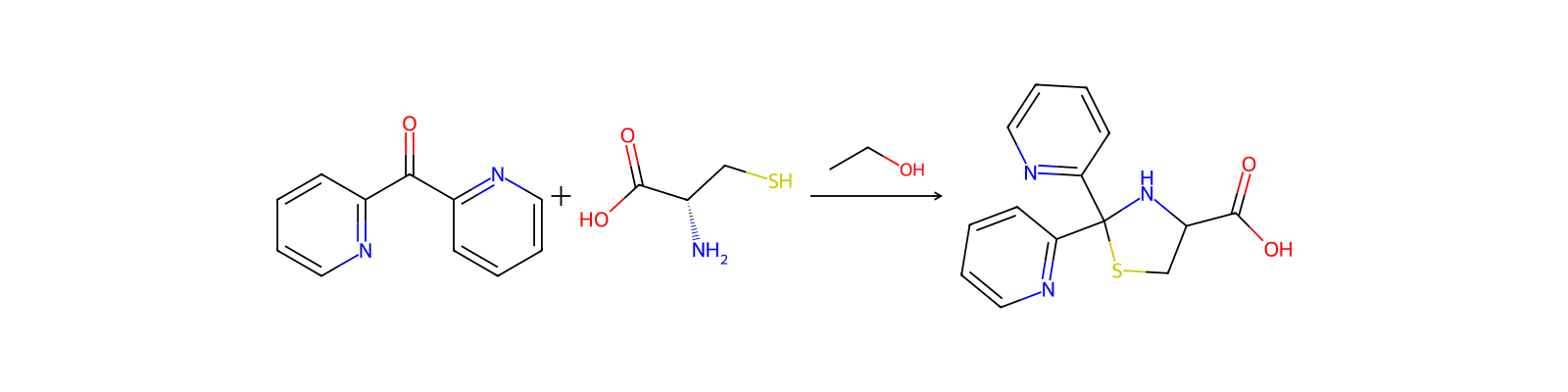
Usesdi-2-Pyridyl ketone has been used in the preparation of unusual {Ni(II)(3)Ln(III)(μ-OR)(6)}(3+) complexes with a "star" topology. Its monoanionic form has been used in the synthesis of triangular Ni(2)M (M = lanthanide, Y) complexes.

Usesdi-2-Pyridyl ketone has been used in the preparation of unusual {Ni(II)(3)Ln(III)(-OR)(6)}(3+) complexes with a "star" topology. Its monoanionic form has been used in the synthesis of triangular Ni(2)M (M = lanthanide, Y) complexes. The Schiff base ligands derived from di-2-pyridyl ketone exhibit ant proliferative activity in SK-N-MC neuroepithelioma (cancer) cells.

Upstream & downstream products

Upstream raw materials

Ammonium hydroxideNitrogen2-BromopyridineTetrahydrofuranDiethyl etherHydrochloric acid2-Cyanopyridinen-Butyllithium

Related reactions

39 records
New reaction record
HRID 80310 reaction equation
HRID 80310As reactant
HRID 129727 reaction equation
HRID 129727As reactant
HRID 178619 reaction equation
HRID 178619As reactant
HRID 378740 reaction equation
HRID 378740As reactant
HRID 378741 reaction equation
HRID 378741As reactant
HRID 378742 reaction equation
HRID 378742As reactant
HRID 378743 reaction equation
HRID 378743As reactant
HRID 378744 reaction equation
HRID 378744As reactant
PreviousPage 1 of 5

Compound notes

On this pageBasic informationNames & identifiersPropertiesSafety & regulationChemistry & industryRelated reactionsCompound notes