
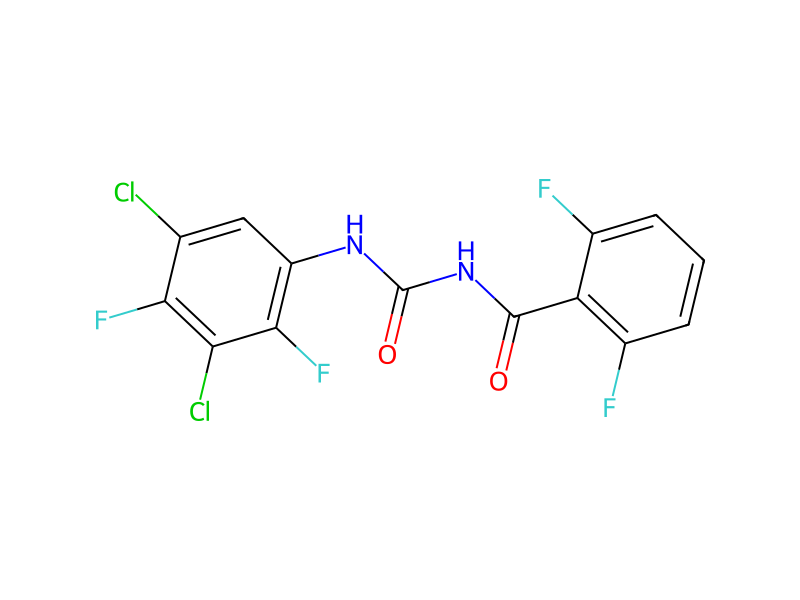
Basic information
- Standard SMILES
O=C(NC(=O)c1c(F)cccc1F)Nc1cc(Cl)c(F)c(Cl)c1F- InChIKey
CJDWRQLODFKPEL-UHFFFAOYSA-N- Molecular formula
- C14H6Cl2F4N2O2
- Average molar mass
- 381.1 g/mol
- Monoisotopic mass
- 379.97424567
Overview
Teflubenzuron is a N-acylurea that is N-carbamoyl-2,6-difluorobenzamide substituted by a 3,5-dichloro-2,4-difluorophenyl group at the terminal nitrogen atom. It has a role as an insecticide, a xenobiotic and an environmental contaminant. It is a dichlorobenzene, a difluorobenzene and a N-acylurea. It is functionally related to a N-benzoylurea.
Names & identifiers
- Preferred name
- Teflubenzuron
- IUPAC
- N-[(3,5-dichloro-2,4-difluorophenyl)carbamoyl]-2,6-difluorobenzamide
- English name
- Teflubenzuron
- Molecular formula
- C14H6Cl2F4N2O2
- Molecular weight
- 381.11
Names & synonyms
Teflubenzuron83121-18-0NomoltN-[(3,5-dichloro-2,4-difluorophenyl)carbamoyl]-2,6-difluorobenzamideDTXSID6042440CME 1341-(3,5-Dichloro-2,4-difluorophenyl)-3-(2,6-difluorobenzoyl)ureaN-(((3,5-Dichloro-2,4-difluorophenyl)amino)carbonyl)-2,6-difluorobenzamideFS9P57VL74CME-134NSC-367306DTXCID4022440
Show more names
dartMK139HOE522NEMOLTcme134diaractcme13406Terfluron
CHEBI:39387N-((3,5-dichloro-2,4-difluorophenyl)carbamoyl)-2,6-difluorobenzamideN-{[(3,5-dichloro-2,4-difluorophenyl)amino]carbonyl}-2,6-difluorobenzamideCME-13406RefChem:187707617-441-5MLS000756919Tefluron
Database identifiers
- CAS
83121-18-0- PubChem CID
- 91734
- DTXSID
DTXSID6042440- ChEMBL
CHEMBL1328219- ChEBI
CHEBI:39387- UNII
- FS9P57VL74
- EC Number
- 617-441-5
- Nikkaji
- J134.962G
Properties
Computed structural properties
- XLogP
- 4.9
- Topological polar surface area
- 58.2 Ų
- Hydrogen bond donors
- 2
- Hydrogen bond acceptors
- 6
- Rotatable bonds
- 2
- Heavy atoms
- 24
- Formal charge
- 0
- Complexity
- 478
Experimental & physicochemical properties
Pesticides
Insecticides
Active substance -> EU Pesticides database: Not approved
Environmental transformation -> Pesticides (parent, predecessor)
Insecticides, Veterinary substances
Pesticide (Teflubenzuron) -> USDA PDB
LogP2.9
Collision Cross Section
178.7 Ų [M-H]- [CCS Type: DT; Buffer gas: N2; Ionization: ESI-; Dataset: TOXCAST; Source Identifier: DTXSID6042440]
171.81 Ų [M+H]+ [CCS Type: TW]
185.79 Ų [M+Na]+
Physicochemical properties
- Melting point
- 221 · 221-224°
- Density
- 1.646 · 1.646±0.06 g/cm3(Predicted)
- vapor pressure
- 8 x · 8 x 10 -7 mPa (20 °C)
- storage temp.
- 0 · 0-6°C
- solubility
- DMSO (Slightly), Methanol (Slightly, Heated, Sonicated)
- Water Solubility
- 0.019 mg · 0.019 mg l-1 (23 °C)
- pka
- 8.16 · 8.16±0.46(Predicted)
- color
- White to Off-White
- Merck
- 13 · 13,9190
- BRN
- 8229925 · 8229925
- Henry's Law Constant
- 6.2 · 6.2×104 mol/(m3Pa) at 25℃, Duchowicz et al. (2020)
- Major Application
- agricultureenvironmental
- InChI
- 1S/C14H6Cl2F4N2O2/c15-5-4-8(12(20)10(16)11(5)19)21-14(24)22-13(23)9-6(17)2-1-3-7(9)18/h1-4H,(H2,21,22,23,24)
- InChIKey
- CJDWRQLODFKPEL-UHFFFAOYSA-N
- SMILES
- Fc1cccc(F)c1C(=O)NC(=O)Nc2cc(Cl)c(F)c(Cl)c2F
- LogP
- 4.98 at · 4.98 at 20℃ and pH4.7
- CAS DataBase Reference
- 83121 · 83121-18-0(CAS DataBase Reference)
- FDA UNII
- 9 P57VL74 · FS9P57VL74
- EPA Substance Registry System
- Teflubenzuron (83121-18-0)
- UNSPSC Code
- 41116107 · 41116107
- NACRES
- 24 · NA.24
- Symbol(GHS)
- 8 · GHS08,GHS09
- Signal word
- Warning
- Hazard statements
- 373 · H373-H410
- Precautionary statements
- 260 · P260-P273-P314-P391-P501
- target organs
- Liver
- PPE
- 95 · Eyeshields, Gloves, type N95 (US)
- RIDADR
- 3077 · 3077
- WGK Germany
- 2 · 2
- RTECS
- 3459590 · CV3459590
- HazardClass
- 9 · 9
- PackingGroup
- III
- Storage Class
- 11 · 11 - Combustible Solids
- Hazard Classifications
- 1 Aquatic · Aquatic Acute 1Aquatic Chronic 1STOT RE 2
- Toxicity
- 50 orally · LD50 orally in rats: >5000 mg/kg (Becher)
- REACH Registrations
- Active
Safety & regulation
GHS classification
GHS Classification
Warning
H400 (100%): Very toxic to aquatic life [Warning Hazardous to the aquatic environment, acute hazard]
P273, P391, and P501 (click each P-code to see the statement)
Aggregated GHS information provided per 108 reports by companies from 3 notifications to the ECHA C&L Inventory. Each notification may be associated with multiple companies.
Danger
H372: Causes damage to organs through prolonged or repeated exposure [Danger Specific target organ toxicity, repeated exposure]
Hazard information
Regulatory Information
Commission Regulation (EC) No 1490/2002
Teflubenzuron is listed in the dataset of EPA Human Health Benchmarks for Pesticides under the Safe Drinking Water Act (40 eCFR 141)
2009/37, Reg. (EU) 2022/801, Reg. (EU) No 540/2011
Status: Active Update: 06-12-2022 https://echa.europa.eu/registration-dossier/-/registered-dossier/32806
Hazard Classes and Categories
Aquatic Acute 1 (100%)
Specific target organ toxicity - Repeated exposure - Category 1 (liver)
Toxicology
RAIS Toxicity Values
0.021
OPP
EPA Human Health Benchmarks for Pesticides
Teflubenzuron
0.021
120
General Population
Human Health Benchmarks for Pesticides - 2021 Update
Safety data
- PPE
- Eyeshields, Gloves, type N95 (US)
- wgk
- 2
- rtecs
- CV3459590
- ridadr
- 3077
- Toxicity
- LD50 orally in rats: >5000 mg/kg (Becher)
- Signal word
- Warning
- Symbol(GHS)
- GHS08,GHS09
- hazard_class
- 9
- Storage Class
- 11 - Combustible Solids
- packing_group
- III
- target organs
- Liver
- Hazard statements
- H373-H410
- REACH Registrations
- Active
- Hazard Classifications
- Aquatic Acute 1Aquatic Chronic 1STOT RE 2
- Precautionary statements
- P260-P273-P314-P391-P501
Chemistry & industry
Pharmacology
ATC CodeQP - Antiparasitic products, insecticides and repellents
Uses & manufacturing
Use Classification
Veterinary Drug -> INSECTICIDE; Veterinary Drug -> -> JECFA Functional Classes
Insecticides, Veterinary substances
Environmental transformation -> Pesticides (parent, predecessor)
Applications
UsesTeflubenzuron’s a fluorobenzoylurea insect growth regulator and a chitinase inhibitor. It achieves the insecticidal purpose through the inhibition of normal molting and development of larvae. It has a particularly high activity on lepidoptera pests, also achieves a good effect when it comes to the larvae of whitefly families, diptera, hymenoptera, coleoptera pests, but it’s invalid for many parasitic insects, predatory insects and spiders. It is mainly used on vegetables, fruit trees, cotton and teabush. E.g. 2000~4000 times diluent of EC can be applied by spraying to larvae of cabbage caterpillar and plutella xylostella in the egg incubation period to 1 to 2 instar.1500~3000 times diluent of EC can be applied by spraying to larvae of plutella xylostella, asparagus caterpillar, prodenia litura in the egg incubation period to 1 to 2 instar, which are resistant to organic phosphorus and pyrethroids. 1500~2000 times diluent of EC can be applied by spraying to cotton bollworm and pink worm in the egg incubation period of the second and third generations, and the elimination rate is about 85% after 10 days.
UsesTeflubenzuron is used for the control of Lepidoptera, Coleoptera, Diptera, Aleyrodidae, Hymenoptera, Psyllidae and Hemiptera larvae on vines, pome fruit, citrus, vegetables, soyabeans, tobacco and cotton. It also controls fly and mosquito larvae and immature stages of locusts.
UsesTeflubenzuron is an benzoylphenylurea chitin synthesis inhibitor used to control a wide range of insect pests and mites in fruit, vegetable, cereal and seed crops.
UsesuSE: Insecticide.
Preparation methods
Production MethodMethod 1 The addition reaction of 2,6-Difluorobenzamide and 2,4-difluoro-3,5-dichlorophenyl isocyanate Method 2 preparation of 2,4-Difluoro-3,5-dichlorophenylamine 2,3,4,5-tetrachloronitrobenzene and Potassium fluoride react in DMF solvent at 140℃ for 15h to obtain 2,4-Difluoro-3,5-dichloronitrobenzene,which is then reduced to 2,4-Difluoro-3,5-dichlorophenylamine Preparation of Teflubenzuron As for the preparation of 2,6-difluorobenzoyl isocyanate, see details in the preparation of Teflubenzuron. 2,6-difluorobenzoyl isocyanate and 2,4-Difluoro-3,5-dichlorophenylamine react at room temperature for 15h to obtain Teflubenzuron As for the nitrification, chlorination, reduction, fluorization and condensation of 1,2,4-Trichlorobenzene to prepare Teflubenzuron, see details in bibliography.
Upstream & downstream products
Upstream raw materials
Suppliers50 total
湖北永阔科技有限公司027-59223108 15972152991 · [email protected]
湖北博杰生物科技有限公司0713-2060728 15629612610
上海阿拉丁生化科技股份有限公司400-6206333 13167063860 · [email protected]
Shandong chuangyingchemical Co., Ltd.18853181302 · [email protected]
湖北威德利化学试剂有限公司181-6332-1995 18062128043 · [email protected]
武汉鹏垒生物科技有限公司15871464247 · [email protected]
杭州品高化工有限公司0571-87658025 · [email protected]
Dayang Chem (Hangzhou) Co.,Ltd.+86-0571-88938639 17705817739 · [email protected]
Syntechem Co.,Ltd[email protected]
上海颖心实验室设备有限公司021-59178156 17002132182 · [email protected]
安耐吉化学&3A(安徽泽升科技有限公司)021-58432009 400-005-6266 · [email protected]
梯希爱(上海)化工贸易有限公司021-61109150 · [email protected]
湖北长耀生物科技有限公司17683887209 17683887209 · [email protected]
湖北魏氏化学试剂股份有限公司027-59102966 18717199209 · [email protected]
上海柯维化学技术有限公司021-64609169 18901607656 · [email protected]
广东方信生物科技有限公司0751-2838688 13376594225 · [email protected]
上海相辉医药科技有限公司13761987713; 13761987713 · [email protected]
上海艾梯西生物科技有限公司18721763493
湖北广奥生物科技有限公司027-02702759223056 18162699093 · [email protected]
上海毕楷科技有限公司18516304666
四川库利南科技有限公司400-1166-196 18981987031 · [email protected]
武汉华邦化学新材料有限公司027-83229541 13971313286 · [email protected]
广东元丰化学试剂有限公司0751-2829979 13376591640 · [email protected]
艾科试剂4008-755-333 18080918076 · [email protected]
成都思天德生物科技有限公司028-83243028 19136088901 · [email protected]
深圳振强药物研发有限公司0755-66853366 13670046396 · [email protected]
武汉普洛夫生物科技有限公司17612776928 · [email protected]
南京生利德生物科技有限公司025-57798810 18652991625 · [email protected]
上海丽康新材料有限公司+86-16631818819 +86-17736933208 · [email protected]
上海将来实业股份有限公司400-0066400 13621662912 · [email protected]
天津阿尔塔科技有限公司022-65378550-8551 · [email protected]
常州翔龙医药科技有限公司18915873328 18915873328 · [email protected]
陕西缔都医药化工有限公司029-81024372 17792795018 · [email protected]
湖北巨胜科技有限公司027-59599241 18871490274 · [email protected]
池州凯隆进出口贸易有限公司[email protected]
天津荣燊化工有限公司18317763565; 18317763565 · [email protected]
天津阿尔塔科技有限公司022-6537-8550 15522853686 · [email protected]
Henan Alfa Chemical Co., Ltd+8618339805032 · [email protected]
常州安奈凯医药科技有限公司+86-0519-8359-8696 · [email protected]
武汉鑫儒化工有限公司15927387915 15337108568
泰安嘉岳生物化工有限公司15318151873 · [email protected]
安阳鸿蒙新材料有限公司19588588067 · [email protected]
艾吉析科技(上海)有限公司17721401538;17717235263 17721401538 · [email protected]
上海玖巨化工科技有限公司021-54290889 18117093889;17717355955 · [email protected]
上海源叶生物科技有限公司13636370518 · [email protected]
上海西格生物科技有限公司021-57810052 18930344717 · [email protected]
湖北威德利化学试剂有限公司13429867250 13429867250
南京罗迈美生物科技有限公司[email protected]
武汉曙欧科技有限公司17792809151;18872220797 · [email protected]
湖北扬信医药科技有限公司15374522761 · [email protected]
Additional notes
DefinitionChEBI: Teflubenzuron is a N-acylurea that is N-carbamoyl-2,6-difluorobenzamide substituted by a 3,5-dichloro-2,4-difluorophenyl group at the terminal nitrogen atom. It has a role as a xenobiotic, an environmental contaminant and an insecticide. It is a dichlorobenzene, a N-acylurea and a difluorobenzene. It is functionally related to a N-benzoylurea.
Related reactions
4 records


Linked notes
Loading…