HomeMCPWorkbenchSkills
HomeWorkbenchNotificationsMe
llms.txt · MCP GuidePrivacy Policy · Terms of Service · Supportv1.8.3
  1. Home
  2. /Compound

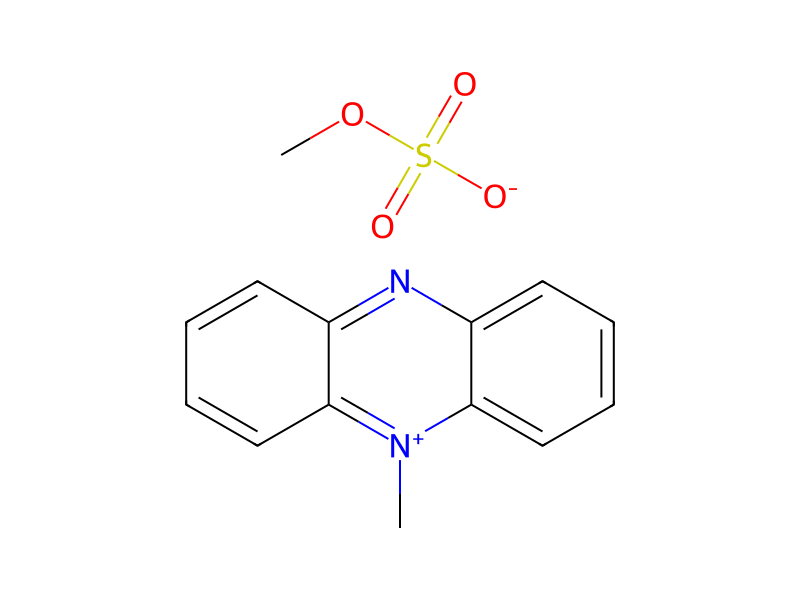
Phenazine Methosulfate

HCID 9285
New reaction
Print
Basic informationOverviewNames & identifiersPropertiesSafety & regulationChemistry & industryRelated reactionsCompound notes
Substructure searchFind similar structures

Basic information

CAS
299-11-6
Standard SMILES
COS(=O)(=O)[O-].C[n+]1c2ccccc2nc2ccccc21
InChIKey
RXGJTUSBYWCRBK-UHFFFAOYSA-M
Molecular formula
C14H14N2O4S
Average molar mass
306.34 g/mol
Monoisotopic mass
306.06742811

Overview

5-methylphenazinium methyl sulfate is an azaheterocycle sulfate salt and a member of phenazines.

Names & identifiers

Preferred name
Phenazine Methosulfate
IUPAC
5-methylphenazin-5-ium;methyl sulfate
English name
Phenazine methosulfate
Molecular formula
C14H14N2O4S
Molecular weight
306.34

Names & synonyms

Phenazine methosulfate299-11-65-Methylphenazinium methyl sulfateN-Methylphenazonium methosulfatePhenazine methosulphateMethylphenazonium methosulfate5-Methylphenazine methylsulfateN-Methylphenazinium methosulfatePMS (pharmaceutical)N-Methylphenazonium methosulphatePhenazinium, 5-methyl-, methyl sulfate5-Methyl phenazine, methyl sulfate salt
Show more names
PMSPHENAZINE METHYL SULFATEPhenazine methosuL5-MethylphenaziniumPhenazine methosulfaPhezine methosulfatePhenazine MethoshlphatePHENAZINE METHOLSULPHATE
J3GYQ3401YDTXSID1059783NSC-34661CHEBI:8055Methosulfate, PhenazineMethosulfate, Methylphenazonium5 Methylphenazinium Methyl SulfateMethyl Sulfate, 5-Methylphenazinium

Database identifiers

CAS
299-11-6
PubChem CID
9285
DTXSID
DTXSID1059783
ChEBI
CHEBI:8055
UNII
J3GYQ3401Y
EC Number
206-072-1

Properties

Computed structural properties

Topological polar surface area
91.6 Ų
Hydrogen bond donors
0
Hydrogen bond acceptors
5
Rotatable bonds
0
Heavy atoms
21
Formal charge
0
Complexity
297

Experimental & physicochemical properties

Chemical ClassesNitrogen Compounds -> Other Aromatics (Nitrogen)
Physical DescriptionYellow to brown solid; [Merck Index] Yellow crystalline solid; [Sigma-Aldrich MSDS]

Physicochemical properties

Melting point
158 · 158-160 °C (dec.)(lit.)
Density
1.3395 · 1.3395 (rough estimate)
refractive index
1.693 · 1.6930 (estimate)
storage temp.
-20 °C · -20°C
solubility
2 O: · H2O: 0.2 g/mL at 20 °C, clear, deep orange
form
Crystalline Powder
color
Dark yellow to brown or khaki
Water Solubility
soluble in water (approximately 200 mg/ml).
Sensitive
Light Sensitive
Merck
14 · 14,6109
BRN
3898869 · 3898869
Stability
Stable. Incompatible with strong oxidizing agents.
InChI
InChI=1S/C13H11N2.CH4O4S/c1-15-12-8-4-2-6-10(12)14-11-7-3-5-9-13(11)15;1-5-6(2,3)4/h2-9H,1H3;1H3,(H,2,3,4)/q+1;/p-1
InChIKey
RXGJTUSBYWCRBK-UHFFFAOYSA-M
SMILES
C12C=CC=CC1=NC1=CC=CC=C1[N+]=2C.S([O-])(=O)(=O)OC
CAS DataBase Reference
299 · 299-11-6(CAS DataBase Reference)
FDA UNII
3 GYQ3401Y · J3GYQ3401Y
EPA Substance Registry System
5 · Phenazinium, 5-methyl-, methyl sulfate (299-11-6)
UNSPSC Code
12352200 · 12352200
NACRES
77 · NA.77
Symbol(GHS)
7 · GHS07
Signal word
Warning
Hazard statements
315 · H315-H319-H335
Precautionary statements
261 · P261-P280a-P304+P340-P305+P351+P338-P405-P501a
PPE
95 · dust mask type N95 (US), Eyeshields, Gloves
Hazard Codes
Xi,Xn,T
Risk Statements
36 · 36/37/38-68-46
Safety Statements
26 · 26-36/37/39-53-45
RIDADR
2811 · 2811
WGK Germany
3 · 3
RTECS
1645000 · SG1645000
F
8 · 8
TSCA
TSCA listed
HS Code
2933990099 · 2933990099
Storage Class
11 · 11 - Combustible Solids

Safety & regulation

Safety information is for reference only and does not replace the supplier’s Safety Data Sheet (SDS), applicable regulations, or professional assessment.

GHS classification

GHS Classification · 4 items

Warning

H315 (100%): Causes skin irritation [Warning Skin corrosion/irritation]

P261, P264, P264+P265, P271, P280, P302+P352, P304+P340, P305+P351+P338, P319, P321, P332+P317, P337+P317, P362+P364, P403+P233, P405, and P501 (click each P-code to see the statement)

Aggregated GHS information provided per 47 reports by companies from 8 notifications to the ECHA C&L Inventory. Each notification may be associated with multiple companies.

Hazard information

Regulatory InformationPhenazinium, 5-methyl-, methyl sulfate: Does not have an individual approval but may be used under an appropriate group standard
Hazards SummaryA moderate irritant; [Sigma-Aldrich MSDS]
Hazard Classes and CategoriesSkin Irrit. 2 (100%)

Safety data

F
8
PPE
dust mask type N95 (US), Eyeshields, Gloves
wgk
3
tsca
TSCA listed
rtecs
SG1645000
ridadr
2811
hs_code
2933990099
risk_code
36/37/38-68-46
Signal word
Warning
Symbol(GHS)
GHS07
hazard_code
Xi,Xn,T
safety_code
26-36/37/39-53-45
Storage Class
11 - Combustible Solids
Hazard statements
H315-H319-H335
Precautionary statements
P261-P280a-P304+P340-P305+P351+P338-P405-P501a

Chemistry & industry

Uses & manufacturing

UsesUsed as an electron carrier and to make succinic dehydrogenase; [Merck Index]
General Manufacturing InformationPhenazinium, 5-methyl-, methyl sulfate (1:1): INACTIVE
Applications · 3 items

DescriptionPhenazine is a free radical generator. It has been used as an electron transfer reactant in cell viability assays. Phenazine (10 μM) induces ssDNA break formation in the presence of the reducing agent NADPH in a cell-free plasmid cleavage assay when used at a concentration of 10 μM. It induces oxidative DNA damage in an alkaline comet assay and apoptosis in A375 melanoma cells when used at a concentration of 10 μM. Phenazine (20 nM) oxidizes cysteine-containing proteins in HepG2 cells.

UsesPhenazine Methosulfate is used in tyrosine transaminase test and for enzymic determination of ethanol in blood by the colorimetric micromethod. Used with ascorbic acid to determine nitric oxide reductase activity. Since the reduced PMS is easily oxidized by oxygen, it is used in assays as an electron carrier between enzymes and oxygen, cytochrome c, indophenols, or tetrazolium salts. The reduced PMS is used as an electron donor to reduce cytochrome c or in photosynthetic experiments. Usage of PMS for detection of specific dehydrogenases has been reported.

General DescriptionPhenazines are heterocyclic compounds produced as secondary metabolites by bacteria.

Upstream & downstream products

Upstream raw materials

2-NitrotoluenePhenazineTolueneDiethyl etherDimethyl sulfatePhenazine, 5,10-dihydro-5,10-bis(phenylmethyl)-Phenazine, 5,10-dihydro-5-methyl-10-(phenylmethyl)-5,10-dihydro-5-methylphenazine2-Nitrodiphenylamine5,10-Dihydro-phenazine5,10-DimethyldihydrophenazineAniline2-NitrochlorobenzeneCatecholo-Phenylenediamine1-Fluoro-2-nitrobenzene
Additional notes · 1 item

DefinitionChEBI: 5-methylphenazinium methyl sulfate is an azaheterocycle sulfate salt and a member of phenazines. It is used as an electron carrier in place of the flavine enzyme of Warburg in the hexosemonophosphate system and also in the preparation of succinic dehydrogenase. Green et al., J. Biol. Chem. 217, 551 (1955).

Related reactions

6 records
New reaction record
HRID 279726 reaction equation
HRID 279726As product
HRID 637007 reaction equation
HRID 637007As product
HRID 850265 reaction equation
HRID 850265As reactant
HRID 1955507 reaction equation
HRID 1955507As reactant
HRID 2073158 reaction equation
HRID 2073158As reactant
HRID 2073159 reaction equation
HRID 2073159As solvent

Compound notes

On this pageBasic informationOverviewNames & identifiersPropertiesSafety & regulationChemistry & industryRelated reactionsCompound notes