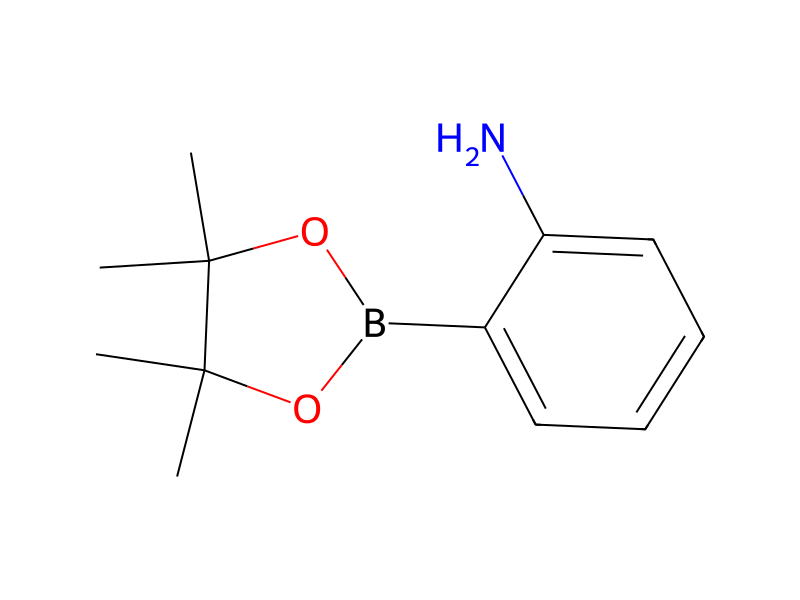
Br[C:2]1[NH:3][C:4]2[C:9]([C:10]=1[CH:11]1[CH2:16][CH2:15][CH2:14][CH2:13][CH2:12]1)=[CH:8][CH:7]=[C:6]([C:17]([O:19][CH3:20])=[O:18])[CH:5]=2.CC1(C)C(C)(C)OB([C:29]2[CH:34]=[CH:33][CH:32]=[CH:31][C:30]=2[NH2:35])O1.C(=O)([O-])O.[Na+]>COCCOC.O.C1C=CC([P]([Pd]([P](C2C=CC=CC=2)(C2C=CC=CC=2)C2C=CC=CC=2)([P](C2C=CC=CC=2)(C2C=CC=CC=2)C2C=CC=CC=2)[P](C2C=CC=CC=2)(C2C=CC=CC=2)C2C=CC=CC=2)(C2C=CC=CC=2)C2C=CC=CC=2)=CC=1>[NH2:35][C:30]1[CH:31]=[CH:32][CH:33]=[CH:34][C:29]=1[C:2]1[NH:3][C:4]2[C:9]([C:10]=1[CH:11]1[CH2:16][CH2:15][CH2:14][CH2:13][CH2:12]1)=[CH:8][CH:7]=[C:6]([C:17]([O:19][CH3:20])=[O:18])[CH:5]=2To a suspension of methyl 2-bromo-3-cyclohexyl-1H-indole-6-carboxylate (6.50 g, 19.3 mmol) obtained in the same manner as in the method described in WO03/010140 and 2-(4,4,5,5-tetramethyl-1,3,2-dioxaborolan-2-yl)phenylamine (5.08 g, 23.2 mmol) in 1,2-dimethoxyethane (90 ml) and water (45 ml) were added sodium hydrogen carbonate (4.81 g, 57.9 mmol) and tetrakis(triphenylphosphine)palladium (1.12 mg, 0.965 mmol), and the mixture was heated under reflux for 9 hr. The mixture was allowed to cool to room temperature, and water was added to the reaction mixture. The mixture was extracted with ethyl acetate and the organic layer was washed successively with saturated aqueous sodium hydrogen carbonate solution and saturated brine and dried over anhydrous magnesium sulfate. After filtration, the solvent was evaporated under reduced pressure. The residue was purified by silica gel chromatography (hexane:ethyl acetate=4:1-3:1) to give methyl 2-(2-aminophenyl)-3-cyclohexyl-1H-indole-6-carboxylate (6.48 g, yield 96%).