Reaction equation

[CH3:1][N:2]([CH3:8])[C:3](=O)[N:4]([CH3:6])[CH3:5].C(Cl)(=O)C(Cl)=O.[CH2:15]([NH2:19])[CH2:16][CH2:17][CH3:18]>ClC(Cl)C>[CH3:1][N:2]([CH3:8])[C:3]([N:4]([CH3:6])[CH3:5])=[N:19][CH2:15][CH2:16][CH2:17][CH3:18]Participants
Reactant 3

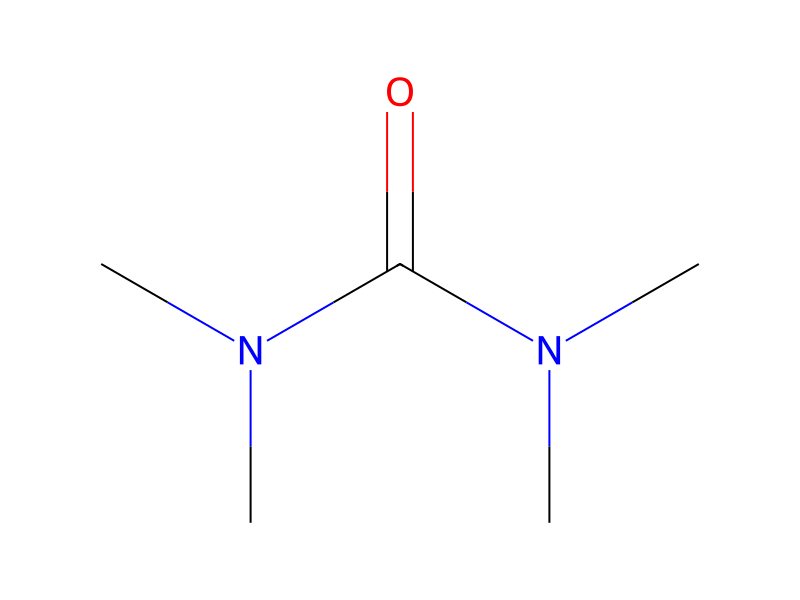

Product 1

Reagents, catalysts & solvents 1

Conditions
- Temperature
- 70 °C
Procedure
N,N,N′,N′-tetramethyl-N″-butylguanidine was prepared as follows: 9.3 g tetramethyl urea was added to 80 mL dry dichloroethane in a two-neck 250 mL round-bottom-flask. 11.3 mL oxalyl chloride was added and the solution was heated at 70° C. for two hours. The solvent was evaporated in vacuo after the solution cooled to room temperature. Residual solid was then dissolved in dry acetonitrile and cooled to 0° C. 15 mL butyl amine (1.02 eq) was slowly added. The solution was slowly warmed and allowed to reflux for one hour. Finally, the mixture was cooled to room temperature and the solvent was removed in vacuo to yield 9 g of a clear oil. 1H (CDCl3): δ (ppm): 2.99 (t, 2H); 2.62 (s, 3H); 2.53 (s, 3H); 1.39 (quintet, 2H); 1.24 (quintet, 2H); 0.78 (t, 3H). The synthesis was performed several times and the yield ranged from 37%-70%.
Workup
- customThe solvent was evaporated in vacuo after the solution
- temperaturecooled to room temperature
- dissolutionResidual solid was then dissolved in dry acetonitrile
- temperaturecooled to 0° C
- temperatureThe solution was slowly warmed
- temperatureto reflux for one hour
- temperatureFinally, the mixture was cooled to room temperature
- customthe solvent was removed in vacuo
Sources & evidence
- ORD record
- ord-ed7d99adbcfb4e95a443846a6fc3f023
- Source dataset
- uspto-grants-2011_07
- Patent number
- US07982069B2
Linked notes
Loading…