Reaction equation
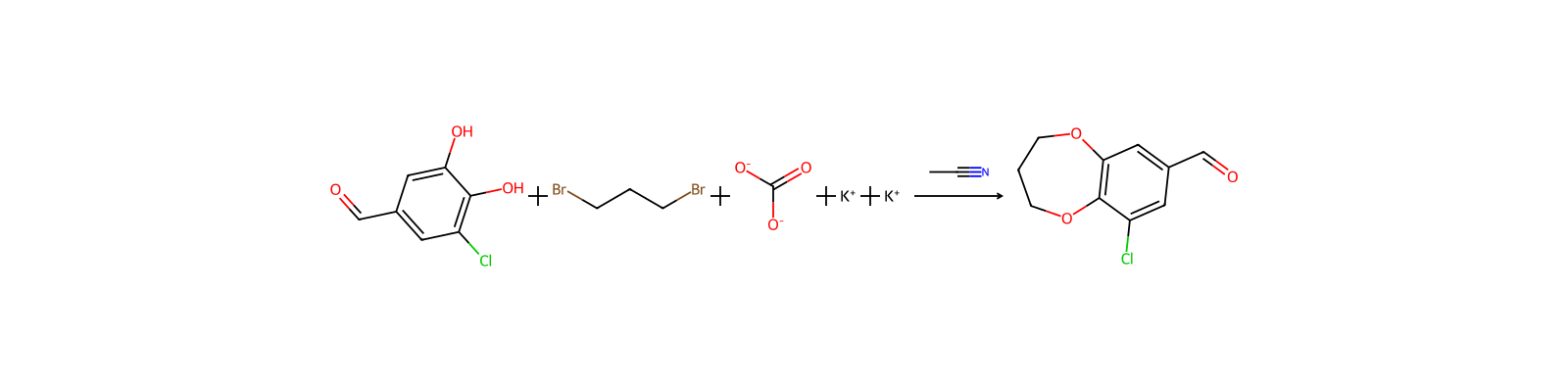
[Cl:1][C:2]1[CH:3]=[C:4]([CH:7]=[C:8]([OH:11])[C:9]=1[OH:10])[CH:5]=[O:6].Br[CH2:13][CH2:14][CH2:15]Br.C(=O)([O-])[O-].[K+].[K+]>C(#N)C>[Cl:1][C:2]1[C:9]2[O:10][CH2:13][CH2:14][CH2:15][O:11][C:8]=2[CH:7]=[C:4]([CH:5]=[O:6])[CH:3]=1Participants
5
Reactant 3



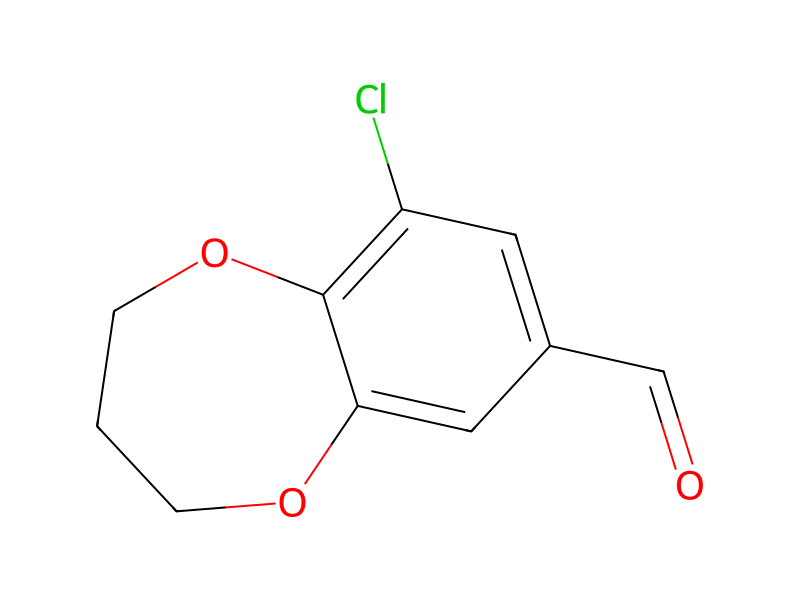
Product 1
Reagents, catalysts & solvents 1

Procedure
A mixture of 3-chloro-4,5-dihydroxy benzaldehyde (4.15 g), of 1,3-dibromopropane (4.71 g, 0.92 eq.) and potassium carbonate (8.28 g, 2.5 eq.) in acetonitrile (160 ml) was heated to 60° C. overnight. The mixture was allowed to cool to room temperature and filtered. The filtrate was concentrated under reduced pressure. The residue was purified by flash chromatography on silica (20% ethyl acetate in hexanes) to give the product as a white crystal. MS (m+1)=212.1
Workup
- filtrationfiltered
- concentrationThe filtrate was concentrated under reduced pressure
- customThe residue was purified by flash chromatography on silica (20% ethyl acetate in hexanes)
Sources & evidence
- ORD record
- ord-5ea4580f0c9f4e5a95641458ceba33f3
- Source dataset
- uspto-grants-2014_05
- Patent number
- US08722896B2
Linked notes
Loading…