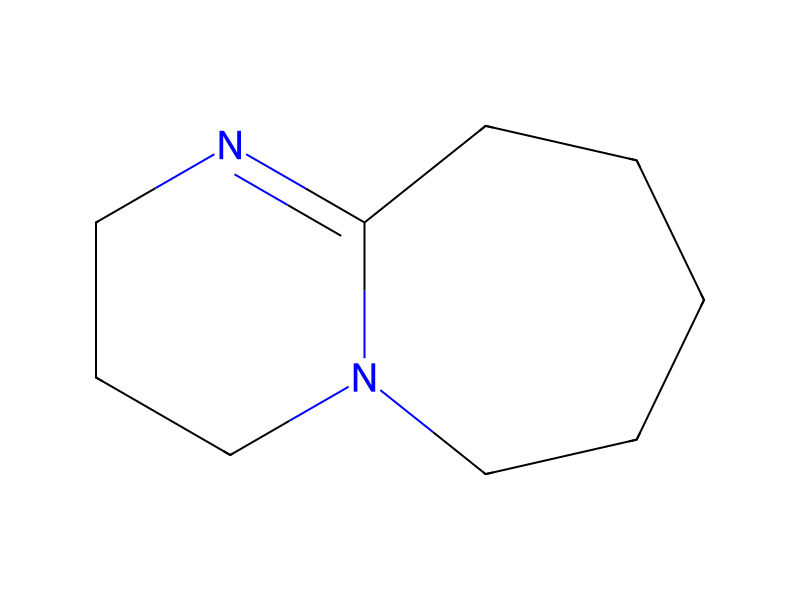
Cl[CH:2]1[C:10]2[C:5](=[CH:6][CH:7]=[CH:8][CH:9]=2)[C:4](=[O:11])[N:3]1[C:12]1[CH:21]=[CH:20][C:19]2[C:14](=[N:15][C:16]([Cl:22])=[CH:17][CH:18]=2)[N:13]=1.[O:23]=[C:24]1[CH2:29][CH2:28][CH2:27][CH2:26][N:25]1[CH2:30][CH2:31][C:32]([OH:34])=[O:33].N12CCCN=C1CCCCC2.O>CN(C)C=O>[O:23]=[C:24]1[CH2:29][CH2:28][CH2:27][CH2:26][N:25]1[CH2:30][CH2:31][C:32]([O:34][CH:2]1[C:10]2[C:5](=[CH:6][CH:7]=[CH:8][CH:9]=2)[C:4](=[O:11])[N:3]1[C:12]1[CH:21]=[CH:20][C:19]2[C:14](=[N:15][C:16]([Cl:22])=[CH:17][CH:18]=2)[N:13]=1)=[O:33]The procedure is as in Example 1, but starting with 3-chloro-2-(7-chloro-1,8-naphthyridin-2-yl)-1-isoindolinone (4,3 g) in anhydrous dimethylformamide (40 cc), 3-(2-oxopiperidino)propionic acid (2.2 g) and 1,8-diazabicyclo [5.4.0]undec-7-ene (2 g). After the reaction mixture has been taken up with water, the resulting mixture extracted with methylene chloride and the solvent evaporated, the residue obtained is recrystallized in acetonitrile. The product thereby obtained is purified by chromatography on silica (0.063-0.2 mm; 100 g) contained in a column 2.3 cm in diameter (eluant: methylene chloride), collecting 50-cc fractions. Fractions 56 to 64 are combined and concentrated to dryness under reduced pressure (2.7 kPa) at 20° C. The residue obtained is recrystallized in acetonitrile. 2-(7-Chloro-1,8-naphthridin-2-yl)-3-oxo-1-isoindolinyl 3-(2-oxopiperidino)propionate (2.8 g), m.p. 175° C., is thereby obtained.