Reaction equation

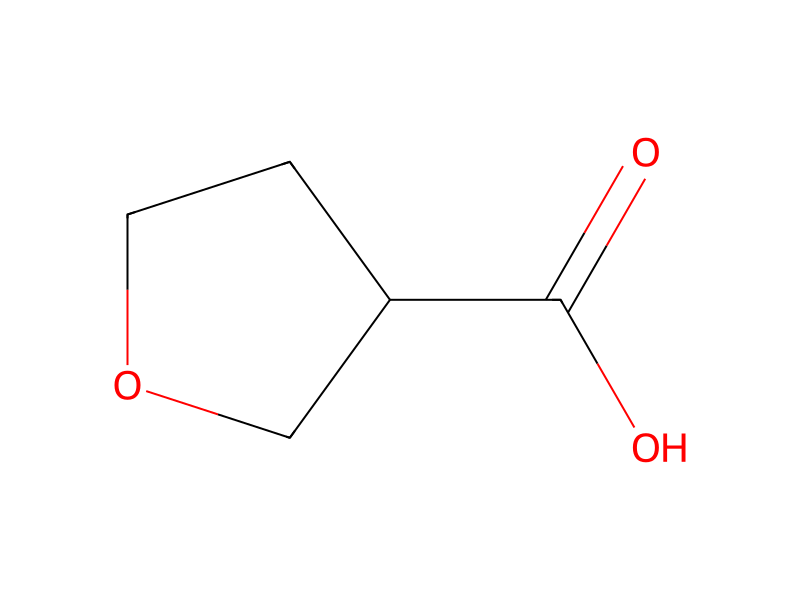
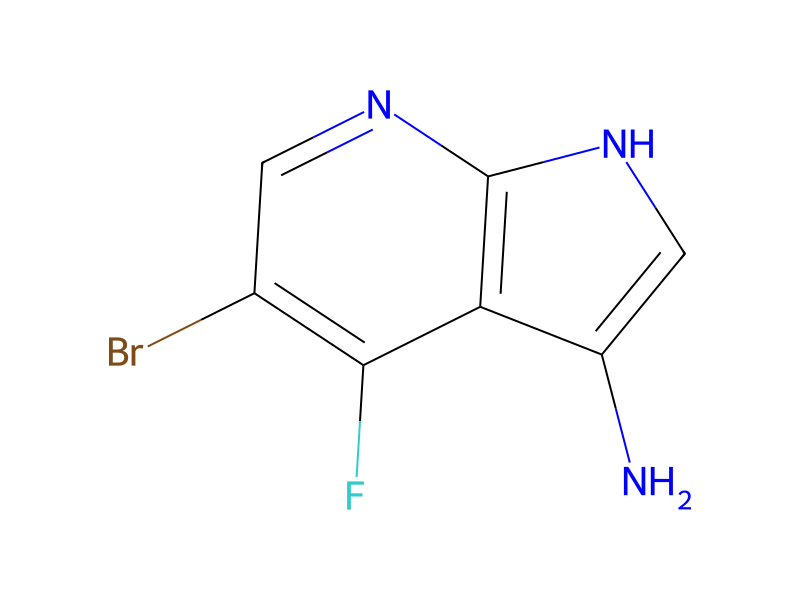
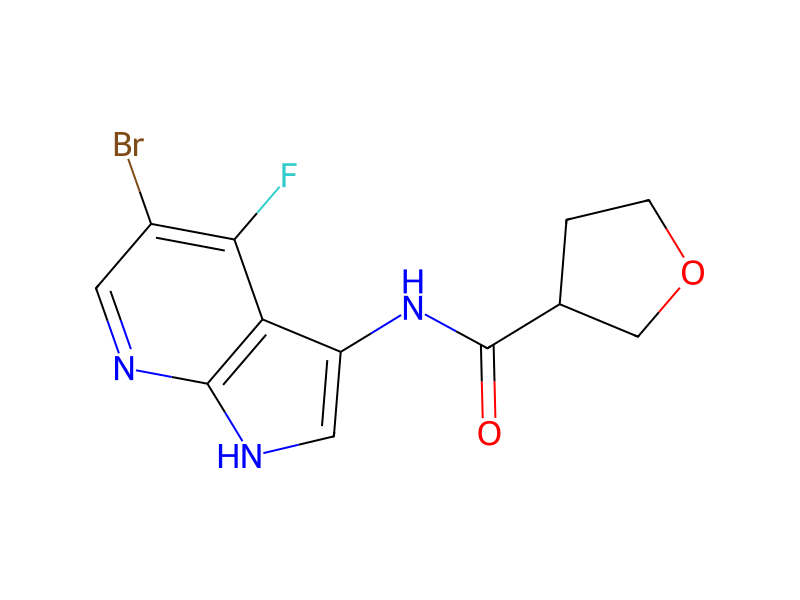
[Br:1][C:2]1[C:3]([F:12])=[C:4]2[C:10]([NH2:11])=[CH:9][NH:8][C:5]2=[N:6][CH:7]=1.[O:13]1[CH2:17][CH2:16][CH:15]([C:18](O)=[O:19])[CH2:14]1.C(N(CC)CC)C.C1N(P(Cl)(N2C(=O)OCC2)=O)C(=O)OC1.O.[OH-].[Li+]>C(Cl)Cl.O>[Br:1][C:2]1[C:3]([F:12])=[C:4]2[C:10]([NH:11][C:18]([CH:15]3[CH2:16][CH2:17][O:13][CH2:14]3)=[O:19])=[CH:9][NH:8][C:5]2=[N:6][CH:7]=1Participants
Reactant 5



Product 1
Reagents, catalysts & solvents 2


Procedure
A mixture of 5-bromo-4-fluoro-1H-pyrrolo[2,3-b]pyridin-3-amine (200 mg, 0.869 mmol, Example 1, Step H), tetrahydrofuran-3-carboxylic acid (202 mg, 1.74 mmol) and triethylamine (606 μL, 4.35 mmol) in CH2Cl2 (10 mL) at room temperature was treated with BOP—Cl (162 mg, 1.74 mmol). The mixture was stirred for 60 minutes, and the solvent was removed in vacuo. The resulting residue was dissolved in THF (10 mL) and treated with lithium hydroxide hydrate (109 mg, 2.61 mmol) in water (1 mL). After 30 minutes, the mixture was concentrated in vacuo, and water (5 mL) was added to the residue. The solid formed was filtered, washed with additional water and dried to provide N-(5-bromo-4-fluoro-1H-pyrrolo[2,3-b]pyridin-3-yl)tetrahydrofuran-3-carboxamide (210 mg, 74% yield) as a solid. 1H NMR (400 MHz, (CD3)2SO) δ 12.07 (br s, 1H), 9.65 (s, 1H), 8.35 (d, 1H), 7.59 (s, 1H), 3.95 (t, 1H), 3.81-3.68 (m, 3H), 3.26-3.18 (m, 1H), 2.11-2.05 (m, 2H); LCMS (APCI+) m/z 327.9, 329.9 (M+H)+, Retention time=2.44 min (Method 2).
Workup
- customthe solvent was removed in vacuo
- dissolutionThe resulting residue was dissolved in THF (10 mL)
- waitAfter 30 minutes
- concentrationthe mixture was concentrated in vacuo, and water (5 mL)
- additionwas added to the residue
- customThe solid formed
- filtrationwas filtered
- washwashed with additional water
- customdried
Sources & evidence
- ORD record
- ord-ccee8ec80c9941a3bb76f3bfc7d017c3
- Source dataset
- uspto-grants-2013_10
- Patent number
- US08545897B2
Linked notes
Loading…