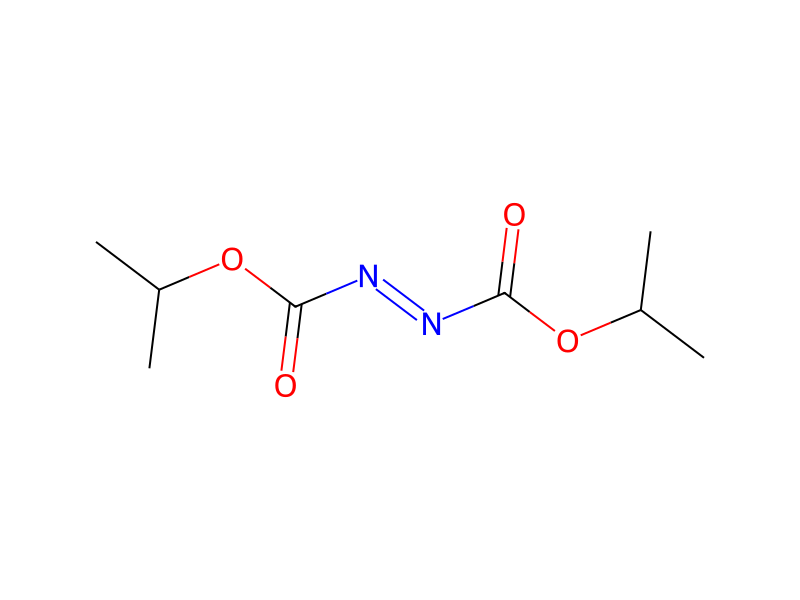
[OH:1][C@@H:2]1[CH2:7][CH2:6][C@H:5]([C:8]([O:10][CH3:11])=[O:9])[CH2:4][CH2:3]1.O[C:13]1[CH:25]=[CH:24][C:16]([C:17]([O:19][C:20]([CH3:23])([CH3:22])[CH3:21])=[O:18])=[CH:15][CH:14]=1.C1(P(C2C=CC=CC=2)C2C=CC=CC=2)C=CC=CC=1.N(C(OC(C)C)=O)=NC(OC(C)C)=O>O1CCCC1>[CH3:11][O:10][C:8]([C@H:5]1[CH2:4][CH2:3][C@H:2]([O:1][C:13]2[CH:25]=[CH:24][C:16]([C:17]([O:19][C:20]([CH3:21])([CH3:22])[CH3:23])=[O:18])=[CH:15][CH:14]=2)[CH2:7][CH2:6]1)=[O:9]2.20 g of methyl cis-4-hydroxycyclohexanecarboxylate (13.88 mmol, 1 eq.), 2.70 g of tert-butyl 4-hydroxybenzoate (13.88 mmol, 1 eq.) and 5.46 g of triphenylphosphine (20.82 mmol, 1.5 eq.) are placed in 30 mL of tetrahydrofuran at room temperature. 4.04 mL of diisopropyl azodicarboxylate (20.82 mmol, 1.5 eq.) are added dropwise to the reaction medium with stirring. After 3 hours at room temperature, the medium is concentrated to dryness and taken up in diethyl ether. The triphenylphosphine oxide is filtered off. The organic phase is washed successively with sodium hydroxide solution and then with water, dried over sodium sulfate, filtered and evaporated to give a residue. This residue is chromatographed on silica gel, eluting with a gradient of ethyl acetate in heptane ranging from 10% to 50%. 1.6 g of tert-butyl trans-4-(4-methoxycarbonylcyclohexyloxy)benzoate are obtained.