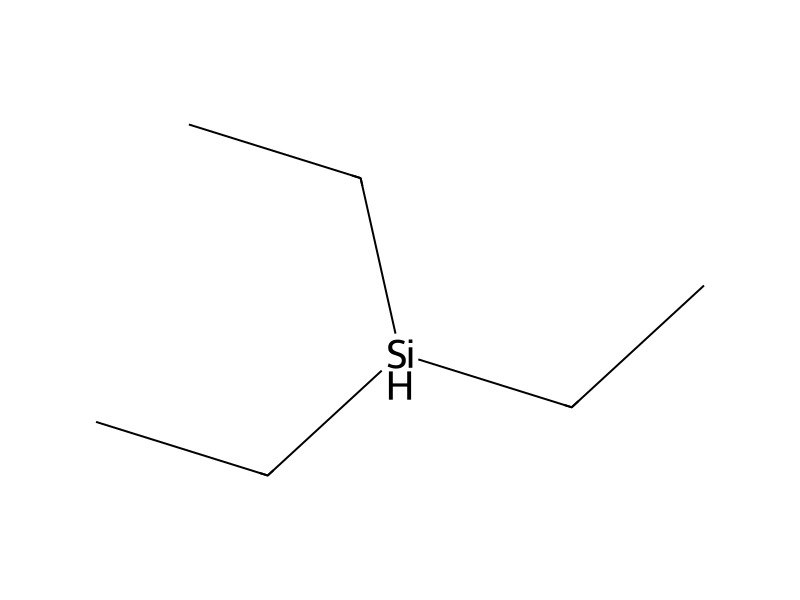
[CH3:1][O:2][C:3]1[CH:24]=[CH:23][C:6]2[C:7](=O)[CH2:8][N:9]([S:12]([C:15]3[CH:20]=[CH:19][C:18]([CH3:21])=[CH:17][CH:16]=3)(=[O:14])=[O:13])[CH2:10][CH2:11][C:5]=2[CH:4]=1.C([SiH](CC)CC)C>FC(F)(F)C(O)=O>[CH3:1][O:2][C:3]1[CH:24]=[CH:23][C:6]2[CH2:7][CH2:8][N:9]([S:12]([C:15]3[CH:16]=[CH:17][C:18]([CH3:21])=[CH:19][CH:20]=3)(=[O:13])=[O:14])[CH2:10][CH2:11][C:5]=2[CH:4]=17-Methoxy-3-(toluene-4-sulfonyl)-2,3,4,5-tetrahydro-benzo[d]azepin-1-one (8.0 g/23 mmol; prepared in 4 steps as described by Kanao et al. Chem. Pharm. Bull., 1982, 30, 180-188) was dissolved in trifluoroacetic acid (10 mL) and cooled to 0° C. Triethylsilane (ca. 20 mL/230 mmol) was then added via syringe (mild exotherm) and the reaction allowed to warm to room temperature overnight. The reaction was concentrated and the residue partitioned between diethyl ether and 1 M aqueous sodium hydroxide (100 mL). The organic layer was washed with brine (100 mL), dried (magnesium sulfate), filtered and concentrated onto silica gel. Chromatography on silica gel (eluting with 0→30% ethyl acetate/hexanes) afforded 7-Methoxy-3-(toluene-4-sulfonyl)-2,3,4,5-tetrahydro-1H-benzo[d]azepine as a white solid (4.0 g/55%). 1H NMR (400 MHz, CDCl3) δ 7.62 (d, J=8.0 Hz, 2H), 7.25 (d, J=8.0 Hz, 2H), 6.98 (d, J=9.1 Hz, 1H), 6.68 (m, 2H), 3.78 (s, 3H), 3.28 (m, 4H), 2.94 (m, 4H), 2.39 (s, 3H).