Reaction equation

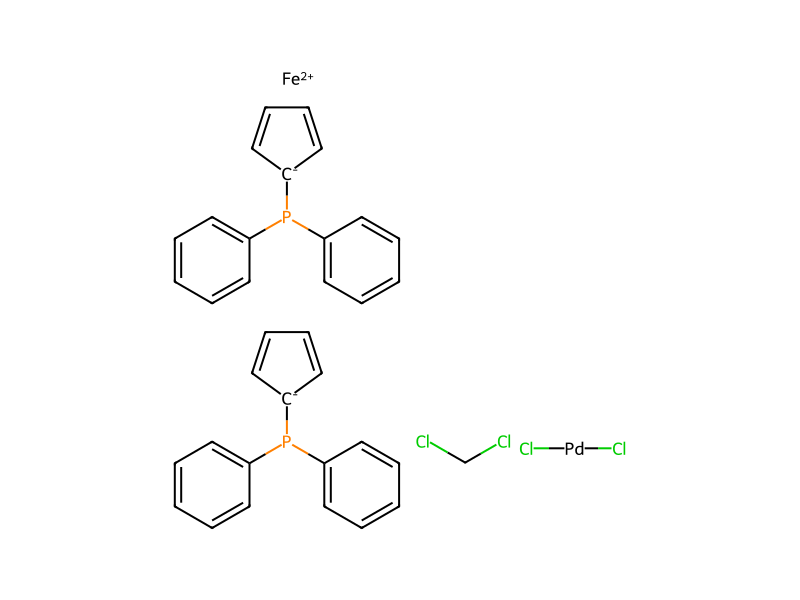
Br[C:2]1[CH:11]=[CH:10][C:9]2[C:4](=[C:5]([Br:12])[CH:6]=[CH:7][CH:8]=2)[N:3]=1.[CH:13](OB([O-])[O-])=[CH2:14].C(N(CC)CC)C.N#N>C1COCC1.CC(O)C.CCOC(C)=O.O.C1C=CC(P(C2C=CC=CC=2)[C-]2C=CC=C2)=CC=1.C1C=CC(P(C2C=CC=CC=2)[C-]2C=CC=C2)=CC=1.Cl[Pd]Cl.[Fe+2].ClCCl>[Br:12][C:5]1[CH:6]=[CH:7][CH:8]=[C:9]2[C:4]=1[N:3]=[C:2]([CH:13]=[CH2:14])[CH:11]=[CH:10]2Participants
8
Reactant 4




Product 1

Reagents, catalysts & solvents 3


Conditions
- Temperature
- 55 °C
Procedure
To 2,8-dibromoquinoline (1.836 g, 6.398 mmol) in THF/IPA (20 mL/10 mL) was added vinylborate (0.9428 g, 7.038 mmol) and triethylamine (0.7769 g, 7.678 mmol). The reaction mixture was purged with N2, and PdCl2(dppf) dichloromethane adduct (0.3685 g, 0.4479 mmol) was added. The reaction was stirred at 55° C. for 12 hours, then cooled to ambient temperature. The reaction mixture was diluted with EtOAc/H2O, and the organic layer was separated and concentrated to provide the crude product.
Workup
- additionwas added
- temperaturecooled to ambient temperature
- customthe organic layer was separated
- concentrationconcentrated
Sources & evidence
- ORD record
- ord-c3839b95bf424f1f8b545afef0bba66f
- Source dataset
- uspto-grants-2013_10
- Patent number
- US08557809B2
Linked notes
Loading…