Reaction equation

O=P(Cl)(Cl)Cl.[CH3:6][C:7]1[S:8][C:9]([CH3:12])=[CH:10][CH:11]=1.[C:13]([O-])(=[O:15])C.[Na+]>CN(C=O)C>[CH3:6][C:7]1[S:8][C:9]([CH3:12])=[CH:10][C:11]=1[CH:13]=[O:15]Participants
5
Reactant 3
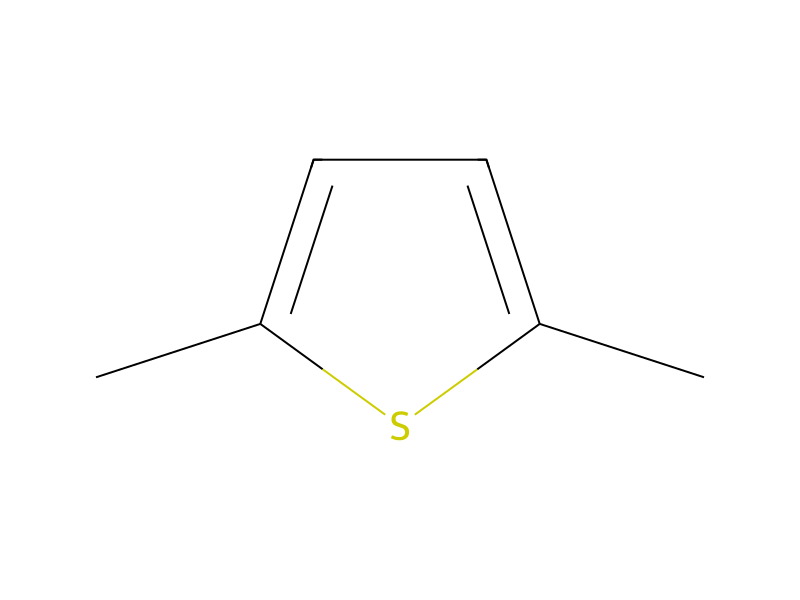


Product 1

Reagents, catalysts & solvents 1

Procedure
To DMF (100 mL) stirred in an ice bath was added POCl3 (25 mL) drop wise followed by the addition of 2,5-dimethyl-thiophene (5 mL). The solution was warmed to room temperature and then was heated at 80° C. overnight. The reaction was cooled to room temperature and was slowly added to ice. Sodium acetate was added to bring the pH to between 5 and 6. The aqueous portion was extracted with ethyl acetate, and the organic portion was dried over sodium sulfate, concentrated under reduced pressure and purified on a silica gel column (eluent: 10:1:hexanes:EtOAc→4:1:hexanes:EtOAc to yield 2,5-dimethyl-thiophene-3-carboxaldehyde (1.5 g).
Workup
- temperaturewas heated at 80° C. overnight
- temperatureThe reaction was cooled to room temperature
- additionwas slowly added to ice
- extractionThe aqueous portion was extracted with ethyl acetate
- dry with materialthe organic portion was dried over sodium sulfate
- concentrationconcentrated under reduced pressure
- custompurified on a silica gel column (eluent
Sources & evidence
- ORD record
- ord-442415df1ea74f20aaaf2ca30bc9512b
- Source dataset
- uspto-grants-2013_10
- Patent number
- US08563742B2
Linked notes
Loading…