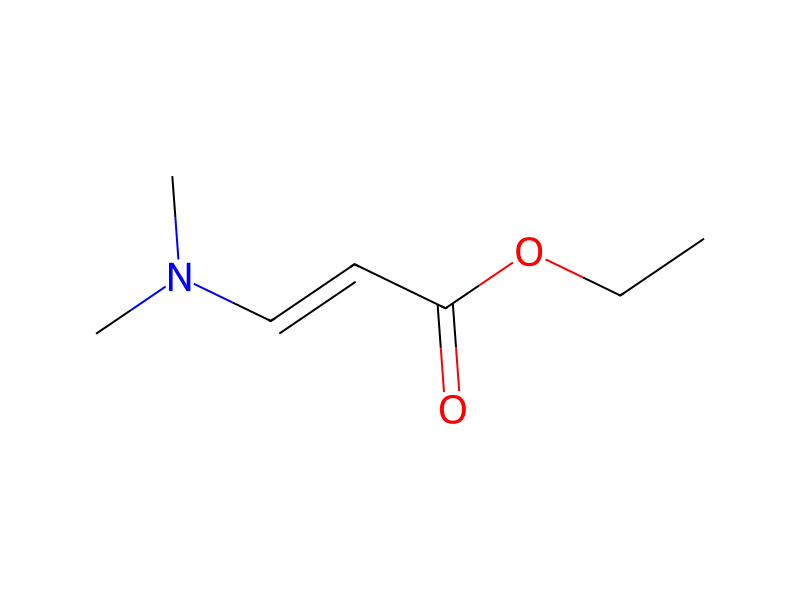
To a solution of 2-bromo-5-fluoroisonicotinic acid (25 g, 113.64 mmol, 1 equiv.) in toluene (251 mL) was added thionyl chloride (41.5 mL, 568.19 mmol, 5 equiv.). The reaction was stirred at 110° C. for 4 h. The reaction was cooled to room temperature and concentrated. The residue was re-suspended in THF (100 mL) and added drop-wise to a solution of ethyl 3-(dimethylamino)acrylate (16.3 mL, 113.64 mmol, 1 equiv.) and triethylamine (23.8 mL, 170.46 mmol, 1.5 equiv.) in THF (151 mL). The reaction was stirred at 70° C. for 5 h. The reaction was cooled to room temperature and diluted with water. The reaction was partitioned between water (300 mL) and ethyl acetate (300 mL). The aqueous layer was extracted with ethyl acetate (2×300 mL), and the organics were washed with 1 N HCl (300 mL) and saturated brine (300 mL), dried over sodium sulfate, and concentrated. The compound was purified (silica gel chromatography) and concentrated to provide ethyl 2-(2-bromo-5-fluoroisonicotinoyl)-3-(dimethylamino)acrylate as a solid (28.6 g, 73%). Calcd for C13H14BrFN2O3 [M+H]+: 346.90.