HomeMCPSkillsWorkbenchOpenChem
HomeWorkbenchNotificationsMe
llms.txt · skill.md · MCP GuidePrivacy Policy · Terms of Service · Supportv1.8.5
  1. Home
  2. /Reaction

Diisopropylethylamine → HCID 89699969, compound

HRID 1055736
Print

Reaction equation

CN(C(ON1N=NC2C=CC=NC1=2)=[N+](C)C)C.F[P-](F)(F)(F)(F)F.C(N(CC)C(C)C)(C)C.[CH3:34][C:35]1[CH:41]=[CH:40][C:38]([NH2:39])=[CH:37][C:36]=1[N:42]1[C:49]2[N:45]([N:46]=[C:47]([C:50]3[CH:51]=[N:52][CH:53]=[CH:54][CH:55]=3)[CH:48]=2)[CH:44]=[CH:43]1.[C:56]([C:60]1[CH:61]=[C:62]([CH:66]=[C:67]([C:69]#[N:70])[CH:68]=1)[C:63](O)=[O:64])([CH3:59])([CH3:58])[CH3:57]>CS(C)=O.C(OCC)(=O)C>[C:56]([C:60]1[CH:61]=[C:62]([CH:66]=[C:67]([C:69]#[N:70])[CH:68]=1)[C:63]([NH:39][C:38]1[CH:40]=[CH:41][C:35]([CH3:34])=[C:36]([N:42]2[C:49]3[N:45]([N:46]=[C:47]([C:50]4[CH:51]=[N:52][CH:53]=[CH:54][CH:55]=4)[CH:48]=3)[CH:44]=[CH:43]2)[CH:37]=1)=[O:64])([CH3:59])([CH3:57])[CH3:58]
ParticipantsConditionsProcedureWorkupSources & evidenceReaction notes

Participants

7

Reactant 4

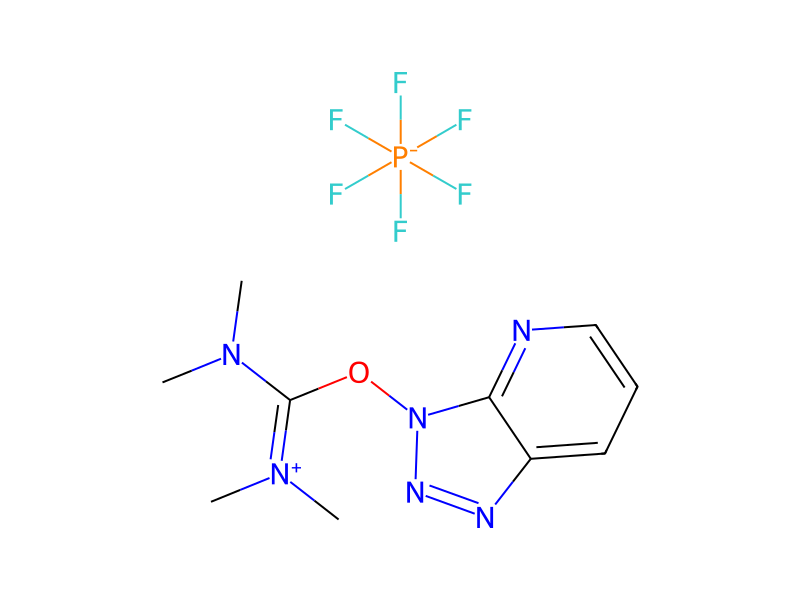
HCID 81531DiisopropylethylamineHCID 9886157Methanaminium, N-((dimethylamino)(3H-1,2,3-triazolo(4,5-b)pyridin-3-yloxy)methylene)-N-methyl-, hexafluorophosphate(1-) (1:1)HCID 247296293-tert-Butyl-5-cyanobenzoic acidHCID 897000234-Methyl-3-[6-(pyridin-3-yl)-1H-imidazo[1,2-b]pyrazol-1-yl]aniline

Product 1

HCID 89699969
HCID 89699969, compound

Reagents, catalysts & solvents 2

HCID 679Dimethyl SulfoxideSolventHCID 8857Ethyl AcetateSolvent

Conditions

Temperature
25 °C

Procedure

144 mg (0.38 mmol) of HATU and 81 mg (0.63 mmol) of N,N-diisopropylethylamine were added to a solution of 91 mg (0.31 mmol) of the compound of Example 6A and 173 mg (purity 37%, 0.31 mmol) of 3-tert-butyl-5-cyanobenzoic acid [lit.: WO 2008/021388 A1, intermediate E, page 164] in 2.0 ml of DMSO. The reaction was stirred at 25° C. for 16 h. The reaction mixture was then diluted with ethyl acetate and the phases were separated. The organic phase was washed twice with in each case 50 ml of saturated sodium bicarbonate solution and then dried over sodium sulphate. After filtration, the mixture was concentrated under reduced pressure and the residue obtained in this manner was purified by double chromatography on a Biotage system (first run: 25 g Snap column, mobile phase gradient ethyl acetate/hexane, starting with 20% ethyl acetate, then increasing rapidly to 100% ethyl acetate, then ethyl acetate/methanol, from 0% methanol increasing steadily to 50% methanol; second run: 10 g Snap column, mobile phase gradient ethyl acetate/hexane, starting with 20% ethyl acetate, then increasing rapidly to 100% ethyl acetate, then ethyl acetate/methanol, from 0% methanol increasing steadily to 50% methanol). This gave 17.8 mg (11% of theory) of the title compound.

Workup

  1. customthe phases were separated
  2. washThe organic phase was washed twice with in each case 50 ml of saturated sodium bicarbonate solution
  3. dry with materialdried over sodium sulphate
  4. filtrationAfter filtration
  5. concentrationthe mixture was concentrated under reduced pressure
  6. customthe residue obtained in this manner
  7. customwas purified by double chromatography on a Biotage system (first run
  8. temperatureincreasing rapidly to 100% ethyl acetate
  9. temperatureincreasing rapidly to 100% ethyl acetate

Sources & evidence

ORD record
ord-eb02df112c2a43c09f9c294512641c47
Source dataset
uspto-grants-2016_07
DOI
10.6084/m9.figshare.5104873.v1
Patent number
US09394309B2

Reaction notes

On this pageParticipantsConditionsProcedureWorkupSources & evidenceReaction notes