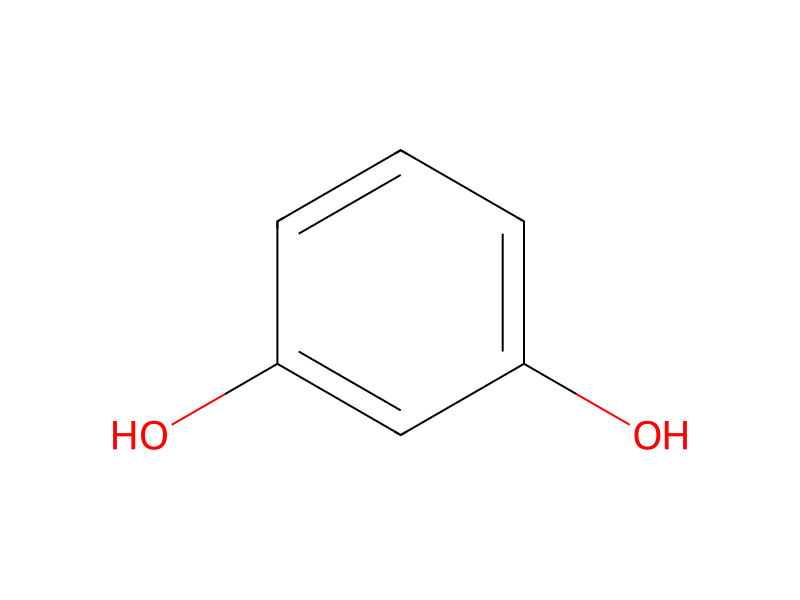
[CH3:1][C:2]1[CH:7]=[C:6]([CH3:8])[CH:5]=[CH:4][C:3]=1[C:9]1[N:14]=[C:13]([C:15]2[CH:20]=[CH:19][C:18]([CH3:21])=[CH:17][C:16]=2[CH3:22])[N:12]=[C:11](OC2C=CC=CC=2)[N:10]=1.[C:30]1([CH:37]=[CH:36][CH:35]=[C:33]([OH:34])[CH:32]=1)[OH:31].[Cl-].[Al+3].[Cl-].[Cl-].C1S(=O)(=O)CCC1.Cl>>[CH3:1][C:2]1[CH:7]=[C:6]([CH3:8])[CH:5]=[CH:4][C:3]=1[C:9]1[N:14]=[C:13]([C:15]2[CH:20]=[CH:19][C:18]([CH3:21])=[CH:17][C:16]=2[CH3:22])[N:12]=[C:11]([C:35]2[CH:36]=[CH:37][C:30]([OH:31])=[CH:32][C:33]=2[OH:34])[N:10]=1To a 250 mL round-bottomed flask equipped with a magnetic stirrer, a condenser and a nitrogen atmosphere are added 6.00 g (0.0157 mol) of the product of Example 2, 2.08 g (0.0189 mol) of resorcinol, 2.09 g (0.0157 mol) of aluminum chloride and 6 mL of tetramethylene sulfone (sulfolane). The mixture is stirred at 138° C. for six hours, 147° C. for seven hours, 160° C. for 10.5 hours and then allowed to cool to room temperature. A portion of 2N hydrochloric acid is added and the mixture is refluxed for two hours and then allowed to cool to room temperature. The solids formed are collected by vacuum filtration and then washed with portions of water and heptane. The crude solid is taken up in ethyl acetate and passed through a plug of silica gel. The solvent is removed under reduced pressure to give 5.25 g of crude product. The crude product is recrystallized from methanol to afford 4.29 g (69% yield) of the title compound as a yellow solid melting at 199-201° C.