HomeMCPWorkbenchSkills
HomeWorkbenchNotificationsMe
llms.txt · MCP GuidePrivacy Policy · Terms of Service · Supportv1.8.0
  1. Home
  2. /Reaction

Dicyclohexylcarbodiimide → boc-D-Trp (+/-) trans-2,5-dicarbethoxypyrrolidine

HRID 1077672
Notes
Print preview

Reaction equation

HRID 1077672 reaction equation
C1(N=C=NC2CCCCC2)CCCCC1.[C:16]([C@H:21]1[CH2:25][CH2:24][C@H:23]([C:26]([O:28][CH2:29][CH3:30])=[O:27])[NH:22]1)([O:18][CH2:19][CH3:20])=[O:17].[C:31]([NH:38][C@@H:39]([C:50]([OH:52])=[O:51])[CH2:40][C:41]1[C:49]2[C:44](=[CH:45][CH:46]=[CH:47][CH:48]=2)[NH:43][CH:42]=1)([O:33][C:34]([CH3:37])([CH3:36])[CH3:35])=[O:32].O.ON1C2C=CC=CC=2N=N1>CN(C)C=O.C(OCC)(=O)C.C(Cl)(Cl)Cl.CO>[CH3:37][C:34]([O:33][C:31]([NH:38][C@@H:39]([C:50]([OH:52])=[O:51])[CH2:40][C:41]1[C:49]2[C:44](=[CH:45][CH:46]=[CH:47][CH:48]=2)[NH:43][CH:42]=1)=[O:32])([CH3:35])[CH3:36].[C:16]([C@H:21]1[CH2:25][CH2:24][C@H:23]([C:26]([O:28][CH2:29][CH3:30])=[O:27])[NH:22]1)([O:18][CH2:19][CH3:20])=[O:17]
ParticipantsProcedureWorkupSources & evidenceReaction notes

Participants

8

Reactant 4

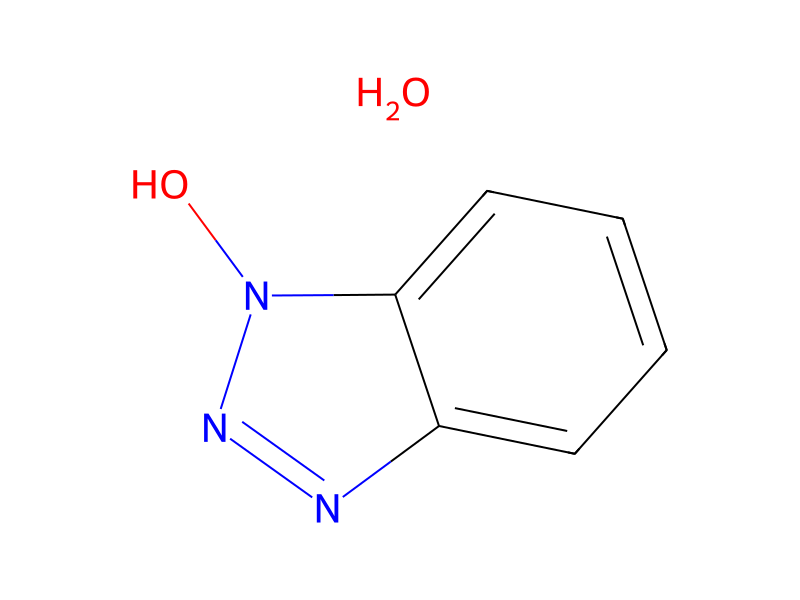
HCID 10868Dicyclohexylcarbodiimide2×HCID 111050N-((tert-Butoxy)carbonyl)-D-tryptophanHCID 27960291-Hydroxybenzotriazole hydrateHCID 109109122,5-Diethyl (2R,5R)-pyrrolidine-2,5-dicarboxylate

Product 1

HCID 131719485boc-D-Trp (+/-) trans-2,5-dicarbethoxypyrrolidineYield 115%

Reagents, catalysts & solvents 3

HCID 6228DimethylformamideSolventHCID 8857Ethyl AcetateSolventHCID 21584188Chloroform methanolSolvent

Procedure

3.9 g (19 mmol) of 1,3-dicyclohexylcarbodiimide (DCC) was added at 0° C. to a solution containing 1.63 g (7.58 mmol) of (±)-trans -2,5dicarbethoxypyrrolidine (1), 2.54 g (11 mmol) of Boc-D-tryptophan, 2.56 g (19 mmol) of 1-hydroxy benzotriazole hydrate, 3.3 ml (19 mmol) of diisopropyloethylamine in 25 ml of dry dimethylformamide (DMF). The resulting clear colorless solution was stirred under an argon atmosphere at room temperature for a period of 18 hr which resulted in the formation of a white precipitate. TLC analysis of the mixture (97:3 CHCl3 /MeOH) indicated that there was some remaining pyrrolidine diester. Therefore, an 2.0 g of DCC was added and the solution was stirred for an additional 5 hr at room temperature. Ethyl acetate (80 ml) was added to the reaction mixture and the solution was washed with water (3×25 ml) and brine solution (1×25 ml), and dried over MgSO4. Solvents were removed in vacuo and to produce 4.53 g of a thick yellow oil. Chromatography of the crude product on silica gel using the eluent showed that the product was a diastereomeric mixture (Rf=0.29 and 0.25) of the coupled products in an approximate ratio of 1.5:1. Total yield for both of the fractions containing the tryptophan pyrrolidine diester was 1.69 g (44.6%). The diastereomer possessing the higher Rf (0.29) was separated and analyzed yielding the following 1H NMR (CDCl3, 360 MHz) spectroscopic data:


Workup

  1. customresulted in the formation of a white precipitate
  2. stirringthe solution was stirred for an additional 5 hr at room temperature
  3. washthe solution was washed with water (3×25 ml) and brine solution (1×25 ml)
  4. dry with materialdried over MgSO4
  5. customSolvents were removed in vacuo

Sources & evidence

ORD record
ord-05ec79f2025d4555bb2d9b3d629e60d3
Source dataset
uspto-grants-1996_08
DOI
10.6084/m9.figshare.5104873.v1
Patent number
US05543521

Reaction notes

Loading…

On this pageParticipantsProcedureWorkupSources & evidenceReaction notes