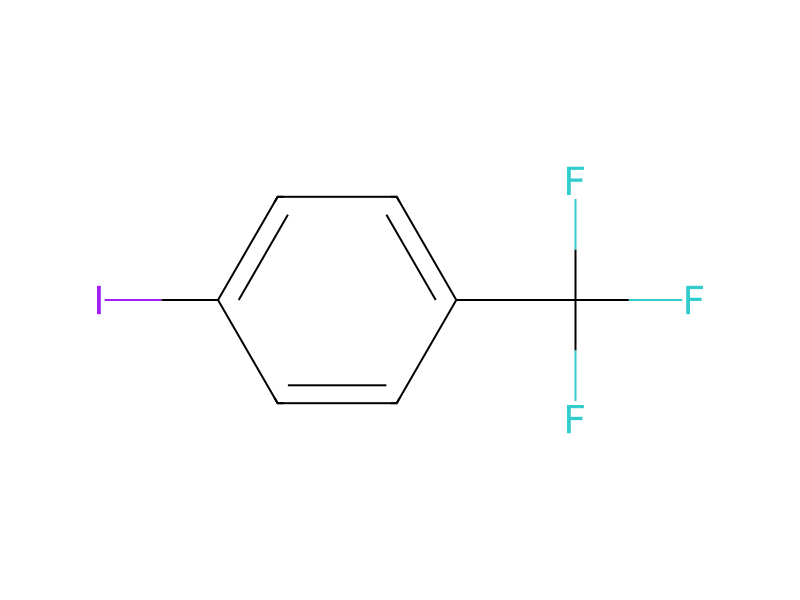
[NH2:1][C:2]1[C:7]([C:8]#[N:9])=[C:6]([CH3:10])[C:5]([C:11]#[CH:12])=[CH:4][N:3]=1.[F:13][C:14]([F:23])([F:22])[C:15]1[CH:20]=[CH:19][C:18](I)=[CH:17][CH:16]=1.C(N(CC)CC)C>C(#N)C.Cl[Pd](Cl)([P](C1C=CC=CC=1)(C1C=CC=CC=1)C1C=CC=CC=1)[P](C1C=CC=CC=1)(C1C=CC=CC=1)C1C=CC=CC=1.[Cu]I>[NH2:1][C:2]1[C:7]([C:8]#[N:9])=[C:6]([CH3:10])[C:5]([C:11]#[C:12][C:18]2[CH:19]=[CH:20][C:15]([C:14]([F:23])([F:22])[F:13])=[CH:16][CH:17]=2)=[CH:4][N:3]=1A solution of 1.6 grams (0.010 mole) of 2-amino-3-cyano-4-methyl-5-ethynylpyridine, 3.8 grams (0.014 mole) of 4-trifluoromethylphenyl iodide (commercially available), 3.5 grams (0.035 mole) of triethylamine, 0.3 gram (catalyst) of bis(triphenylphosphine)palladium(II) chloride, and 0.3 gram (catalyst) of copper(I) iodide in 75 mL of acetonitrile is stirred at ambient temperature for about 18 hours. After this time the reaction mixture is concentrated under reduced pressure to a residue. The residue is partitioned between ethyl acetate and aqueous 1N hydrochloric acid. The aqueous layer and the organic layer are separated, and the aqueous layer is washed with ethyl acetate. The ethyl acetate wash is combined with the organic layer, and the combination is washed with an aqueous solution of 10% lithium chloride. The organic layer is dried with magnesium sulfate and filtered. The filtrate is concentrated under reduced pressure, yielding 2-amino-3-cyano-4-methyl-5-[(4-trifluoromethylphenyl)ethynyl]pyridine.