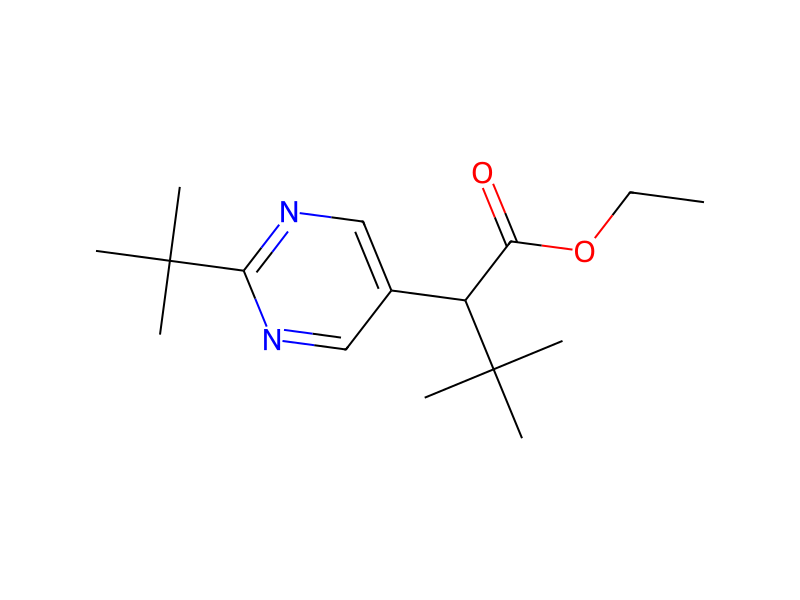
C([SnH](CCCC)CCCC)CCC.Cl[C:15]([C:25]1[CH:26]=[N:27][C:28]([C:31]([CH3:34])([CH3:33])[CH3:32])=[N:29][CH:30]=1)([C:21]([CH3:24])([CH3:23])[CH3:22])[C:16]([O:18][CH2:19][CH3:20])=[O:17].N(C(C)(C)C#N)=NC(C)(C)C#N.O>C1(C)C=CC=CC=1>[CH3:34][C:31]([C:28]1[N:27]=[CH:26][C:25]([CH:15]([C:21]([CH3:22])([CH3:24])[CH3:23])[C:16]([O:18][CH2:19][CH3:20])=[O:17])=[CH:30][N:29]=1)([CH3:32])[CH3:33]Tri-n-Butyl tin hydride (1.3 cm3) was added to a solution of ethyl (RS)-2-chloro-2-[2-(1,1-dimethylethyl)pyrimidin-5-yl]-3,3-dimethylbutanoate (1.4 g) and a catalytic amount of 2,2'-azobisisobutyronitrile in dry toluene (10 cm3). The mixture was heated to the reflux temperature for a period of 11/2 hours, after which it was cooled to the ambient temperature, poured into water, and extracted into ethyl acetate. After concentration by evaporation of the solvent under reduced pressure, the residue was subjected to column chromatography on silica gel using hexane followed by ethyl acetate as eluent to give ethyl (RS)-2-[2-(1,1-dimethyl-ethyl)pyrimidin-5-yl]-3,3-dimethylbutanoate (1.1 g) as a pale yellow liquid, the spectral data of which were identical to those obtained for the sample generated in Example 9.