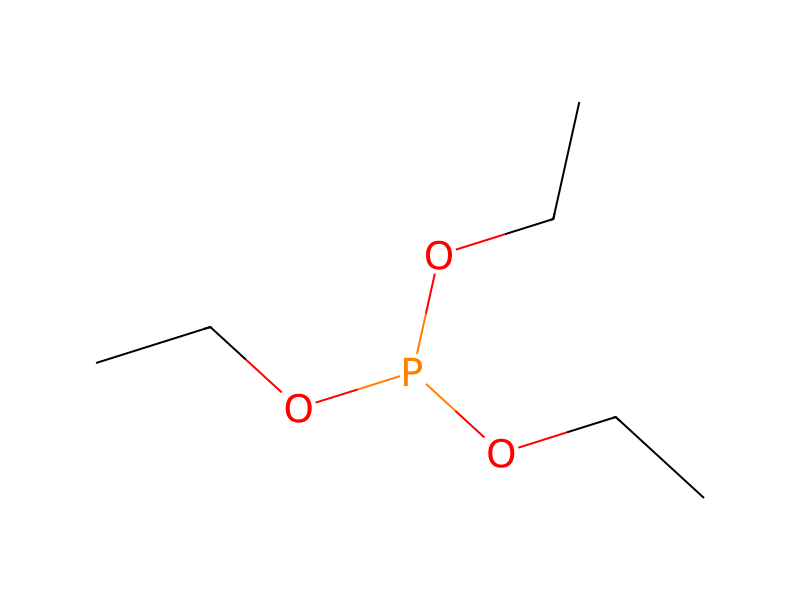
[Cl:1][C:2]1[CH:3]=[C:4]([CH:7]=[C:8]([Cl:22])[C:9]=1[O:10][C:11]1[CH:16]=[CH:15][C:14]([O:17][CH3:18])=[C:13]([CH:19]([CH3:21])[CH3:20])[CH:12]=1)[CH2:5]Br.[CH2:23]([O:25][P:26]([O:30]CC)[O:27][CH2:28][CH3:29])[CH3:24]>CN(C=O)C.C(OCC)(=O)C>[Cl:1][C:2]1[CH:3]=[C:4]([CH:7]=[C:8]([Cl:22])[C:9]=1[O:10][C:11]1[CH:16]=[CH:15][C:14]([O:17][CH3:18])=[C:13]([CH:19]([CH3:21])[CH3:20])[CH:12]=1)[CH2:5][P:26](=[O:30])([O:27][CH2:28][CH3:29])[O:25][CH2:23][CH3:24]A mixture of 3,5-dichloro-4-(3′-iso-propyl-4′-methoxyphenoxy)benzyl bromide (0.61 g, 1.51 mmol) and triethylphosphite (0.61 g, 3.56 mmol) in DMF (2.0 mL) was heated under reflux for 4 h. The reaction mixture was cooled to room temperature, diluted with ethyl acetate, and washed with water and brine. The organic layer was concentrated under reduced pressure and the residue was purified by column chromatography on silica gel, eluting with acetone-hexanes (3:7) to afford diethyl 3,5-dichloro-4-(3′-iso-propyl-4′-methoxyphenoxy)benzylphosphonate as an oil (0.59 g, 85%): 1H NMR (300 MHz, DMSO-d6): δ 7.55 (s, 2 H), 6.88 (d, J=9.0 Hz, 1 H), 6.75 (d, J=3.0 Hz, 1 H), 6.43 (m, 1 H), 4.01 (m, 4 H), 3.75 (s, 3 H), 3.41 (m, 2 H), 3.22 (m, 1 H), 1.20 (m, 6 H), 1.12 (d, J=6.0 Hz, 6 H); TLC conditions: Uniplate silica gel, 250 microns; Mobile phase=hexanes-ethyl acetate (4:1); Rf=0.22.