Reaction equation

[CH2:1](O)[C:2]1[CH:7]=[CH:6][CH:5]=[CH:4][CH:3]=1.[Na].[N:10]12[CH2:17][CH2:16][CH:13]([CH2:14][CH2:15]1)[C@@H:12]([OH:18])[CH2:11]2.C([O:26][C:27]([N:29]1[CH2:38][CH2:37][C:36]2[C:31](=[CH:32][CH:33]=[CH:34][CH:35]=2)[C@@H:30]1[C:39]1[CH:44]=[CH:43][CH:42]=[CH:41][CH:40]=1)=O)C1C=CC=CC=1>CN(C=O)C.C1(C)C=CC=CC=1>[CH2:1]([CH:11]1[CH:12]([O:18][C:27]([N:29]2[CH2:38][CH2:37][C:36]3[C:31](=[CH:32][CH:33]=[CH:34][CH:35]=3)[CH:30]2[C:39]2[CH:44]=[CH:43][CH:42]=[CH:41][CH:40]=2)=[O:26])[CH:13]2[CH2:16][CH2:17][N:10]1[CH2:15][CH2:14]2)[C:2]1[CH:7]=[CH:6][CH:5]=[CH:4][CH:3]=1Participants
7
Reactant 4




Product 1
Reagents, catalysts & solvents 2


Procedure
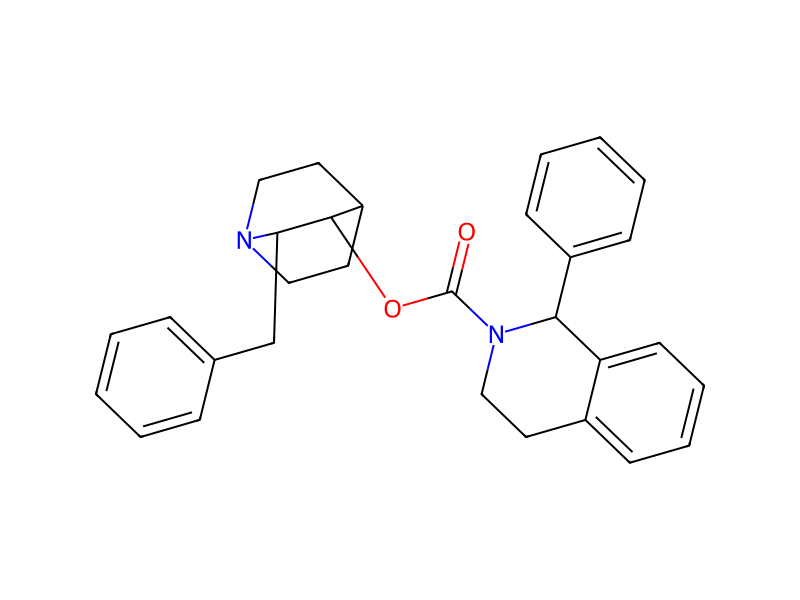
In a mixture of sodium benzyl alkoxide prepared from 0.19 g of benzyl alcohol and 0.04 g of metallic sodium with 15 ml of toluene and 0.75 ml of DMF, 1.33 g of (R)-quinuclidin-3-ol was allowed to react with 3.00 g of (S)-1-phenyl-1,2,3,4-tetrahydroisoquinoline-2-carboxylic acid benzyl ester for 8 hours while evaporating the solvents, thereby obtaining 1.38 g of 1-phenyl-1,2,3,4-tetrahydroisoquinoline-2-carboxylic acid 2-benzylquinuclidin-3-yl ester (to be referred to as “compound F” hereinafter).
Workup
- customwhile evaporating the solvents
Sources & evidence
- ORD record
- ord-a4adb67befd146c3ae8495e14908e573
- Source dataset
- uspto-grants-2010_11
- Patent number
- US07829715B2
Linked notes
Loading…