Reaction equation

[Br:1][C:2]1[C:3](Cl)=[N:4][C:5]([NH:8][C:9]2[CH:10]=[CH:11][C:12]([S:15]([NH2:18])(=[O:17])=[O:16])=[N:13][CH:14]=2)=[N:6][CH:7]=1.[SH:20][CH:21]([CH2:25][CH3:26])[C:22](=[O:24])[CH3:23].C(N(CC)CC)C>CN(C=O)C>[Br:1][C:2]1[C:3]([S:20][CH:21]([CH2:25][CH3:26])[C:22](=[O:24])[CH3:23])=[N:4][C:5]([NH:8][C:9]2[CH:10]=[CH:11][C:12]([S:15]([NH2:18])(=[O:17])=[O:16])=[N:13][CH:14]=2)=[N:6][CH:7]=1Participants
5
Reactant 3



Product 1
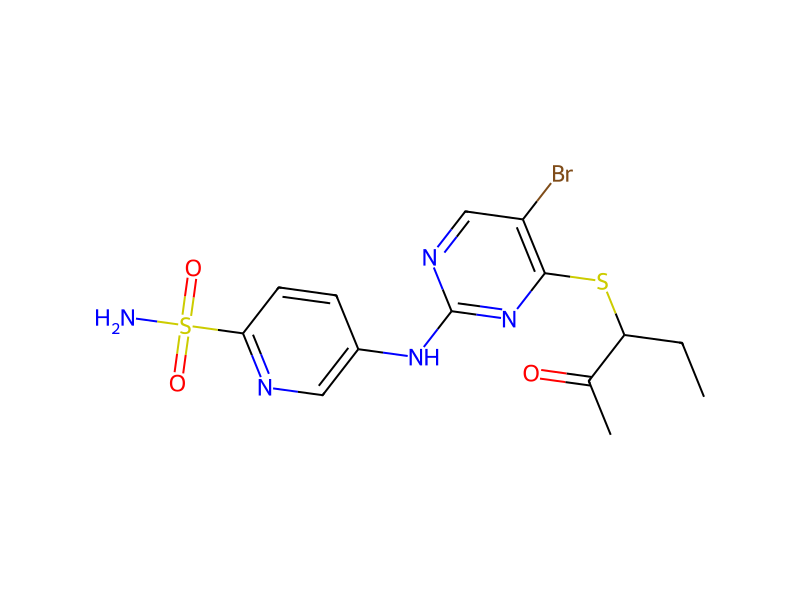
Reagents, catalysts & solvents 1

Conditions
- Temperature
- 50 °C
Procedure
73 mg (0.2 mmol) of 5-(5-bromo-4-chloro-pyrimidin-2-ylamino)-pyridine-2-sulfonic acid amide and 32 mg (0.27 mmol) of 3-mercapto-2-pentanone are dissolved in 4 ml of DMF p.a. After 0.038 ml (0.27 mmol) of triethylamine is added, it is allowed to stir for 2 hours at room temperature and for 3 hours at 50° C. After concentration by evaporation, it is flashed with dichloromethane/MeOH (9:1).
Workup
- concentrationAfter concentration
- customby evaporation, it
Sources & evidence
- ORD record
- ord-3c4bd87c289f423588e0c9618dde772d
- Source dataset
- uspto-grants-2007_10
- Patent number
- US07288547B2
Linked notes
Loading…