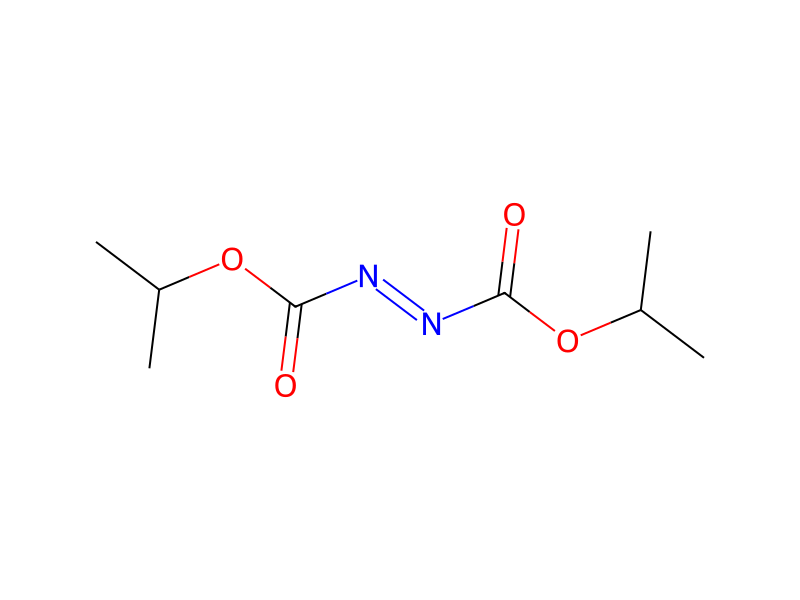
C1(P(C2C=CC=CC=2)C2C=CC=CC=2)C=CC=CC=1.N(C(OC(C)C)=O)=NC([O:24][CH:25]([CH3:27])C)=O.O[CH:35]([CH2:47][CH2:48][CH3:49])[CH2:36][CH2:37][N:38]([CH3:46])[C:39](=[O:45])[O:40][C:41]([CH3:44])([CH3:43])[CH3:42].[S:50]1C=CC=C1CC(O)=O>O1CCCC1>[C:25]([S:50][CH:35]([CH2:47][CH2:48][CH3:49])[CH2:36][CH2:37][N:38]([CH3:46])[C:39](=[O:45])[O:40][C:41]([CH3:44])([CH3:43])[CH3:42])(=[O:24])[CH3:27]To an ice-cooled stirred solution of triphenylphosphine (25.0 g, 95.4 mmol) in tetrahydrofuran (450 ml) under nitrogen was added dropwise diisopropyl azodicarboxylate (19 ml, 93.3 mmol). After 0.5 h, a solution of (3-hydroxyhexyl)methylcarbamic acid, 1,1-dimethylethyl ester (11.5 g, 49.8 mmol) and thiolacetic acid (6.8 ml, 95.2 mmol) in tetrahydrofuran (50 ml) was added slowly. The resulting mixture was stirred at 0° C. for 1 h, then allowed to warm to room temperature and stir overnight. The mixture was concentrated to near dryness, the residue triturated with hexanes, the solids removed by filtration, and the filtrate concentrated and the crude material subjected to flash chromatography using ethyl acetate/hexanes as eluent to give the title compound (12 g) as an oil.