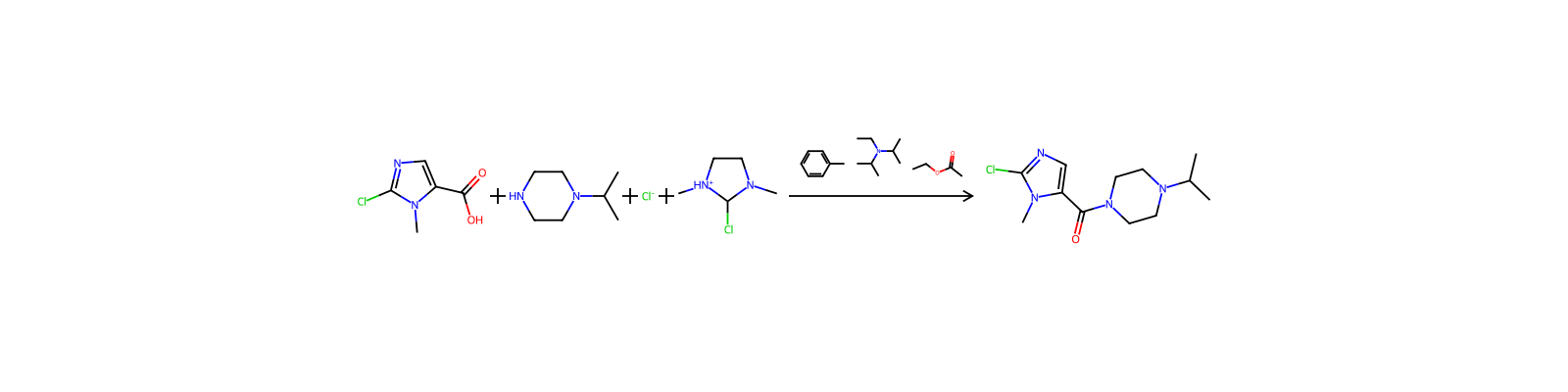
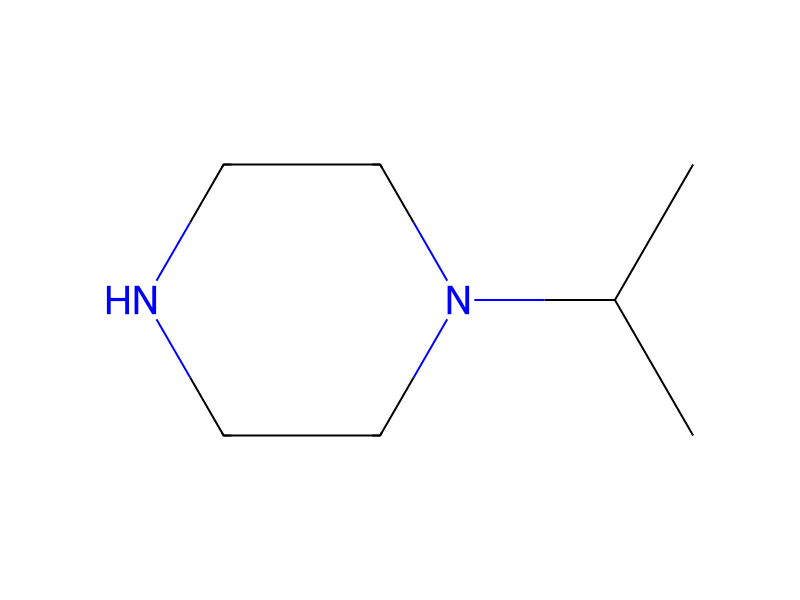
[Cl:1][C:2]1[N:6]([CH3:7])[C:5]([C:8]([OH:10])=O)=[CH:4][N:3]=1.[CH:11]([N:14]1[CH2:19][CH2:18][NH:17][CH2:16][CH2:15]1)([CH3:13])[CH3:12].[Cl-].ClC1N(C)CC[NH+]1C>C1(C)C=CC=CC=1.CCN(C(C)C)C(C)C.CCOC(C)=O>[Cl:1][C:2]1[N:6]([CH3:7])[C:5]([C:8]([N:17]2[CH2:18][CH2:19][N:14]([CH:11]([CH3:13])[CH3:12])[CH2:15][CH2:16]2)=[O:10])=[CH:4][N:3]=1Under nitrogen, 2-chloro-3-methyl-3H-imidazole-4-carboxylic acid (0.161 g, 1.0 mmol) is dissolved in toluene (5 mL, anhydrous) and DIEA (0.26 mL). N-isopropylpiperazine (0.2 M in toluene; 5.5 mL; 1.1 mmol) is added followed by the slow addition of 2-chloro-1,3-dimethylimidazolinium chloride (0.3 M in acetonitrile; 4.0 mL; 1.2 mmol). The reaction mixture is stirred at rt for 2 hr and is then diluted with EtOAc and washed with NaOH (1 N). The aqueous layer is drained and reextracted with EtOAc and the combined organic extracts are extracted twice with HCl (1 N). The combined acidic aqueous extracts are washed with EtOAc then basified with NaOH (2.5 M). The resulting basic aqueous solution is extracted three times with EtOAc and the combined organic extracts are washed with brine, then dried over Na2SO4, filtered and concentrated in vacuo.
Loading…