HomeMCPWorkbenchSkills
HomeWorkbenchNotificationsMe
llms.txt · MCP GuidePrivacy Policy · Terms of Service · Supportv1.8.3
  1. Home
  2. /Reaction

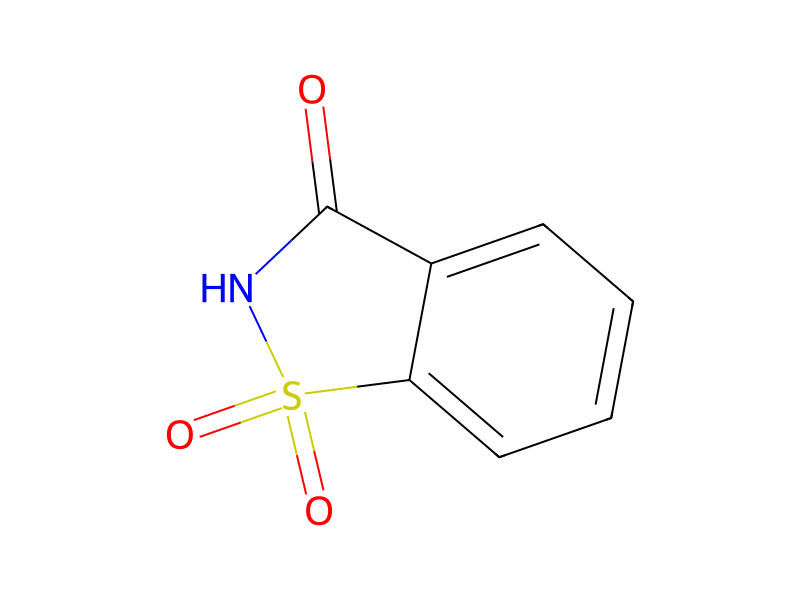
Saccharin → 4-hydroxy-1H-1,2-benzisothiazole-1,1,3(2H)-trione

HRID 1248779
Print

Reaction equation

HRID 1248779 reaction equation
[S:1]1(=[O:12])(=[O:11])[C:5]2[CH:6]=[CH:7][CH:8]=[CH:9][C:4]=2[C:3](=[O:10])[NH:2]1.FC(F)(F)C(O)=[O:16]>C(Cl)Cl.F[B-](F)(F)F.C([N+](CC)(CC)CC)C>[OH:16][C:9]1[C:4]2[C:3](=[O:10])[NH:2][S:1](=[O:11])(=[O:12])[C:5]=2[CH:6]=[CH:7][CH:8]=1
ParticipantsProcedureWorkupSources & evidenceReaction notes

Participants

5

Reactant 2

HCID 5143SaccharinHCID 6422Trifluoroacetic acid

Product 1

HCID 14865224-hydroxy-1H-1,2-benzisothiazole-1,1,3(2H)-trioneYield 58%

Reagents, catalysts & solvents 2

HCID 2724277Tetraethylammonium tetrafluoroborateCatalystHCID 6344DichloromethaneSolvent

Procedure

4.6 g (25 mmol) of 1,2-benzisothiazol-3(2H)-one-1,1-dioxide (Saccharin®) were dissolved in a mixture of 65 ml of methylene chloride, 35 ml of trifluoroacetic acid and 2.1 g of tetraethylammonium tetrafluoroborate. The solution was electrolysed at ambient temperature in an electrolysis trough without any separation of the cathode and anode spaces (undivided cell) using a platinum coil (diameter of wire 1 mm, diameter of coil 0.5 cm, length of coil 7.5 cm) as cathode and a cylindrical platinum wire gauze (cylinder diameter 3.5 cm, cylinder height 5 cm, cylinder surface area 5 cm2) as anode. A dry rectifier with potentiometer was used as the source of current. An ammeter connected in series was used to determine the ampere hours and a voltage meter served to measure the potential between the cathode and anode (about 5 to 7 volts). After a charge quantity of about 0.5 Ah had been used up, electrolysis was stopped. The solution was added to ice water. The organic phase was separated off and combined with the chloroform extracts of the aqueous phase. After evaporation of the solvent the residue was distributed between an aqueous iron (III) chloride solution and methylene chloride. 2.7 g of starting material were recovered from the methylene chloride phase. The iron (III) chloride solution was made alkaline and filtered. The filtrate was then acidified and extracted with methylene chloride. After evaporation and recrystallisation from water, 1.2 g of 4-hydroxy-1,2-benzisothiazol-3(2H)-one-1,1-dioxide were obtained. This corresponds to a yield of 58% based on the starting material reacted and a current yield of 67%.

Workup

  1. customThe solution was electrolysed at ambient temperature in an electrolysis trough without any separation of the cathode and anode spaces (undivided cell)
  2. additionThe solution was added to ice water
  3. customThe organic phase was separated off
  4. customAfter evaporation of the solvent the residue
  5. custom2.7 g of starting material were recovered from the methylene chloride phase
  6. filtrationfiltered
  7. extractionextracted with methylene chloride
  8. customAfter evaporation and recrystallisation from water

Sources & evidence

ORD record
ord-21a22ea25ff04675b7183ee879acc18b
Source dataset
uspto-grants-1986_12
DOI
10.6084/m9.figshare.5104873.v1
Patent number
US04626325

Reaction notes

On this pageParticipantsProcedureWorkupSources & evidenceReaction notes
