Reaction equation

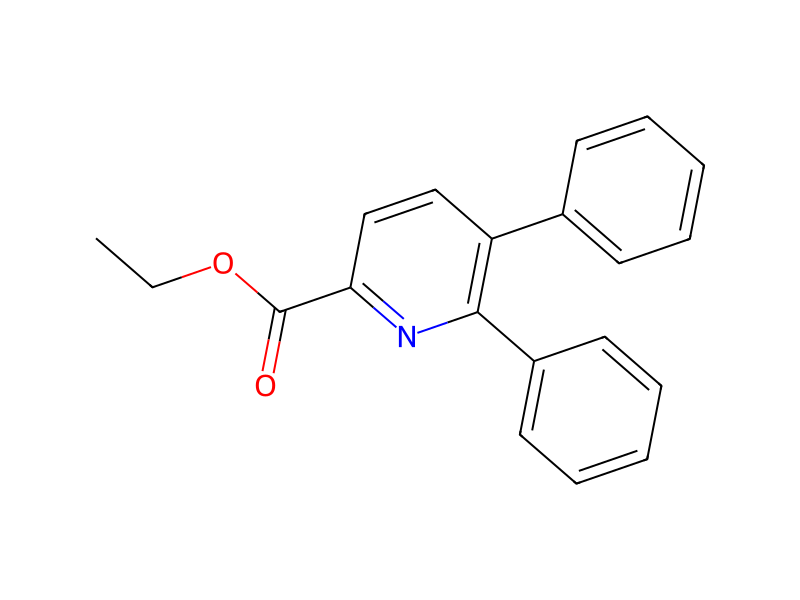
[C:1]1([C:7]2[CH:8]=[CH:9][C:10]([C:19]([O:21]CC)=[O:20])=[N:11][C:12]=2[C:13]2[CH:18]=[CH:17][CH:16]=[CH:15][CH:14]=2)[CH:6]=[CH:5][CH:4]=[CH:3][CH:2]=1.[Li+].[OH-].Cl>CCO>[C:1]1([C:7]2[CH:8]=[CH:9][C:10]([C:19]([OH:21])=[O:20])=[N:11][C:12]=2[C:13]2[CH:14]=[CH:15][CH:16]=[CH:17][CH:18]=2)[CH:2]=[CH:3][CH:4]=[CH:5][CH:6]=1Participants
5
Reactant 3


Product 1

Reagents, catalysts & solvents 1

Procedure
A solution of ethyl 5,6-diphenylpyridine-2-carboxylate (Compound 21, 40 mg, 0.13 mmol) and LiOH (1N, 1 ml) in EtOH (2 ml) was stirred at room temperature overnight. The mixture was acidified with 10% HCl, then extracted with EtOAc. The organic layer was washed with water, and brine, and dried over Na2SO4. The filtered solvent was concentrated in vacuo, and the residue was purified by silica gel chromatography (20-80% Ethyl acetate in hexane) to give title compound as a solid.
Workup
- extractionextracted with EtOAc
- washThe organic layer was washed with water, and brine
- dry with materialdried over Na2SO4
- concentrationThe filtered solvent was concentrated in vacuo
- customthe residue was purified by silica gel chromatography (20-80% Ethyl acetate in hexane)
Sources & evidence
- ORD record
- ord-43af859442634bd7bb2952e0d4381809
- Source dataset
- uspto-grants-2010_06
- Patent number
- US07728014B2
Linked notes
Loading…