HomeMCPWorkbenchSkills
HomeWorkbenchNotificationsMe
llms.txt · MCP GuidePrivacy Policy · Terms of Service · Supportv1.8.3
  1. Home
  2. /Reaction

Water → 2-Chloro-3-(difluoromethoxy)pyridine

HRID 1259332
Print

Reaction equation

HRID 1259332 reaction equation
[Cl:1][C:2]1[C:7]([OH:8])=[CH:6][CH:5]=[CH:4][N:3]=1.O.Cl[C:11]([F:16])([F:15])C([O-])=O.[Na+].C(=O)([O-])[O-].[K+].[K+]>CN(C=O)C>[Cl:1][C:2]1[C:7]([O:8][CH:11]([F:16])[F:15])=[CH:6][CH:5]=[CH:4][N:3]=1
ParticipantsConditionsProcedureWorkupSources & evidenceReaction notes

Participants

6

Reactant 4

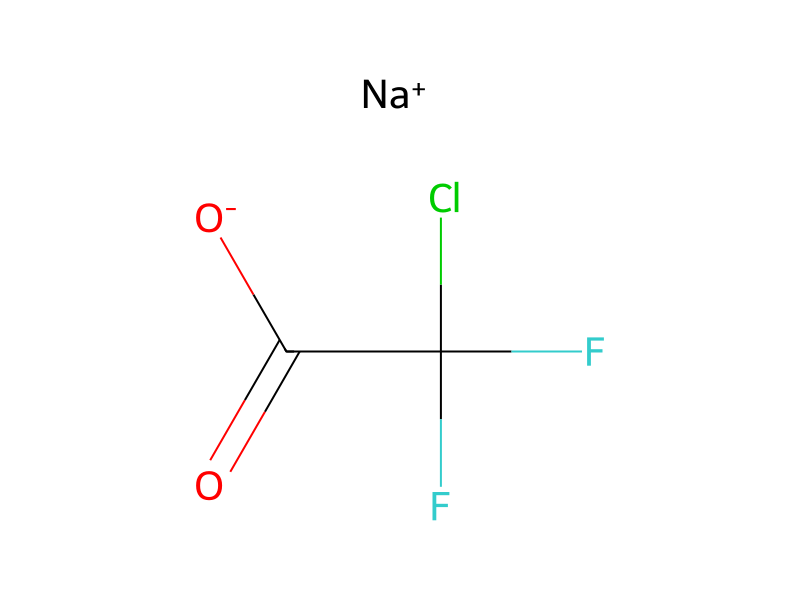
HCID 962WaterHCID 11430Potassium Carbonate2×HCID 811362-Chloro-3-pyridinol2×HCID 2734985Sodium chlorodifluoroacetate2×

Product 1

HCID 533020352-Chloro-3-(difluoromethoxy)pyridineYield 72%

Reagents, catalysts & solvents 1

HCID 6228
Dimethylformamide
Solvent

Conditions

Temperature
100 °C

Procedure

As shown in step 3(a)-i of Scheme 3(a), 2-chloro-3-hydroxypyridine (Compound 2005, 2.0 g, 15.4 mmol, obtained from Aldrich Chemical Co.) was dissolved in 40 mL of DMF and 5.0 mL of water along with sodium chlorodifluoroacetate (4.71 g, 30.9 mmol, obtained from Lancaster Synthesis, Inc.) and anhydrous potassium carbonate (2.56 g; 18.5 mmol). The reaction mixture was heated in an oil bath at 100° C. for 2 hours. Another equivalent of sodium chlorodifluoroacetate and 1.2 equiv. of potassium carbonate were added and heating continued for an additional 2.0 hours. After this time, the reaction was cooled and the volatiles removed under reduced pressure. The residue was partitioned between brine and ethyl acetate and the organics washed once more with brine, dried over Na2SO4, filtered, and the volatiles removed under reduced pressure. The product was purified by silica gel chromatography, eluting with a hexanes/DCM to DCM gradient, to produce 2-chloro-3-(difluoromethoxy)pyridine as a white solid (Compound 2006, 2.0 g, 72% yield): ESMS (M+H) 180; 1H NMR (CDCl3) δ 8.05 (m, 1H), 7.45 (m, 1H), 6.90 (m, 1H), 6.60 (t, 1H; J=75 Hz), 4.01 (s, 3H).


Workup

  1. temperatureheating
  2. temperatureAfter this time, the reaction was cooled
  3. customthe volatiles removed under reduced pressure
  4. customThe residue was partitioned between brine and ethyl acetate
  5. washthe organics washed once more with brine
  6. dry with materialdried over Na2SO4
  7. filtrationfiltered
  8. customthe volatiles removed under reduced pressure
  9. customThe product was purified by silica gel chromatography
  10. washeluting with a hexanes/DCM to DCM gradient

Sources & evidence

ORD record
ord-d889b49058e048babc2fc7265dcc8792
Source dataset
uspto-grants-2013_06
DOI
10.6084/m9.figshare.5104873.v1
Patent number
US08466288B2

Reaction notes

On this pageParticipantsConditionsProcedureWorkupSources & evidenceReaction notes