HomeMCPWorkbenchSkills
HomeWorkbenchNotificationsMe
llms.txt · MCP GuidePrivacy Policy · Terms of Service · Supportv1.8.0
  1. Home
  2. /Reaction

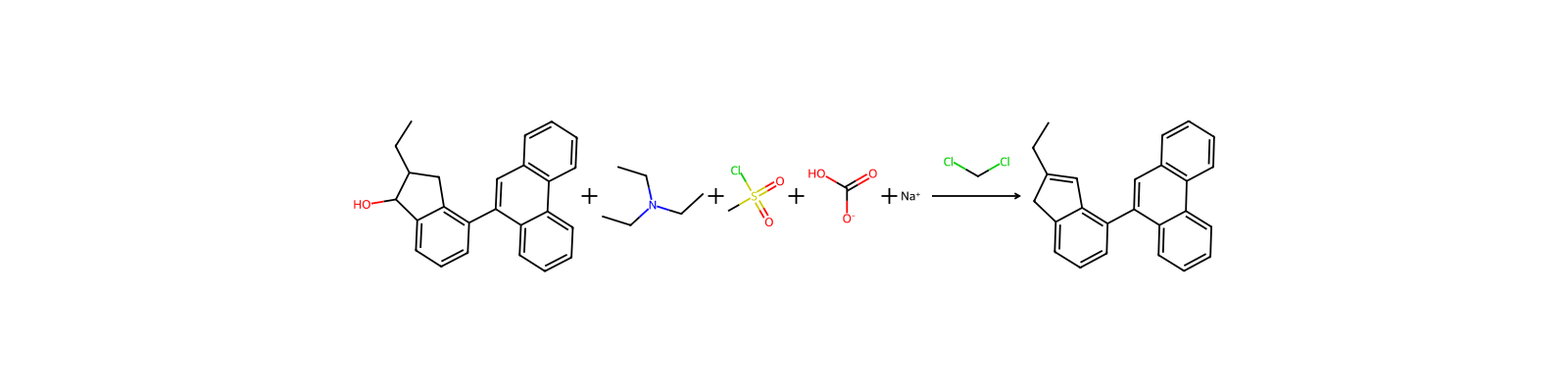
Triethylamine → 2-Ethyl-4-(9-phenathryl)indene

HRID 1260
Notes
Print preview

Reaction equation

HRID 1260 reaction equation
[CH2:1]([CH:3]1[CH2:11][C:10]2[C:5](=[CH:6][CH:7]=[CH:8][C:9]=2[C:12]2[C:13]3[C:18]([C:19]4[CH:20]=[CH:21][CH:22]=[CH:23][C:24]=4[CH:25]=2)=[CH:17][CH:16]=[CH:15][CH:14]=3)[CH:4]1O)[CH3:2].C(N(CC)CC)C.CS(Cl)(=O)=O.C(=O)(O)[O-].[Na+]>C(Cl)Cl>[CH2:1]([C:3]1[CH2:4][C:5]2[C:10]([CH:11]=1)=[C:9]([C:12]1[C:13]3[C:18]([C:19]4[CH:20]=[CH:21][CH:22]=[CH:23][C:24]=4[CH:25]=1)=[CH:17][CH:16]=[CH:15][CH:14]=3)[CH:8]=[CH:7][CH:6]=2)[CH3:2]
ParticipantsProcedureWorkupSources & evidenceReaction notes

Participants

6

Reactant 4

HCID 8471TriethylamineHCID 31297Methanesulfonyl chlorideHCID 516892Sodium BicarbonateHCID 212219312-Ethyl-1-hydroxy-4-(9-phenanthryl)indane

Product 1

HCID 180081962-Ethyl-4-(9-phenathryl)indeneYield 83%

Reagents, catalysts & solvents 1

HCID 6344
Dichloromethane
Solvent
2×

Procedure

A 300-ml three-necked round flask equipped with a stirring bar, a Dimroth condenser, a dropping funnel and a thermometer was charged with 12.3 g (36.3 mmol) of 2-ethyl-1-hydroxy-4-(9-phenanthryl)indane, 19.7 ml (142 mmol) of triethylamine and 61.5 ml of methylene chloride. To the mixture was gradually dropwise added a solution containing 3.3 ml (42.6 mmol) of methansulfonyl chloride dissolved in 5 ml of methylene chloride under a nitrogen atmosphere at 0° C. After the addition was completed, the temperature was elevated to room temperature, and the reaction mixture was stirred for additional 4 hours. To the reaction mixture was added 80 ml of a saturated aqueous solution of sodium bicarbonate. The organic phase was separated, and the aqueous phase was extracted with 50 ml of methylene chloride two times. The combined organic phase was washed with water, and then a saturated aqueous solution of sodium chloride, followed by drying over anhydrous Na2SO4. The solvent was evaporated under reduced pressure. The residue was chromatographed on silica gel (eluting with hexane, and hexane/ethyl acetate (100/3 parts by volume)) to give 9.61 g of the desired product (mixture of two isomers) as a pasty pale yellow-green liquid (yield: 83%).

Workup

  1. customA 300-ml three-necked round flask equipped with a stirring bar
  2. additionTo the mixture was gradually dropwise added a solution
  3. additionAfter the addition
  4. customwas elevated to room temperature
  5. customThe organic phase was separated
  6. extractionthe aqueous phase was extracted with 50 ml of methylene chloride two times
  7. washThe combined organic phase was washed with water
  8. dry with materialby drying over anhydrous Na2SO4
  9. customThe solvent was evaporated under reduced pressure
  10. customThe residue was chromatographed on silica gel (eluting with hexane, and hexane/ethyl acetate (100/3 parts by volume))

Sources & evidence

ORD record
ord-c816ac4ef7654d68886954c067ebcb25
Source dataset
uspto-grants-1998_03
DOI
10.6084/m9.figshare.5104873.v1
Patent number
US05723640

Reaction notes

Loading…

On this pageParticipantsProcedureWorkupSources & evidenceReaction notes

