HomeMCPWorkbenchSkills
HomeWorkbenchNotificationsMe
llms.txt · MCP GuidePrivacy Policy · Terms of Service · Supportv1.8.3
  1. Home
  2. /Reaction

Triphenylphosphine → 2-(3-Bromophenylthio)-3-[3-(pyridin-3-yl)propoxy]pyridine

HRID 1267950
Print

Reaction equation

HRID 1267950 reaction equation
[N:1]1[CH:6]=[CH:5][CH:4]=[C:3]([CH2:7][CH2:8][CH2:9][OH:10])[CH:2]=1.C1(P(C2C=CC=CC=2)C2C=CC=CC=2)C=CC=CC=1.N(C(OC(C)C)=O)=NC(OC(C)C)=O.[Br:44][C:45]1[CH:46]=[C:47]([S:51][C:52]2[C:57](O)=[CH:56][CH:55]=[CH:54][N:53]=2)[CH:48]=[CH:49][CH:50]=1>C1COCC1>[Br:44][C:45]1[CH:46]=[C:47]([S:51][C:52]2[C:57]([O:10][CH2:9][CH2:8][CH2:7][C:3]3[CH:2]=[N:1][CH:6]=[CH:5][CH:4]=3)=[CH:56][CH:55]=[CH:54][N:53]=2)[CH:48]=[CH:49][CH:50]=1
ParticipantsProcedureWorkupSources & evidenceReaction notes

Participants

6

Reactant 4

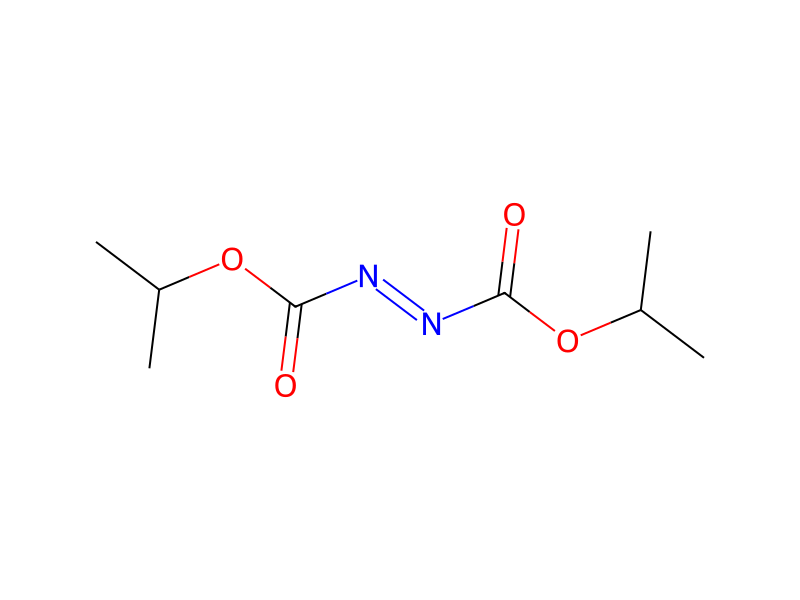
HCID 11776TriphenylphosphineHCID 178613-PyridinepropanolHCID 75555Diisopropyl diazene-1,2-dicarboxylateHCID 114602232-(3-Bromophenylthio)-3-pyridinol

Product 1

HCID 101578532-(3-Bromophenylthio)-3-[3-(pyridin-3-yl)propoxy]pyridineYield 94.1%

Reagents, catalysts & solvents 1

HCID 8028TetrahydrofuranSolvent

Procedure

3-(Pyridin-3-yl)-1-propanol (5.5 g, 40 mmol) and triphenylphosphine (10.5 g, 40 mmol) are dissolved in THF (120 ml), and thereto are added successively with stirring diisopropyl azodicarboxylate (6.1 g, 30 mmol) and 2-(3-bromophenylthio)-3-pyridinol (5.0 g, 18 mmol) obtained in Reference Example 1 under ice-cooling. The mixture is further stirred at room temperature for 30 minutes, and the reaction solution is concentrated under reduced pressure. To the residue is added ethyl acetate (300 ml), and the mixture is extracted with a 10% aqueous hydrochloric acid solution (150 ml×2). The pH value of the aqueous layer is adjusted to pH 12 with potassium carbonate, and the mixture is extracted with ethyl acetate (200 ml×2). The organic layer is washed with a saturated brine (50 ml×2), dried over anhydrous magnesium sulfate, and concentrated under reduced pressure. The residue is purified by silica gel column chromatography (eluent: ethyl acetate/hexane), and recrystallized from diethyl ether to give the title compound (6.8 g) as colorless crystals, m.p. 75-76° C.

Workup

  1. customobtained in Reference Example 1 under ice-
  2. temperaturecooling
  3. concentrationthe reaction solution is concentrated under reduced pressure
  4. additionTo the residue is added ethyl acetate (300 ml)
  5. extractionthe mixture is extracted with a 10% aqueous hydrochloric acid solution (150 ml×2)
  6. extractionthe mixture is extracted with ethyl acetate (200 ml×2)
  7. washThe organic layer is washed with a saturated brine (50 ml×2)
  8. dry with materialdried over anhydrous magnesium sulfate
  9. concentrationconcentrated under reduced pressure
  10. customThe residue is purified by silica gel column chromatography (eluent: ethyl acetate/hexane)
  11. customrecrystallized from diethyl ether

Sources & evidence

ORD record
ord-71d32177d99e4866b4940ca2ec990446
Source dataset
uspto-grants-2003_04
DOI
10.6084/m9.figshare.5104873.v1
Patent number
US06555557B1

Reaction notes

On this pageParticipantsProcedureWorkupSources & evidenceReaction notes