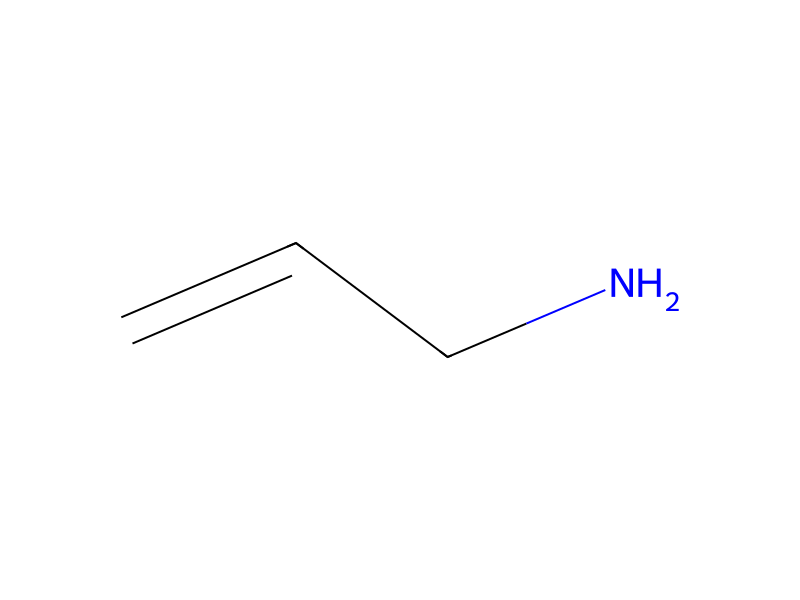
Allylamine → 3-nitro-N-prop-2-enylbenzamide
HRID 1268417
Reaction equation

[CH2:1]([NH2:4])[CH:2]=[CH2:3].[N+:5]([C:8]1[CH:9]=[C:10]([CH:14]=[CH:15][CH:16]=1)[C:11](Cl)=[O:12])([O-:7])=[O:6]>C(OCC)(=O)C>[CH2:1]([NH:4][C:11](=[O:12])[C:10]1[CH:14]=[CH:15][CH:16]=[C:8]([N+:5]([O-:7])=[O:6])[CH:9]=1)[CH:2]=[CH2:3]Participants
4
Reactant 2

Product 1

Reagents, catalysts & solvents 1

Conditions
- Temperature
- 0 °C
Procedure
Step 1′ A 3-L, three-necked, round-bottomed flask equipped with a mechanical stirrer, a nitrogen inlet adapter, and a 500-mL pressure-equalizing addition finnel fitted with a glass stopper was purged with nitrogen. The flask was charged with allylamine (K) 33.9 g (0.593 mol), 50 mL of ethyl acetate, triethylaamine 60.0 g (0.593 mol), and then cooled with an ice-water bath. The addition funnel was charged with 3-nitro-benzoyl chloride (J) 100.0 g (0.539 mol) and 230 mL ethyl acetate, and this solution was then added dropwise to the reaction mixture over 1 h while the reaction mixture was maintained at 0° C. The reaction mixture was stirred at 0° C. for 3 h and then filtered. The filtrate was transferred to a separatory finnel and washed with 150 mL of a 10% (by volume) HCl aqueous solution, 100 mL of saturated sodium chloride solution, dried over magnesium sulfate, and the solvent volume was reduced to one-third the original volume under reduced pressure. The clear solution was cooled to 0° C. overnight. The resulting yellow solid was collected by filtration and dried in a vacuum oven at 50° C. for 6 h to afford 89.4 g (80% yield) of N-allyl-3-nitrobenzamide (L) as a yellow solid.