Reaction equation

Br[C:2]1[CH:7]=[CH:6][C:5]([C:8]2[N:9]=[C:10]3[CH:15]=[C:14]([CH3:16])[CH:13]=[CH:12][N:11]3[CH:17]=2)=[CH:4][CH:3]=1.C(N(CC)CC)C.[CH2:25]([OH:29])[CH2:26][C:27]#[CH:28]>C(#N)C.C1C=CC([P]([Pd]([P](C2C=CC=CC=2)(C2C=CC=CC=2)C2C=CC=CC=2)([P](C2C=CC=CC=2)(C2C=CC=CC=2)C2C=CC=CC=2)[P](C2C=CC=CC=2)(C2C=CC=CC=2)C2C=CC=CC=2)(C2C=CC=CC=2)C2C=CC=CC=2)=CC=1.[Cu]I>[OH:29][CH2:25][CH2:26][C:27]#[C:28][C:2]1[CH:7]=[CH:6][C:5]([C:8]2[N:9]=[C:10]3[CH:15]=[C:14]([CH3:16])[CH:13]=[CH:12][N:11]3[CH:17]=2)=[CH:4][CH:3]=1Participants
7
Reactant 3


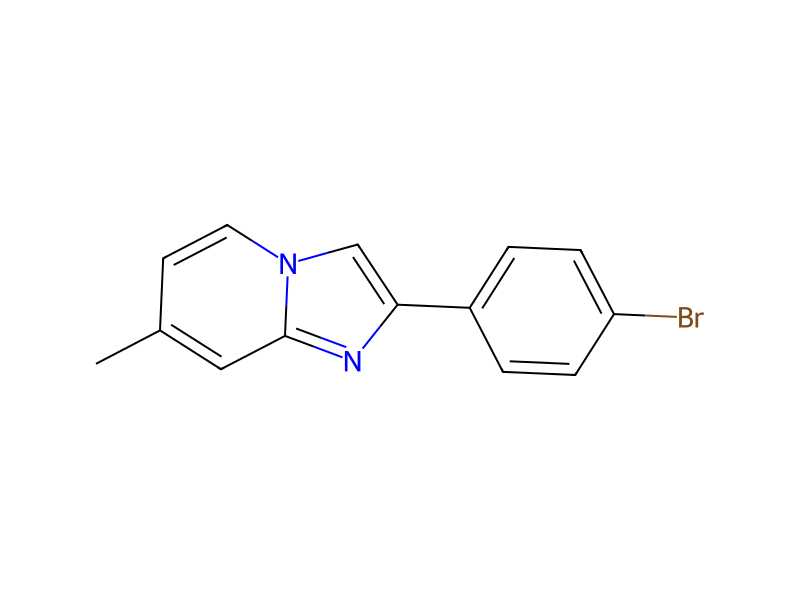
Product 1

Reagents, catalysts & solvents 3



Conditions
- Temperature
- 60 °C
Procedure
The product of Step A (1.8 g) in dry acetonitrile (40 mL) was treated sequentially with tetrakis(triphenylphosphine)palladium(0) (0.1 g), triethylamine (1.27 g), and CuI (10 mg) then heated at 60° C. for 30 minutes. The mixture was cooled to ambient temperature, treated with 3-butyn-1-ol (0.361 g) and heated at reflux temperature for 18 hours. The mixture was cooled to ambient temperature and evaporated to dryness. The residue was crystallized, twice, from acetone to afford the title compound (1.02 g).
Workup
- temperatureThe mixture was cooled to ambient temperature
- temperatureheated
- temperatureat reflux temperature for 18 hours
- temperatureThe mixture was cooled to ambient temperature
- customevaporated to dryness
- customThe residue was crystallized
Sources & evidence
- ORD record
- ord-42f904bf8fa3461590766760e228b820
- Source dataset
- uspto-grants-2007_04
- Patent number
- US07199117B2
Linked notes
Loading…