HomeMCPWorkbenchSkills
HomeWorkbenchNotificationsMe
llms.txt · MCP GuidePrivacy Policy · Terms of Service · Supportv1.8.3
  1. Home
  2. /Reaction

Hydrochloric Acid → N-(6-Cyano-3,4-dihydro-2,2-dimethyl-2H-1-benzopyran-4-yl)-a-hydroxybenzeneacetamide

HRID 129187
Print

Reaction equation

HRID 129187 reaction equation
[CH:1]1[CH:6]=[CH:5][C:4]([C@@H:7]([OH:11])[C:8]([OH:10])=O)=[CH:3][CH:2]=1.O.ON1C2C=CC=CC=2N=N1.CN1CCOCC1.[C:30]([C:32]1[CH:33]=[CH:34][C:35]2[O:40][C:39]([CH3:42])([CH3:41])[CH2:38][CH:37]([NH:43]C(NC3C=CC=CC=3)=O)[C:36]=2[CH:53]=1)#[N:31].CN(C)CCCCCN=C=N.Cl>>[C:30]([C:32]1[CH:33]=[CH:34][C:35]2[O:40][C:39]([CH3:42])([CH3:41])[CH2:38][CH:37]([NH:43][C:8](=[O:10])[CH:7]([OH:11])[C:4]3[CH:3]=[CH:2][CH:1]=[CH:6][CH:5]=3)[C:36]=2[CH:53]=1)#[N:31]
ParticipantsProcedureWorkupSources & evidenceReaction notes

Participants

7

Reactant 6

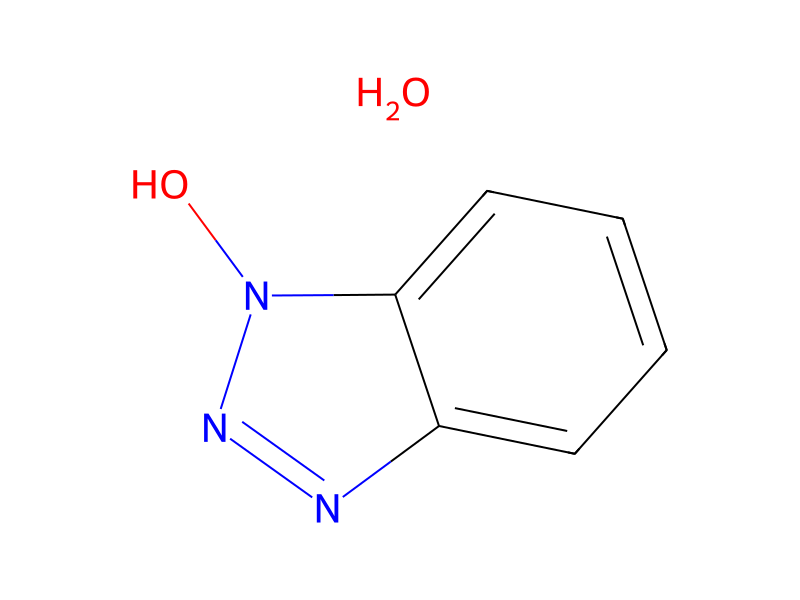
HCID 313Hydrochloric AcidHCID 79724-MethylmorpholineHCID 11914(-)-Mandelic acidHCID 27960291-Hydroxybenzotriazole hydrateHCID 9973362N-(6-Cyano-3,4-dihydro-2,2-dimethyl-2H-1-benzopyran-4-yl)-N'-phenylureaHCID 536288631-(3-Dimethylaminopropyl)-2-ethylcarbodiimide

Product

1
HCID 19373579N-(6-Cyano-3,4-dihydro-2,2-dimethyl-2H-1-benzopyran-4-yl)-a-hydroxybenzeneacetamideYield 110.4%

Procedure

To a solution of R-(-)-mandelic acid (22.1 g, 0.14 mole) and 1-hydroxy-benzotriazole hydrate (19.6 g, 0.14 mole) Cooled to 0° C. was added successively N-methylmorpholine (16.2 g, 0.16 mole), 4-amino-6-cyano-3,4-dihydro-2,2-dimethyl-2H-1-benzopyran (29.4 g, 0.14 mole, from Example 8, part D) and 1-(3 -dimethylaminopropyl)-2-ethylcarbodiimide.HCl (27.9 g, 0.14 mole), The reaction mixture was stirred 0.5 hours at 0° C. and two hours at room temperature. The solvent was recovered under vacuum and the residue was partitioned between 5% aqueous HCl and ethyl acetate. The organic fraction was washed with saturated sodium bicarbonate solution, saturated sodium chloride solution, dried over magnesium sulfate and evaporated in vacuo to obtain 52 g of yellow gum. The crude diastereomer mixture was chromatographed on silica eluting with 1:1 hexane/ethyl acetate to obtain 19.8 g (40.6%) of Isomer B (isomer A being subject of Example 19 , part A); m.p.=135°-136° C., [α]D25 =-60.8°. 1H NMR (CDCl3) δ7.51-7.30 (m, 6H), 7.27 (d, J=1.76 Hz, 1H), 6.80 (m, 2H), 5.18 (m, 1H), 5.08 (d, J=2.93 Hz, 1H), 3.97 (d, J=2.93 Hz, 1H), 2.12 (dd, J=6.15 and 13.19 Hz, 1H), 1.69 (dd, J=11.43 and 13.20 Hz, 1H), 1.40 (s, 3H), 1.30 (s, 3H); 13C NMR (CDCl3) δ172.59, 157.53, 139.13, 133.07, 132.81, 131.98, 128.92, 126.38, 122.86, 118.97, 118.56, 103.25, 76.83, 74.26, 41.81, 38.96, 29.15, 24.62; MS: (M+H)+ @337.


Workup

  1. customThe solvent was recovered under vacuum
  2. customthe residue was partitioned between 5% aqueous HCl and ethyl acetate
  3. washThe organic fraction was washed with saturated sodium bicarbonate solution, saturated sodium chloride solution
  4. dry with materialdried over magnesium sulfate
  5. customevaporated in vacuo

Sources & evidence

ORD record
ord-4a2bfeda1c1d420583b927bee6fb65cd
Source dataset
uspto-grants-1995_11
DOI
10.6084/m9.figshare.5104873.v1
Patent number
US05466817

Reaction notes

On this pageParticipantsProcedureWorkupSources & evidenceReaction notes