Allylamine → N-allyl-4-[(3-bromophenyl)amino]-5,6,7,8-tetrahydro[1]benzothieno[2,3-d]pyrimidine-7-carboxamide
Reaction equation

[Br:1][C:2]1[CH:3]=[C:4]([NH:8][C:9]2[C:10]3[C:17]4[CH2:18][CH2:19][CH:20]([C:22](O)=[O:23])[CH2:21][C:16]=4[S:15][C:11]=3[N:12]=[CH:13][N:14]=2)[CH:5]=[CH:6][CH:7]=1.[CH2:25]([NH2:28])[CH:26]=[CH2:27]>C1COCC1>[CH2:25]([NH:28][C:22]([CH:20]1[CH2:19][CH2:18][C:17]2[C:10]3[C:9]([NH:8][C:4]4[CH:5]=[CH:6][CH:7]=[C:2]([Br:1])[CH:3]=4)=[N:14][CH:13]=[N:12][C:11]=3[S:15][C:16]=2[CH2:21]1)=[O:23])[CH:26]=[CH2:27]Participants
4
Reactant 2
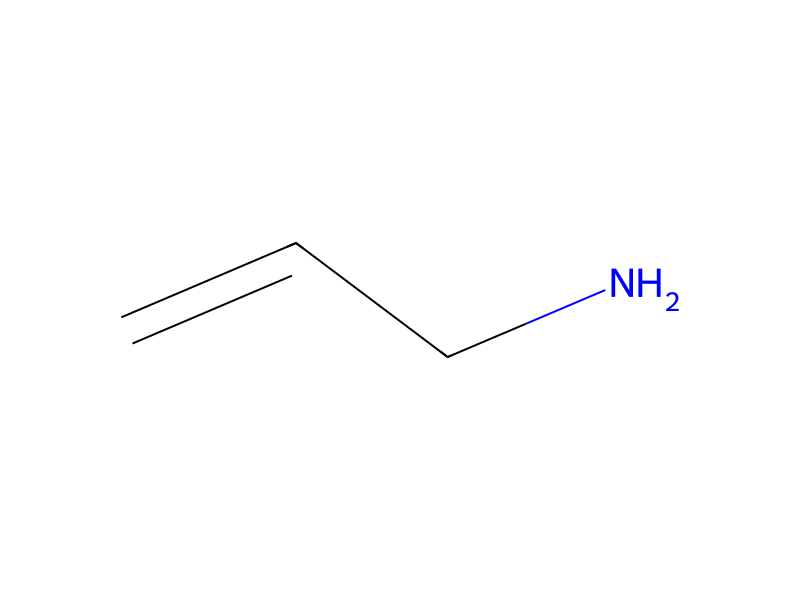

Product 1

Reagents, catalysts & solvents 1

Procedure
To a 15 mL round-bottom flask were added 50 mg (0.124 mmol, 1 equiv) of 4-[(3-bromophenyl)amino]-5,6,7,8-tetrahydro[1]benzothieno[2,3-d]pyrimidine-7-carboxylic acid, 1, 20 mg (0.124 mmol, 1 equiv) of CDl and THF (1.25 mL). The reaction was stirred for 4 h at rt and then 0.01 mL (0.186 mmol, 1.5 equiv) of allyl amine was added via syringe and the reaction was allowed to stir at rt overnight. The reaction was stopped and THF was concentrated in vacuo and the crude solid was re-dissolved in CH2Cl2 (5 mL). This solution was poured into a separatory funnel and washed with satd NaHCO3 (1×5 mL), water (1×5 mL), and brine (1×5 mL). The organic layer was dried (MgSO4), filtered and concentrated to yield a white solid. The compound was triturated with diethyl ether to yield pure material, 56, as a white solid (36 mg, 66%). 1H-NMR (DMSO-d6) δ 8.42 (s, 1H), 8.31 (s, 1H), 8.19 (t, 1H), 7.86 (m, 1H), 7.63 (m, 1H), 7.25 (m, 2H), 5.82 (m, 1H), 5.08 (m, 2H), 3.75 (t, 2H), 3.21 (m, 2H), 2.97 (d, 2H), 2.69 (m, 1H), 2.15 (m, 1H), 1.82 (m, 1H); LCMS RT=2.78 min; [M+H]+=444.