Reaction equation

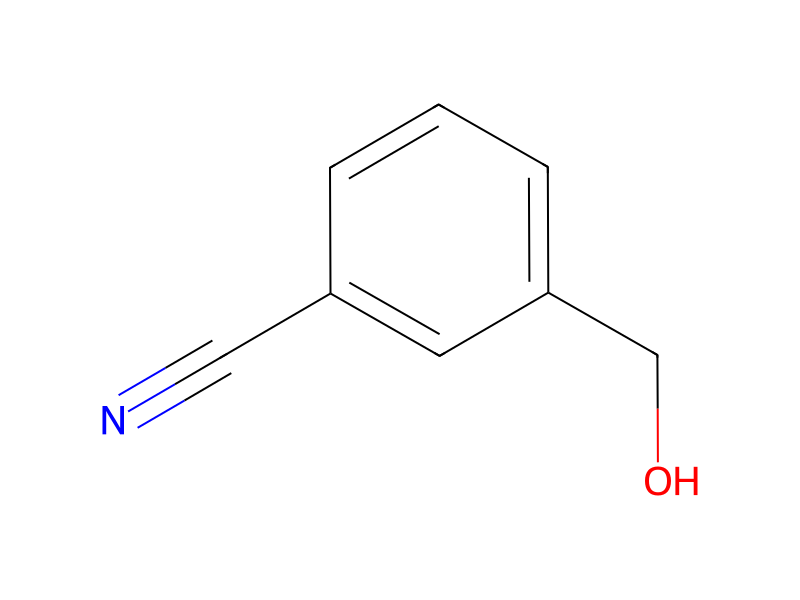
[OH:1][CH2:2][C:3]1[CH:4]=[C:5]([CH:8]=[CH:9][CH:10]=1)[C:6]#[N:7].C1(P(C2C=CC=CC=2)C2C=CC=CC=2)C=CC=CC=1.O[C:31]1[CH:38]=[CH:37][C:34]([CH:35]=[O:36])=[CH:33][CH:32]=1.N(C(OCC)=O)=NC(OCC)=O>C1COCC1>[CH:35]([C:34]1[CH:37]=[CH:38][C:31]([O:1][CH2:2][C:3]2[CH:4]=[C:5]([CH:8]=[CH:9][CH:10]=2)[C:6]#[N:7])=[CH:32][CH:33]=1)=[O:36]Participants
6





Procedure
To a solution of 3-(Hydroxymethyl)benzonitrile (1.1 equiv), triphenylphosphine (1.1 equiv), and 4-Hydroxybenzaldehyde (1 equiv) in dry THF was added dropwise Diethyl azodicarboxilate (DEAD) (1.4 equiv). The reaction mixture stirred at room temperature overnight. The reaction was monitored by TLC. The solvent was removed under vacuum. It was purified by silica gel chromatography using Hexane:Ethyl acetate (3:1) to afford the title compound as a white solid.
Workup
- customThe solvent was removed under vacuum
- customIt was purified by silica gel chromatography
Sources & evidence
- ORD record
- ord-b85e87cf6bf74ca8bdaa5cf2c0e17b8f
- Source dataset
- uspto-grants-2008_06
- Patent number
- US07381750B2
Linked notes
Loading…