Reaction equation

C1(NC2C=CC=CC=2)C=CC=CC=1.C(O)(=O)C.N([O-])=O.[Na+].[OH-].[Na+].[NH2+]([O-])(=O)C(N)=S.[N:30]([N:32]([C:39]1[CH:44]=[CH:43][CH:42]=[CH:41][CH:40]=1)[C:33]1[CH:38]=[CH:37][CH:36]=[CH:35][CH:34]=1)=O>O.CO>[C:33]1([N:32]([C:39]2[CH:44]=[CH:43][CH:42]=[CH:41][CH:40]=2)[NH2:30])[CH:34]=[CH:35][CH:36]=[CH:37][CH:38]=1Participants







Procedure
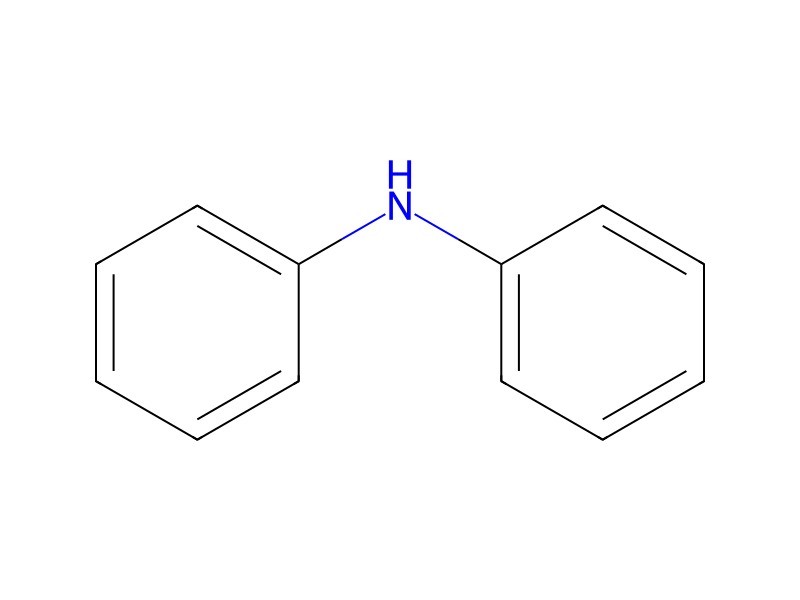
Into a 500 ml four-neck flask were added 16.9 g (100 mmol) of diphenylamine, 15.1 g (251 mmol) of acetic acid, and 207 g of methanol and the whole was dissolved under stirring. Thereto was added 13.8 g (200 mmol) of sodium nitrite dissolved in 57 g of water, followed by stirring at 15 to 20° C. for 3 hours. After the disappearance of diphenylamine was confirmed by high-performance liquid chromatography, 26.1 g (653 mmol) of sodium hydroxide dissolved in 119 g of water and 259 g (240 mmol) of thiourea dioxide were added, followed by stirring at 38 to 43° C. for 3 hours. After the disappearance of N-nitrosodiphenylamine was confirmed by high-performance liquid chromatography, methanol was removed by distillation under reduced pressure, followed by extraction with 120 g of toluene to obtain a toluene solution of 1,1-diphenylhydrazine. The compositional ratio excluding toluene determined by high-performance liquid chromatography was 88.9% of 1,1-diphenylhydrazine and 10.2% of diphenylamine.
Workup
- dissolutionthe whole was dissolved
- stirringby stirring at 15 to 20° C. for 3 hours
- stirringby stirring at 38 to 43° C. for 3 hours
- customwas removed by distillation under reduced pressure
- extractionfollowed by extraction with 120 g of toluene
Sources & evidence
- ORD record
- ord-7f63dda49f474447b69ca3b0b2fb0d6a
- Source dataset
- uspto-grants-2011_02
- Patent number
- US07884245B2
Linked notes
Loading…