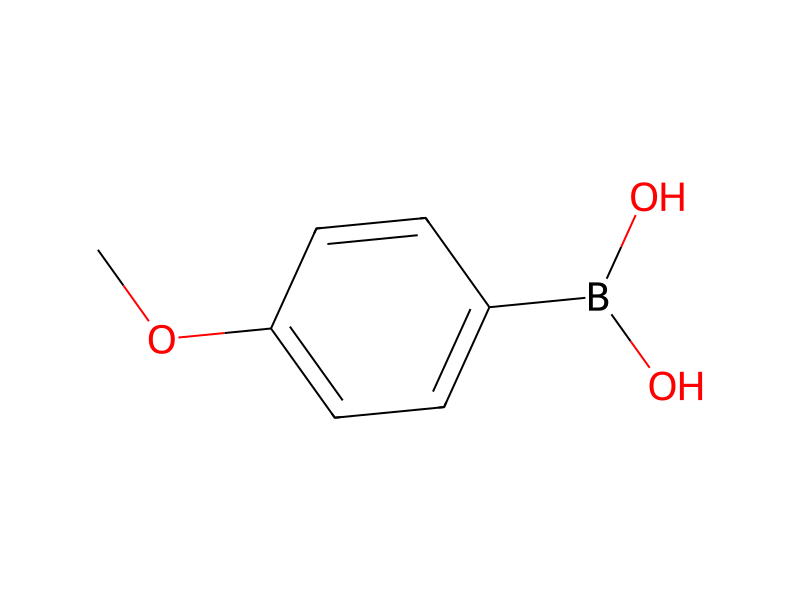
[CH3:1][O:2][C:3]1[CH:8]=[CH:7][C:6](B(O)O)=[CH:5][CH:4]=1.C([O-])([O-])=O.[Na+].[Na+].I[C:19]1[CH:20]=[CH:21][C:22](C)=[C:23](O)[CH:24]=1.COCCOC>CCOC(C)=O.C1C=CC([P]([Pd]([P](C2C=CC=CC=2)(C2C=CC=CC=2)C2C=CC=CC=2)([P](C2C=CC=CC=2)(C2C=CC=CC=2)C2C=CC=CC=2)[P](C2C=CC=CC=2)(C2C=CC=CC=2)C2C=CC=CC=2)(C2C=CC=CC=2)C2C=CC=CC=2)=CC=1>[CH3:1][O:2][C:3]1[CH:8]=[CH:7][C:6]([C:19]2[CH:20]=[CH:21][CH:22]=[CH:23][CH:24]=2)=[CH:5][CH:4]=1A mixture of 4-methoxyphenylboronic acid (4.55 g, 21.38 mmol), Na2CO3 (32.1 ml 2 N aqueous, 64.2 mmol), Pd(PPh3)4 (1.24 g, 1.07 mmol), 5-iodo-2-methylphenol (Hodgson, Moore J. Chem. Soc. 1926, 2038) (5.0 g, 21.38 mmol), and ethylene glycol dimethyl ether (225 ml) was heated to reflux overnight. The reaction was cooled, diluted with EtOAc and the layers separated. The organic layer was dried over anhydrous Na2SO4, passed through a silica plug and concentrated. Chromatography (30% EtOAc/hexanes) afforded 1.64 g (36%) product as a white solid and 2 g 4-methoxy biphenyl as an undesired by-product: mp 146–147° C.; 1H NMR (300 MHz, DMSO-d6): δ 2.13 (3H, s), 3.78 (3H, s), 6.94 (1H, dd, J=8.1 Hz, 2.7 Hz), 7.00 (3H, m), 7.09 (1H, d, J=8.1 Hz), 7.48 (1H, d, J=9.5 Hz), 9.36 (1H, s).