Reaction equation

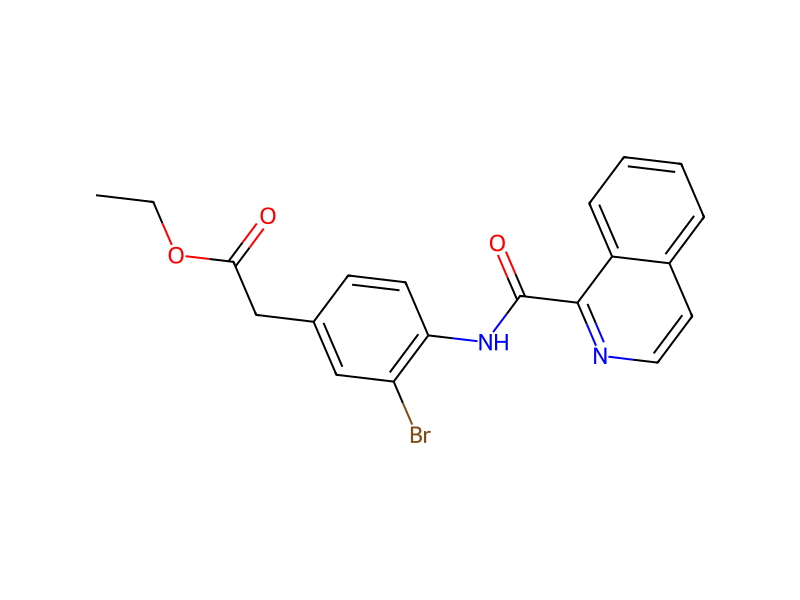
[Br:1][C:2]1[CH:3]=[C:4]([CH2:21][C:22]([O:24]CC)=[O:23])[CH:5]=[CH:6][C:7]=1[NH:8][C:9]([C:11]1[C:20]2[C:15](=[CH:16][CH:17]=[CH:18][CH:19]=2)[CH:14]=[CH:13][N:12]=1)=[O:10].[OH-].[Na+].Cl>C1COCC1>[Br:1][C:2]1[CH:3]=[C:4]([CH2:21][C:22]([OH:24])=[O:23])[CH:5]=[CH:6][C:7]=1[NH:8][C:9]([C:11]1[C:20]2[C:15](=[CH:16][CH:17]=[CH:18][CH:19]=2)[CH:14]=[CH:13][N:12]=1)=[O:10]Participants
5




Procedure
Ethyl (3-bromo-4-((1-isoquinolinylcarbonyl)amino)phenyl)acetate (1.64 g, 3.97 mmol) was dissolved in THF (40 ml). To the resulting solution was added 0.25N NaOH (24.0 ml, 5.95 mmol), and the mixture was stirred at room temperature for 8 hours. The reaction mixture was poured into 1N HCl (50 ml) to acidify the mixture. The crystals thus precipitated were collected by filtration under reduced pressure, washed with water, and dried under reduced pressure to give (3-bromo-4-((1-isoquinolinylcarbonyl)amino)phenyl)acetic acid (1.50 g, 98%) as a pale yellow solid.
Workup
- customThe crystals thus precipitated
- filtrationwere collected by filtration under reduced pressure
- washwashed with water
- customdried under reduced pressure
Sources & evidence
- ORD record
- ord-32f773e534ce42acac00bdeb04ff47cd
- Source dataset
- uspto-grants-2007_01
- Patent number
- US07157487B2
Linked notes
Loading…