HomeMCPWorkbenchSkills
HomeWorkbenchNotificationsMe
llms.txt · MCP GuidePrivacy Policy · Terms of Service · Supportv1.8.3
  1. Home
  2. /Reaction

Cyclopentylamine → N-[3-(2-anilino-4-pyrimidinyl)-2-(4-fluorophenyl)pyrazolo[1,5-a]pyridin-5-yl]-N-cyclopentylamine

HRID 1373414
Print

Reaction equation

HRID 1373414 reaction equation
Cl[C:2]1[CH:7]=[CH:6][N:5]2[N:8]=[C:9]([C:24]3[CH:29]=[CH:28][C:27]([F:30])=[CH:26][CH:25]=3)[C:10]([C:11]3[CH:16]=[CH:15][N:14]=[C:13]([NH:17][C:18]4[CH:23]=[CH:22][CH:21]=[CH:20][CH:19]=4)[N:12]=3)=[C:4]2[CH:3]=1.C1(P(C2C=CC=CC=2)C2C=CC3C(=CC=CC=3)C=2C2C3C(=CC=CC=3)C=CC=2P(C2C=CC=CC=2)C2C=CC=CC=2)C=CC=CC=1.C(=O)([O-])[O-].[Cs+].[Cs+].C(OCC)(=O)C.[CH:89]1([NH2:94])[CH2:93][CH2:92][CH2:91][CH2:90]1>C([O-])(=O)C.[Pd+2].C([O-])(=O)C.O>[NH:17]([C:13]1[N:12]=[C:11]([C:10]2[C:9]([C:24]3[CH:29]=[CH:28][C:27]([F:30])=[CH:26][CH:25]=3)=[N:8][N:5]3[CH:6]=[CH:7][C:2]([NH:94][CH:89]4[CH2:93][CH2:92][CH2:91][CH2:90]4)=[CH:3][C:4]=23)[CH:16]=[CH:15][N:14]=1)[C:18]1[CH:23]=[CH:22][CH:21]=[CH:20][CH:19]=1

ParticipantsConditionsProcedureWorkupSources & evidenceReaction notes

Participants

8

Reactant 5

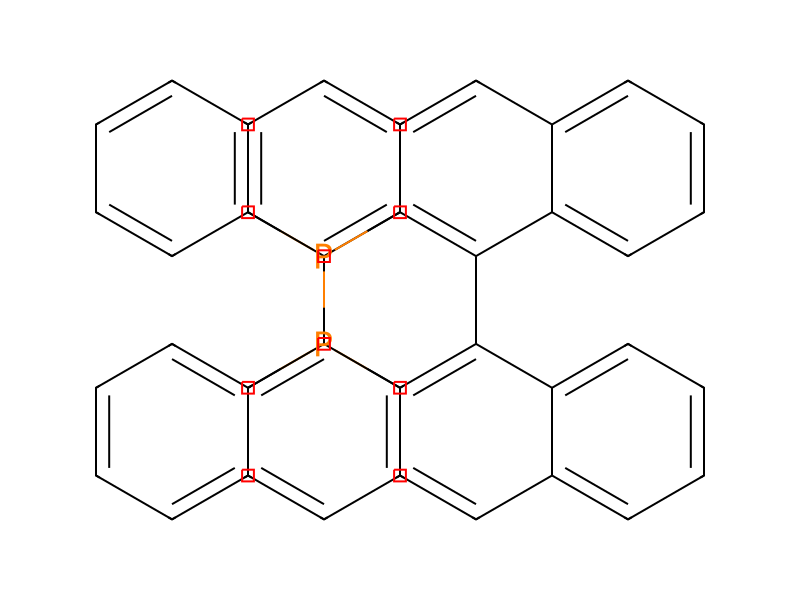
HCID 2906CyclopentylamineHCID 8857Ethyl AcetateHCID 10796Cesium carbonateHCID 634876Binap, (A+-)-2×HCID 112470274-[5-chloro-2-(4-fluorophenyl)pyrazolo[1,5-a]pyridin-3-yl]-N-phenyl-2-pyrimidinamine

Product 1

HCID 22350049
N-[3-(2-anilino-4-pyrimidinyl)-2-(4-fluorophenyl)pyrazolo[1,5-a]pyridin-5-yl]-N-cyclopentylamine
Yield 36%

Reagents, catalysts & solvents 2

HCID 167845palladium(II) acetateCatalyst2×HCID 962WaterSolvent

Conditions

Temperature
100 °C

Procedure

To a solution of 4-[5-chloro-2-(4-fluorophenyl)pyrazolo[1,5-α]pyridin-3-yl]-N-phenyl-2-pyrimidinamine (100 mg, 0.24 mmol) in cyclopentylamine (5 mL) was added successively racemic-2,2′-bis(diphenylphosphino)-1,1′-binaphthyl (72 mg), cesium carbonate (200 mg), and palladium (II) acetate (16 mg). The resulting mixture was stirred at 100° C. for 24 hours, then additional racemic-2,2′-bis(diphenylphosphino)-1,1′-binaphthyl (72 mg) and palladium (II) acetate (16 mg) were added and the reaction stirred at 100° C. for additional 24 hours, at which time the reaction was judged complete by thin layer chromatography. The solution was cooled to room temperature and ethyl acetate and water were added to the reaction mixture. The phases were separated, and the aqueous phase again extracted with ethyl acetate. The combined organic phases were dried (magnesium sulfate), filtered and concentrated. The resulting residue was purified by flash chromatography (1:1 hexanes:ethyl acetate) to give N-[3-(2-anilino-4-pyrimidinyl)-2-(4-fluorophenyl)pyrazolo[1,5-α]pyridin-5-yl]-N-cyclopentylamine (40 mg, 36%) as a solid. 1H NMR (CDCl3): δ 8.21 (d, 1H), 8.13 (d, 1H), 7.65 (m, 4H), 7.4–7.24 (m, 4H), 7.18 (t, 2H), 7.06 (t, 1H), 6.44 (d, 1H), 6.30 (dd, 1H), 4.16 (d, 1H), 3.68 (m, 1H), 1.4–2.2 (m, 8H); 19F-NMR (CDCl3): δ −113.32; MS m/z 466 (M+1).

Workup

  1. stirringthe reaction stirred at 100° C. for additional 24 hours, at which time the reaction
  2. temperatureThe solution was cooled to room temperature
  3. customThe phases were separated
  4. extractionthe aqueous phase again extracted with ethyl acetate
  5. dry with materialThe combined organic phases were dried (magnesium sulfate)
  6. filtrationfiltered
  7. concentrationconcentrated
  8. customThe resulting residue was purified by flash chromatography (1:1 hexanes:ethyl acetate)

Sources & evidence

ORD record
ord-ad19a3849be84c4ebc4e73f46eb63e45
Source dataset
uspto-grants-2007_01
DOI
10.6084/m9.figshare.5104873.v1
Patent number
US07160897B2

Reaction notes

On this pageParticipantsConditionsProcedureWorkupSources & evidenceReaction notes