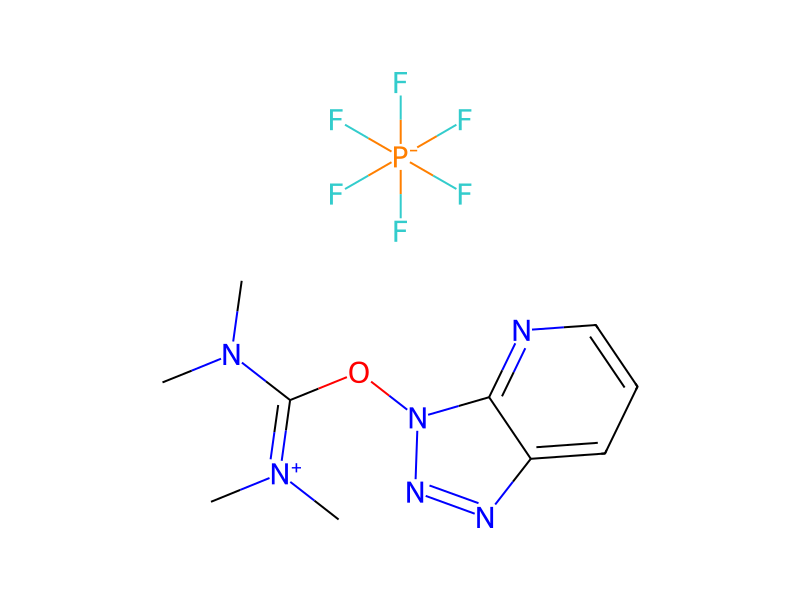
[NH2:1][C:2]1[C:3]([N+:17]([O-:19])=[O:18])=[C:4]([CH:8]=[C:9]([N:11]2[CH2:16][CH2:15][O:14][CH2:13][CH2:12]2)[N:10]=1)[C:5]([OH:7])=[O:6].[CH3:20]N(C(ON1N=NC2C=CC=NC1=2)=[N+](C)C)C.F[P-](F)(F)(F)(F)F.CO.CCN(CC)CC>C1COCC1>[NH2:1][C:2]1[C:3]([N+:17]([O-:19])=[O:18])=[C:4]([CH:8]=[C:9]([N:11]2[CH2:16][CH2:15][O:14][CH2:13][CH2:12]2)[N:10]=1)[C:5]([O:7][CH3:20])=[O:6]A mixture of 2-amino-6-morpholino-3-nitroisonicotinic acid (12.3 g, 45.9 mmol), HATU (19.2 g, 50.5 mmol), MeOH (14.7 g, 459 mmol) and Et3N (13.9 g, 137.7 mmol) in THF (300 mL) was stirred at room temperature for 16 h. The solvent was removed in vacuo and the residue was diluted with EA (500 mL). It was then washed with brine (500 mL×3). The organic layer was then concentrated in vacuo. The residue was then purified by chromatography on silica gel eluted with MeOH/DCM=1/100 to afford the crude product as a yellow solid (4.8 g, 37%); LC/MS: MS (ES+) m/e 283 (MH+).
Loading…