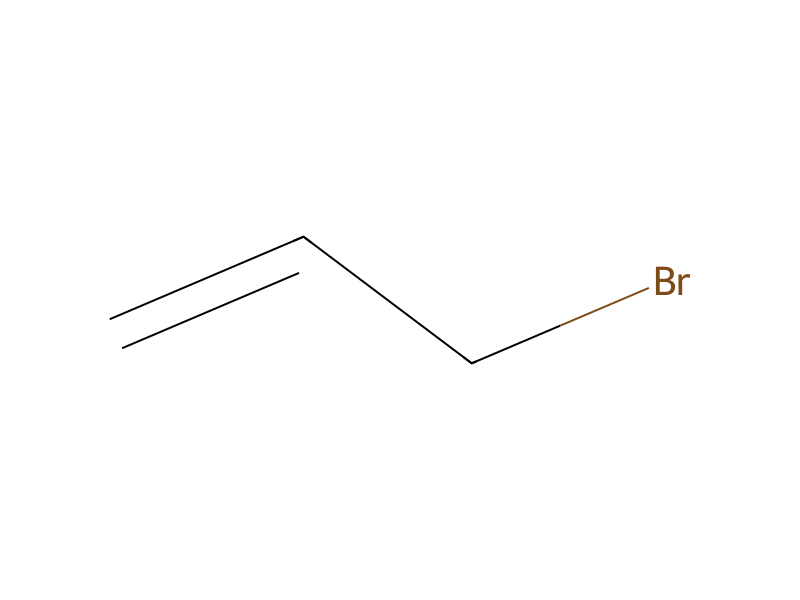
In a dry 3-necked flask flushed with argon containing a solution of 5-bromo-2-chloro-3-fluoro pyridine (4.0 g, 19.05 mmol) at 0° C. was added isopropyl magnesium chloride lithium chloride complex (1.3 M THF solution, 24.8 mmol, 19.1 mL) over 10 min. After additional 10 min of stirring at 0° C., CuI (0.73 g, 3.81 mmol) was added, and the mixture was stirred for 10 minutes at 0° C. and then a solution of allyl bromide (38.1 mmol, 3.3 mL) in THF (4.0 mL) was added at 0° C. over 10 min. After further stirring for 1 h at 0° C., the reaction was quenched with 10% citric acid and extracted with ethyl acetate (100 mL×2). The organic layers were washed with brine, dried over Na2SO4, and concentrated. The obtained residue was chromatographed on silica gel eluted with hexane and 10% ethyl acetate in hexanes to afford 2.5 g of 2 (77%) as a colorless oil. 1H NMR (CDCl3) δ 3.40 (2 H, d, J=6.60 Hz), 5.16 (2 H, m), 5.91 (1 H, m), 7.32 (1 H, dd, J=2.20, 9.00 Hz), 8.06 (1 H, d, J=1.76 Hz); LC/MS (M+1) 172.